Back
Back





FEDERAL COURT PUTRAJAYA
NALLINI PATHMANATHAN, FCJ
LOW CHENG TEIK & ORS – Appellant
Versus
LOW EAN NEE – Respondent
[Civil Appeal No: 02(f)-30-04-2023(W)]
Key Points: - Point 1 (!) - Point 2 (!) - Point 3 (!) - Point 4 (!) - Point 5 (!) - Point 6 (!) - Point 7 (!) - Point 8 (!) - Point 9 (!) - Point 10 (!)
Introduction
[1] This is an appeal by Low Cheng Teik and three others ('the Appellants') against the decision of the Court of Appeal finding:
(i) Oppression against Low Ean Nee ('the Respondent'), a member with an equal shareholding in SNE Marketing Sdn Bhd ('the Company'); and
(ii) Granting the remedy of a buy-out of the Respondent's shares pursuant to s 346 of the Companies Act 2016 ('the Act'). Out of eight grievances, one act was found to establish oppression, stemming from a single Director's breach of fiduciary duties, relating to a diversion of assets of the Company. This breach of duty by the Director was remedied before and during the course of this action.
[2] In the High Court , the Respondent, who was the Plaintiff, brought eight separate grounds in support of her oppression action. The High Court rejected all eight complaints of oppression, dismissing the action. On appeal, the Court of Appeal upheld the rejection of seven out of eight of the grounds but reversed the High Court 's decision on one complaint of oppression.
[3] This ground of complaint, summarily put, concerned the assignment of a series of trademarks of the Company to one SNE Global Sdn Bhd ('SNE Global'). The Court of Appeal concluded that the Appellants had, by such assignment of the trademarks, acted so as to benefit themselves indirectly, via other corporate entities, that were controlled by or related to them, to the prejudice of the Respondent, who held a substantial shareholding in the Company. The Appellants were accordingly found to be liable for oppression.
[4] The primary issue that arose for consideration in this appeal was whether this particular grievance of the Respondent was properly brought by way of an oppression action. This, in turn, warrants a consideration of whether the grievance featured:
(i) a personal wrong or injury against the Respondent as a shareholder;
(ii) a corporate wrong or injury against the Company; or
(iii) a case of an overlap between a personal wrong and a corporate wrong.
[5] The nature of the wrong resulting in damage to the shareholder or the company is dealt with by the Legislature vide different statutory provisions and accordingly different and distinct remedies. This appears in the form of s 346 of the Act vide the oppression action which addresses the shareholder's complaint of loss or damage suffered in the capacity of shareholder. Section 347 of the Act provides for the statutory derivative action which addresses the loss or damage suffered by the company by reason of the wrongdoing of those in control of it, providing relief for the company itself.
[6] Is an oppression action the appropriate form of action to be utilised to provide redress where the fact situation features a corporate wrong? Is such an action, the appropriate statutory provision to use when there is a wrong suffered by the company which overlaps with shareholder loss? These issues warrant consideration to provide guidance on when the appropriate statutory provisions should be utilised, and to ensure that litigants do not improperly initiate an oppression action when a statutory derivative action would provide the available and more appropriate remedy. This issue was not, with respect, considered by the Court of Appeal.
[7] In this appeal, the key issue for consideration is the legal basis on which to determine when an oppression action as opposed to a derivative action should be instituted.
Salient Background Facts
[8] The Company is a multi-level marketing company that supplies food supplements, nutritional supplements, and dietetic substances for medicinal use bearing the trademark of SNE and its variants. The Company is the registered proprietor of SNE trademarks no 2013002164 in Class 5 and no 2013002165 in Class 35 ('the SNE Trademarks').
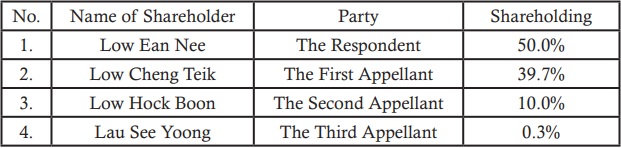
[9] The Respondent is the majority shareholder in the Company, holding 50% of the Company's shares, whereas the 1st appellant holds 39.7%, the 2nd appellant h



An indispensable Tool for Legal Professionals, Endorsed by Various High Court and Judicial Officers
Please visit our Training & Support
Center or Contact Us for assistance

Scan Me!
India’s Legal research and Law Firm App, Download now!


For Daily Legal Updates, Join us on :



 Back to top