Searching Case Laws & Precedent on Legal Query.....!
Analysing the retrieved Case Laws
Scanned Judgements…!



Searching Case Laws & Precedent on Legal Query.....!
Analysing the retrieved Case Laws
Scanned Judgements…!
Marriage solemnization requires proper ceremonies and due form — A marriage is considered valid only if it is celebrated or performed with the appropriate rituals and in accordance with legal and customary rites. Merely admitting to a marriage or having some association with it does not constitute proof of valid solemnization ["2023 0 Supreme(Raj) 1339"] ["2023 0 Supreme(Raj) 1335"] ["
Shruti Agnihotri VS Anand Kumar Srivastava - Current Civil Cases
"] ["2024 0 Supreme(All) 1015"] ["2025 0 Supreme(Gau) 576"] ["2024 4 Supreme 165"] ["2012 0 Supreme(Gau) 376"] ["1974 0 Supreme(Ori) 175"].Admission alone is insufficient as proof of marriage — Courts have consistently held that an admission of marriage by a party does not automatically prove that the marriage was properly solemnized. The essential ceremonies must be performed, and proof of such ceremonies is necessary to establish the validity of the marriage ["2023 0 Supreme(Raj) 1339"] ["2023 0 Supreme(Raj) 1335"] ["1979 0 Supreme(Mad) 150"] ["1974 0 Supreme(Ori) 175"] ["2024 0 Supreme(All) 1015"].
Ceremonies are vital for the validity of Hindu and Christian marriages — For Hindu marriages, customary rites such as Saptapadi are essential, and failure to perform these rites can render the marriage void or invalid. Similarly, Christian marriages must follow prescribed rites and ceremonies, failure of which can lead to a marriage being considered fabricated or invalid ["2023 0 Supreme(Raj) 1339"] ["2023 0 Supreme(Raj) 1335"] ["
Shruti Agnihotri VS Anand Kumar Srivastava - Current Civil Cases
"] ["2022 0 Supreme(Ker) 706"] ["2024 0 Supreme(Cal) 329"] ["2025 0 Supreme(Gau) 576"] ["Smt. Neelam Jaiswal(Out Jail) vs Shashank Jaiswal - Chhattisgarh"].Legal recognition and registration depend on proper ceremonies — Without proper performance of ceremonies, registration authorities cannot recognize or register a marriage as valid under law. This underscores that registration alone does not prove the marriage's legitimacy ["2024 0 Supreme(All) 1015"] ["2023 0 Supreme(Raj) 1339"].
In cases of bigamy or second marriages, proof of solemnization is crucial — Courts require concrete evidence that the second marriage was performed with the necessary rituals and ceremonies. Mere admission or partial evidence is insufficient; the ceremonies must be proved to establish the validity of the second marriage ["2023 0 Supreme(Raj) 1339"] ["1974 0 Supreme(Ori) 175"] ["1979 0 Supreme(Mad) 150"].
Courts presume marriage in fact when the celebration of marriage is established — Once a marriage in fact is proved, it is presumed to be valid in law unless rebutted by evidence showing the absence of proper ceremonies or legal compliance ["2025 0 Supreme(Gau) 576"] ["
ARUMUGAM v. ATHAI
"].Analysis and Conclusion:The consistent legal principle across the cited cases is that an admission of marriage does not negate the necessity of proper ceremonies for the marriage to be deemed valid. The performance of prescribed rites and rituals is a crucial legal requirement for the solemnization and validity of marriages under Hindu, Christian, and other religious laws. Therefore, the admission of a marriage cannot be used as a substitute for proof that the marriage was properly celebrated according to law. Without such ceremonies, the marriage remains invalid or fabricated, and its admission cannot be treated as conclusive evidence of its validity ["2023 0 Supreme(Raj) 1339"] ["2023 0 Supreme(Raj) 1335"] ["
Shruti Agnihotri VS Anand Kumar Srivastava - Current Civil Cases
"] ["2024 0 Supreme(All) 1015"].References:- ["2023 0 Supreme(Raj) 1339"]- ["2023 0 Supreme(Raj) 1335"]- ["
Shruti Agnihotri VS Anand Kumar Srivastava - Current Civil Cases
"]- ["2024 0 Supreme(All) 1015"]- ["2024 0 Supreme(Cal) 329"]- ["2025 0 Supreme(Gau) 576"]- ["Smt. Neelam Jaiswal(Out Jail) vs Shashank Jaiswal - Chhattisgarh"]- ["2022 0 Supreme(Ker) 706"]- ["ARUMUGAM v. ATHAI
"]- ["1974 0 Supreme(Ori) 175"]- ["2024 4 Supreme 165"]- ["2012 0 Supreme(Gau) 376"]- ["1979 0 Supreme(Mad) 150"]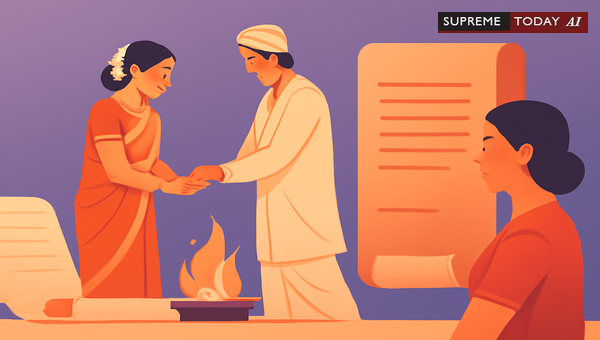
In family law disputes, questions about the validity of a marriage often hinge on whether ceremonies were properly performed. A common issue arises: Admission of marriage ceremonies cannot be negated by denial. But what does this mean in practice? Many couples face challenges where one party admits to a marriage but later denies the ceremonies, or vice versa. Understanding court presumptions can make all the difference in .
This blog post delves into the legal principle that courts generally presume essential marriage ceremonies—such as in Hindu marriages—were conducted once the (the fact that a marriage occurred) is established. We'll explore key judgments, exceptions, and practical recommendations, drawing from established case law. Note: This is general information; consult a legal professional for advice specific to your situation.
Courts do not allow a mere denial to overturn an admission or established fact of marriage. Once the is proven, judges typically presume the performance of necessary ceremonies unless specifically challenged with evidence. As stated in a key judgment: Reliance is placed on the principle that once it is proved that marriage was performed in fact, the court will also presume that the necessary ceremonies have been performed. 1989 0 Supreme(Gau) 213
This presumption supports social stability and prevents frivolous denials from dissolving long-standing relationships. Key points include:- Presumption upon proof: Courts assume ceremonies like and customary rites were observed if marriage is established. 1989 0 Supreme(Gau) 213- Denial insufficient alone: Simply denying the marriage doesn't negate it; supporting evidence is needed. 1989 0 Supreme(Gau) 213- Burden of proof: The party claiming the marriage bears the initial burden, but presumptions aid once factum is shown. 2024 4 Supreme 165
In civil proceedings, proving the marriage's existence through witnesses, social recognition, or conduct leads to a presumption of ceremonies. Judicial precedents like and reinforce this: proof of marriage fact leads to assuming ceremonies unless disputed. 1965 0 Supreme(SC) 187
For example, in one case, despite the respondent denying marriage, witness testimony about the event led the court to presume ceremonies: The respondent, while denying any marriage between him and the petitioner, has not provided evidence to disprove the , and the court presumes the performance of ceremonies based on the evidence of witnesses who testified to the marriage. 1989 0 Supreme(Gau) 213
Social acceptance and cohabitation further bolster this. Even unregistered marriages may be recognized if community conduct supports it. 1981 0 Supreme(Gau) 6
Essential rites under the (Section 7), like , are fundamental. However, if not directly proven, courts presume them in civil cases. Positive evidence becomes crucial only if challenged specifically. 1989 0 Supreme(Gau) 213 2004 1 Supreme 355
From other rulings, evasive denials in pleadings can be deemed admissions. In a , the respondent's silence on ceremony details was treated as admission, but proof was still weighed. 2023 0 Supreme(Pat) 841
The claimant must initially prove validity, including ceremonies. But: The burden of proving the validity of marriage, including ceremonies, rests on the person asserting it. Nonetheless, courts have held that once the fact of marriage is established, the performance of ceremonies is presumed unless specifically disputed and proven otherwise. 2024 4 Supreme 165
This favors marriage validity in civil matters for social justice.
Presumptions aren't absolute:- Specific challenge: If non-performance of ceremonies is alleged, the claimant must provide positive proof. 2004 1 Supreme 355- Criminal cases (e.g., ): Higher standard applies. Solemnise marriage means to celebrate the marriage with proper ceremonies and in due form. Mere going through certain ceremonies with an intention of marriage will not make the ceremonies prescribed... Essential ceremonies must be proven beyond doubt; admission alone isn't enough. 1965 0 Supreme(SC) 187 2020 0 Supreme(Chh) 63- No presumption without factum: Long cohabitation may raise legitimacy presumptions for children (), but only if marriage is valid. Without solemnization proof, no benefits under . 2018 0 Supreme(Ker) 306
In prosecutions, failure to prove second marriage's ceremonies dismisses cases, even with admissions. 2020 0 Supreme(Chh) 63 Similarly, mere intention or partial rites don't suffice: The valid marriage under refers to which again refers to with proper ceremonies and in accepted form. Therefore, mere admission of marriage or going through certain ceremonies with the intention of marriage will never make the ceremonies as . 2010 0 Supreme(Kar) 436
Courts consider reputation and behavior. In , mere denial doesn't dismiss claims; courts must verify truthfulness: The marriage may be proved by customs or ceremonies sacraments but mere denial of the marriage without recording satisfaction to the truthfulness of the said denial, suit cannot be dismissed. 2019 0 Supreme(MP) 628
Witness consistency on rites like strengthens cases. Unchallenged testimony on can confirm validity. 2009 0 Supreme(Ori) 358
In forced marriage claims, lack of rebuttal evidence (e.g., no relatives listed) and evasive denials led to annulment for non-performance. 2023 0 Supreme(Pat) 841
As recommended: When parties admit to the fact of marriage but deny its validity on procedural grounds, courts should carefully examine evidence of social recognition and conduct before negating the marriage. 1989 0 Supreme(Gau) 213
In summary, admission of marriage ceremonies cannot be negated by denial—courts presume performance once factum is shown, promoting stability unless robustly rebutted. For personalized guidance, seek expert legal counsel. Stay informed on evolving family law.
References:1. 1989 0 Supreme(Gau) 213: Core presumption principle.2. 2024 4 Supreme 165: Burden and presumptions.3. 1965 0 Supreme(SC) 187: Civil vs. criminal distinctions.4. Additional insights from 2020 0 Supreme(Chh) 63, 2023 0 Supreme(Pat) 841, 2019 0 Supreme(MP) 628, 2018 0 Supreme(Ker) 306, 2010 0 Supreme(Kar) 436, 2009 0 Supreme(Ori) 358.
#MarriageLaw, #HinduMarriage, #FamilyLaw


It follows, therefore, that unless the marriage is "celebrated or performed with proper ceremonies and due form", it cannot be said to be 'solemnized'. ... the parties, the marriage cannot be said to have been 'solemnized' and therefore appellant No.1 cannot be held to have committed the offence under Section 494 IPC." ... It is further held:- "....Secondly, it is clear that in law such admission is not evidence of the fact of the second marriage hav....

It follows, therefore, that unless the marriage is "celebrated or performed with proper ceremonies and due form", it cannot be said to be 'solemnized'. ... the parties, the marriage cannot be said to have been 'solemnized' and therefore appellant No.1 cannot be held to have committed the offence under Section 494 IPC." ... It is further held:- "....Secondly, it is clear that in law such admission is not evidence of the fact of the second marriage hav....

Unless and until the marriage is performed with appropriate ceremonies and in due form, it cannot be said to be “solemnised”. ... It has been categorically held with reference to Section 7 of the Act, 1955 that unless and until the marriage is performed with appropriate ceremonies and in due form, it cannot be said to be “solemnised”. ... The marriage has been referred as a fabricated marriage. This can never be construed as admission#HL_EN....

Unless and until the marriage is performed with appropriate ceremonies and in due form, it cannot be said to be “solemnised”. ... Therein, also we do not find any admission of such marriage or the ceremonies which are necessary for solemnization of such marriage as per Hindu rites and customs so as to constitute a valid marriage as per law. ... It has been categorically held with reference to Section 7 of the Act, 1955 that unless and until the #HL_S....

We, therefore, are of the opinion that the present appellant/plaintiff cannot be permitted to blow hot and cold. The stand taken in MAT Suit No. 103 of 2011 contains an inherent and explicit admission of marriage being duly solemnized on 31.01.2010 and consummation thereof. ... She has flatly denied the suggestion that the marriage was not held as per rites, customs, ceremonies of the Church, or that the same was not in accordance with the Indian Christian Marriage Act, 1872 (‘Act’ for....

It follows, therefore, that unless the marriage is 'celebrated or performed with proper ceremonies and due form it cannot be said to be 'solemnized'. ... It follows, therefore, that unless the marriage is celebrated or performed with proper ceremonies and due form, it cannot be said to be 'solemnized'. ... The solemnization of marriage means celebrating the marriage with proper ceremonies. 8. ... inter alia, that word 'solemnize' me....

It follows, therefore, that unless the marriage is 'celebrated or performed with proper ceremonies and due form' it cannot be said to be 'solemnized'. ... duly performed in accordance with religious rites available to the form of marriage gone through by the parties and the admission of the accused cannot be in law treated as an evidence of the second marriage having been taken place. ... Section 497 is a denial of substantive equality as it perpetua....

Ceremonies for a Hindu marriage. – (1) A Hindu marriage may be solemnized in accordance with the customary rites and ceremonies of either party thereto. ... No specific case regarding details of valid performance of marriage has been pleaded and as such the same also amounts to evasive denial and therefore, deemed admission and the learned counsel has placed his reliance on the decision of the Hon’ble Apex Court reported in a href= ... is evasive and thus amount to de....
form' it cannot be said to be 'solemnized'. ... of the second marriage must be constituted and proved and admission of the marriage by the valid marriage have been performed. ... marriage having been taken place. ... must be according to ceremonies required by law and if the marriage is p style="position:absolute

Unless and until the marriage is performed with appropriate ceremonies and in due form, it cannot be said to be ‘solemnised’. ... It follows, therefore, that unless the marriage is ‘celebrated or performed with proper ceremonies and due form’ it cannot be said to be ‘solemnized’. ... It follows, therefore, that unless the marriage is 'celebrated or performed with proper ceremonies and in due form' it cannot be said to be 'solemnized....

The marriage may be proved by customs or ceremonies sacraments but mere denial of the marriage without recording satisfaction to the truthfulness of the said denial, suit cannot be dismissed. Therefore, in a suit for restitution of conjugal right the existence of marriage is a sine qua non but on denial of the said marriage, the satisfaction is required to be recorded regarding truthfulness of the said statements and the legal ground for grant of such relief, which can be proved by either party. The judgment of the Chhattisgarh High Court in the case of Santosh Kumar Pandey....

Therefore in the light of the above decision it can be safely concluded that the appellants miserably failed to prove the customary marriage claimed by them with the standard of proof required as laid down by the Supreme Court as well as this Court in the aforesaid decisions. In AIR 1965 SC 1564 (Bhaurao Shankar Lokhande vs The State of Maharashtra) the Supreme Court further held that “solemnise marriage means to celebrate the marriage with proper ceremonies and in due form. Mere going through certain ceremonies with an intention of marriage will not make the ceremonies prescribed ....

Mere going through certain ceremonies with an intention of marriage will not make the ceremonies prescribed by law or approved by custom." "Solemnise marriage means to celebrate the marriage with proper ceremonies and in due form. That was a case where the standard of proof regarding marriage while considering the conviction under section 494 of the Indian Penal Code, it has been held that such things will have to be proved beyond reasonable doubt.

The valid marriage under Section 5 refers to solemnisation of marriage which again refers to solemnisation of marriage with proper ceremonies and in accepted form. Therefore, mere admission of marriage or going through certain ceremonies with the intention of marriage will never make the ceremonies as solemnisation of marriage.

Therefore, at present the respondent cannot be heard to say that performance of some ceremonies is doubtful and therefore the marriage should be disbelieved. She has not been cross-examined at all with regard to ceremonies performed in the marriage.


An indispensable Tool for Legal Professionals, Endorsed by Various High Court and Judicial Officers
Please visit our Training & Support
Center or Contact Us for assistance

Scan Me!
India’s Legal research and Law Firm App, Download now!


For Daily Legal Updates, Join us on :



 Back to top


