Searching Case Laws & Precedent on Legal Query.....!
Analysing the retrieved Case Laws
Scanned Judgements…!



Searching Case Laws & Precedent on Legal Query.....!
Analysing the retrieved Case Laws
Scanned Judgements…!
GURNAM SINGH Vs STATE OF PUNJAB AND OTHERS
, IND_MAD00000027946) show that courts have dismissed claims where the legal proof of documents, like wills or possession, was not adequately established, emphasizing that proof must meet legal standards.Analysis and Conclusion:The legal consensus across these sources underscores that authorities should not rely solely on documents that are unverified or unproved in a court of law. Proper authentication—through calling for original deeds, certified copies, or court judgments—is essential before accepting a document as valid evidence. This safeguards against arbitrary rejection or reliance on potentially false or unsubstantiated documents, ensuring that only legally proved documents influence official decisions.
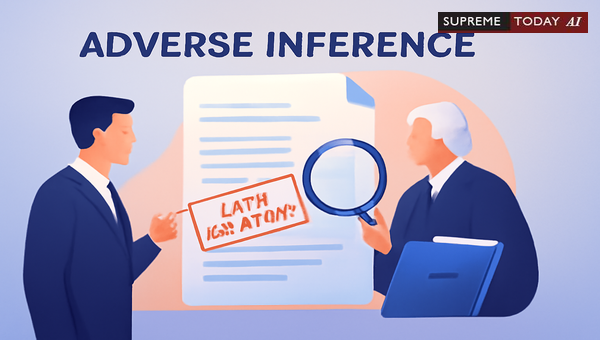
In civil litigation, courts often issue orders directing parties to produce specific documents to establish facts or support claims. But what happens when a party fails to comply? A common question arises: Non Compliance to Produce Document as Per the Order of , Whether to be Taken? This issue strikes at the heart of evidentiary rules and judicial fairness.
Generally, courts may draw an against a non-compliant party, presuming that the withheld documents would be unfavorable to their case. However, this is not automatic and depends on context, proof standards, and precedents under the . This post delves into the legal principles, key judgments, and practical implications, drawing from established rulings to provide clarity.
is a principle where the court infers that unproduced or unproved evidence would harm the withholding party's position. allows courts to presume intent to withhold unfavorable evidence if a party disobeys a production order.
However, courts emphasize that documents must first be in a before reliance. Without proof, a document's evidentiary value is unestablished, and authorities cannot treat it as conclusive. This ties directly to non-compliance: failure to produce prevents proof, potentially triggering adverse inferences. As held, a document must be in a of competent jurisdiction before it can be relied upon by authorities as evidence2024 Supreme(Online)(MP) 37956.
Non-compliance amplifies these issues, as unproduced originals hinder proof, inviting adverse views.
Civil courts apply the standard. Authorities must await judicial proof before acting. For instance, the use of word 'Will' in Niyam, 2018 would not make any difference and the Will cannot be acted upon unless and until it is and decided by the of competent jurisdiction2024 Supreme(Online)(MP) 37956.
Failure to produce as ordered leaves documents unproved, akin to suppression, leading courts to disbelieve claims. In a case, authorities disbelieved a Will because the decree did not uphold it, instead favoring : the decree relied upon does not upheld the Will, on the contrary, the has found that succession must take place in accordance with the principles of
.
Objections to must be raised timely: an objection to of evidence should be taken when it is tendered and not subsequently2003 8 Supreme 193. Post-admission, proof is mandatory. Non-production per court order skips this, risking .
In disability claims, failure to produce or prove certificates led to skepticism, though official records were trusted once produced: the claimant had not produced, nor proved any disability certificate issued by any reliable Civil Hospital... However, once the record has been produced by the Army authorities... this Court would have absolutely no hesitation in believing the same
. This highlights compliance's role in avoiding disbelief.
Revenue or registration officials lack jurisdiction to rule on genuineness: the Registrar cannot cancel a registered document based solely on allegations of fraud or forgery without substantive evidence2024 0 Supreme(Mad) 939. Disputes go to civil courts. Non-compliance in such proceedings reinforces that unproved documents hold no sway.
A ruling noted revenue authorities confirming a patta after proof, rejecting challenges: the authorities confirmed the patta2024 Supreme(Online)(MAD) 28469. Contrastingly, unproven documents fail.
Courts consistently demand proof:- : a document has to be proved and expert reports must comply with Evidence Act 2003 8 Supreme 193.- a document relied upon in a civil case must be properly proved; mere production or admission is insufficient
.
In matters, verified documents avoided forgery claims, but unproven ones faced scrutiny: the document which was stated to be forged, is actually not forged as it was verified by the departmental authorities
AJIT SINGH vs STATE OF RAJASTHAN
. Similarly, proved pattas and site plans were upheld: Whether the learned Courts below have not properly considered the effect of the document EX-1 patta... when it has been found proved?2025 Supreme(Online)(RAJ) 4415.These cases illustrate: compliance and proof prevent adverse inferences; non-compliance invites them.
To avoid adverse inferences:- Comply promptly with production orders, producing originals or authenticated copies.- Prove documents via witnesses, experts, or Evidence Act modes.- Seek adjudication for authenticity disputes, not administrative forums.- Raise timely objections and ensure procedural compliance.
Parties should consult counsel, as outcomes vary by facts.
Typically, non-compliance with a 's document production order may lead to under Evidence Act principles, especially if it prevents proof. Courts prioritize proved evidence; unproduced documents risk disbelief, as seen across precedents like 2024 Supreme(Online)(MP) 379562003 8 Supreme 193
.
Key Takeaways:- Documents require proof before reliance.- Non-compliance hinders proof, inviting adverse views.- ≠ Proof; follow Evidence Act strictly.- Resolve genuineness in civil courts 2024 0 Supreme(Mad) 939.
This is general information based on precedents and not specific legal advice. Consult a qualified lawyer for your situation.
: Mere production insufficient.
,
, 2024 Supreme(Online)(MAD) 28469,
AJIT SINGH vs STATE OF RAJASTHAN
, 2025 Supreme(Online)(RAJ) 4415: Supporting cases on proof and compliance.


Learned counsel for the petitioners in support of his contention that as the subject document is not a public document and is not a certified copy of the original document, it does not fall under any of the provisions of Section 65 of the Act, has relied on the judgment of Hon’ble Supreme Court in Civil ... by any authority and more so, when the said document is not a p....

Learned counsel for the petitioners in support of his contention that as the subject document is not a public document and is not a certified copy of the original document, it does not fall under any of the provisions of Section 65 of the Act, has relied on the judgment of Hon’ble Supreme Court in Civil ... by any authority and more so, when the said document is not a p....

Learned counsel for the petitioner has relied upon civil Court decree dated 23.04.2007 to submit that the authorities below were not justified in disbelieving the Will. ... The decree relied upon does not upheld the Will, on the contrary, the civil Court has found that succession must take place in accordance with the principles of natural succession. ....
Learned counsel for the petitioners in support of his contention that as the subject document is not a public document and is not a certified copy of the original document, it does not fall under any of the provisions of Section 65 of the Act, has relied on the judgment of Hon’ble Supreme Court in Civil ... by any authority and more so, when the said document is not a p....
Learned counsel for the petitioners in support of his contention that as the subject document is not a public document and is not a certified copy of the original document, it does not fall under any of the provisions of Section 65 of the Act, has relied on the judgment of Hon’ble Supreme Court in Civil ... by any authority and more so, when the said document is not a p....

It is stated that the learned Tribunal was in error in taking the disability of the claimant to be 60% as, the claimant had not produced, nor proved any disability certificate issued by any reliable Civil Hospital, nor had he examined any ... However, once the record has been produced by the Army authorities, as discussed earlier also, this Court would have absolutely no hesitation in believing the same”. ... a....

After purchase the plaintiff obtained the patta from the revenue authorities and the same was proved by him and the same was challenged by the defendants before the revenue authorities but the authorities confirmed the patta. ... The judgement relied by the plaintiff is squarely applicable to this case but the authorities relied by the defendants is not support this cas....

On a pointed query being raised by the Court to the counsel for the appellant that whether any document which was relied upon by the Enquiry Officer was not supplied to him or the same Learned counsel submitted that the document which was stated to be forged, is actually not forged as it was verified by the departmental authorities including Mr. K. C. ... Further, the documents, w....

The District Registrar entertained the complaint given by the fourth and fifth respondents and has cancelled all these document mainly on the ground that the Will relied upon by the parties are already held to be invalid by a competent Civil Court. ... These are matters for evidence and appreciation by the competent Civil Court in the light of the evidence tendered. Hence, without any m....

(2) Whether the learned Courts below have not properly considered the effect of the document EX-1 patta and EX-2 to 3 more particularly when it has been found proved? ... (3) Whether the learned Courts below have not properly considered effect of the document EX-2 “Site Plan” with regard to Size of Plaintiff Plot more particularly when it has been found proved? ... This Second Appeal is against the judgment and decree da....


An indispensable Tool for Legal Professionals, Endorsed by Various High Court and Judicial Officers
Please visit our Training & Support
Center or Contact Us for assistance

Scan Me!
India’s Legal research and Law Firm App, Download now!


For Daily Legal Updates, Join us on :



 Back to top


