Searching Case Laws & Precedent on Legal Query.....!
Analysing the retrieved Case Laws
Scanned Judgements…!



Searching Case Laws & Precedent on Legal Query.....!
Analysing the retrieved Case Laws
Scanned Judgements…!
Cheque Signature and Payee Name - Several cases highlight issues where the cheque bears the signature of the accused but lacks the name of the payee or the payee's details are inconsistent or not clearly stated. For example, in 2022 Supreme(Online)(Kar) 53096, the cheque was issued in the name of ‘Prakash Tea’ rather than the complainant, and in 2022 Supreme(Online)(Kar) 31821, the accused disputes the date and signature authenticity, requesting expert examination. Similarly, in 2024 Supreme(Online)(Kar) 36916, the accused admits signing the cheque but disputes the security purpose and the details on the cheque, indicating ambiguity about the payee's name and the cheque's issuance context references: 2022 Supreme(Online)(Kar) 53096, ["2022 Supreme(Online)(Kar) 31821"], ["2024 Supreme(Online)(Kar) 36916"].
Absence of Payee Name or Disputed Payee - The absence of the payee's name or discrepancies in the payee's identification on the cheque is a recurring issue. For instance, in 2022 Supreme(Online)(Kar) 53096, the cheque was issued in the name of ‘Prakash Tea’ instead of the complainant, raising questions about the legitimacy of the cheque for the intended transaction. In some cases, the cheque is issued in a different name or for a different purpose, which complicates the proof of payment or debt reference: 2022 Supreme(Online)(Kar) 53096.
Signature Verification and Disputes - Several cases involve disputes over the authenticity of the signature or alterations in the cheque's date, prompting requests for expert opinion (e.g., 2022 Supreme(Online)(Kar) 31821). The accused often admits signing the cheque but disputes other details, emphasizing the need for forensic verification to establish authenticity references: 2022 Supreme(Online)(Kar) 31821, ["2024 Supreme(Online)(Kar) 36916"].
Payment Evidence and Context - While some cases acknowledge that the cheque was signed by the accused, the actual payment or debt is contested or not clearly established. For example, in 2023 Supreme(Online)(MAD) 4645, the respondent claims payments were made through other means, and the cheque amount was already settled, despite the cheque bearing the signature. Similarly, in 2024 Supreme(Online)(TEL) 4829, the court found no legally enforceable debt despite the signature, as the payment was not proven to be linked to the cheque references: 2023 Supreme(Online)(MAD) 4645, ["2024 Supreme(Online)(TEL) 4829"].
Analysis and ConclusionThe main issue in these cases is the discrepancy or absence of the payee's name on the cheque, which raises questions about the cheque's validity as a payment instrument. When the cheque bears only the signature of the accused without a clear payee, or the payee's name is inconsistent, it complicates the proof of debt or transaction. Courts often require expert verification of signatures and detailed proof of payment or debt to substantiate claims under Section 138 of the NI Act. The presence of signatures alone does not confirm payment unless the payee and other details are unequivocally established. Therefore, in cases where the payee's name is missing or disputed, the cheque's enforceability as proof of debt is challenged, emphasizing the importance of clear, complete cheque details for legal validity.
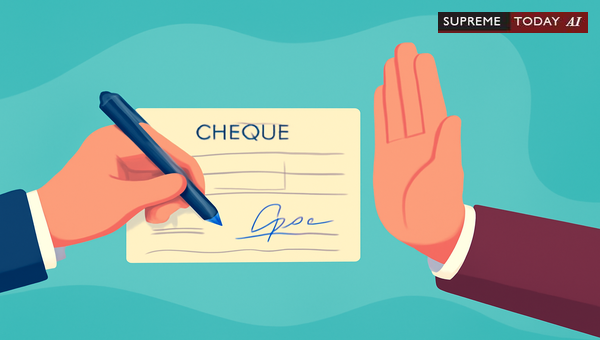
under () are commonplace in India, often hinging on critical evidentiary battles. One of the most pivotal questions arises when the defendant disputes the signature on the cheque: Who has to prove the signature on a cheque—plaintiff or defendant if it is disputed? This issue can make or break a case, as it determines the flow of presumptions and burdens of proof. In this post, we delve into the legal principles, judicial precedents, and related considerations like cheque completeness to provide clarity.
Understanding this burden is essential for complainants, drawers, and businesses relying on cheques for transactions. While courts generally hold that the plaintiff (complainant) must initially prove the disputed signature, subsequent presumptions under shift responsibilities. Let's break it down step by step.
Under the , a successful Section 138 complaint requires proving that the cheque was issued for a or liability, due to insufficient funds, and that the drawer had . However, the starting point is always the signature.
If the defendant admits the signature, a strong presumption arises under that the cheque was issued in discharge of a . The burden then shifts to the defendant to rebut this presumption on a . As one court established: the under of the applies once the signature on a cheque is admitted, shifting the burden to the accused to prove otherwise. 2024 Supreme(Online)(Kar) 36905
But if the signature is disputed, the plaintiff bears the initial burden to prove that the signature on the cheque belongs to the defendant (drawer). Courts have consistently ruled that without establishing the drawer's signature, the do not kick in. For instance:- Once the signature on the cheque is established, the burden shifts to the accused to prove that the cheque was not issued in discharge of a debt. 2024 Supreme(Online)(Kar) 36905- In another case, the respondent-accused admitted his signature on the cheque, triggering the presumption, but failed to rebut it with evidence of no enforceable debt. 2025 Supreme(Online)(KAR) 9826
This principle ensures fairness: the complainant cannot rely solely on the cheque's existence without linking it to the accused through their signature. Expert handwriting analysis, bank records, or the accused's prior admissions often serve as proof. Failure to discharge this burden typically leads to acquittal. 2025 Supreme(Online)(KAR) 9826
Indian courts have reinforced this through landmark rulings:- Presumption under is rebuttable: The standard for the defendant is 'preponderance of probability,' not 'beyond reasonable doubt.' Once the plaintiff proves the signature, documents like loan statements can strengthen the case for debt. 2025 Supreme(Online)(KAR) 9826- In fraud-related property deals, even where privity was questioned, the accused's admission of issuance (implying signature) led to conviction as they failed to rebut . The trial court's acquittal was set aside for ignoring this presumption. 2024 Supreme(Online)(Kar) 36905- Admissions of signature, coupled with account statements showing dues higher than the cheque amount, confirmed liability. 2025 Supreme(Online)(KAR) 9826
Beyond signatures, disputes often involve cheque completeness, such as missing payee names or dates. These can intersect with signature proof, as an allegedly altered cheque might lead to signature denial.
A cheque bearing the drawer's signature and date but lacking the payee's name may still qualify as a valid negotiable instrument if issued for valid consideration. However, per , essential elements include the drawer's signature, payable amount, and payee (or bearer) details. 2003 0 Supreme(Ker) 14
Courts recognize that incomplete instruments (e.g., blank payee) can be filled later with from the drawer, without constituting under Section 87. Insertion without consent, however, prejudices rights and voids the cheque.
1998 0 Supreme(Ker) 155
If a disputed signature coincides with payee insertion claims, the plaintiff must prove both authenticity and no prejudicial alteration. Banks' endorsements confirming no signature variation bolster the case.
2024 Supreme(Online)(Kar) 36905
For plaintiffs:- Secure handwriting experts or comparative signatures early.- Retain transaction proofs (loans, receipts) to support .- Document authority for filling blanks.
For defendants:- Disputing signature requires consistent denial; provide rebuttal evidence like alibis or mismatches.- Prove payments or no consideration via records.
Banks should note endorsements on variations. Always consult records for hypothecation or loans.
In summary, if the signature on a cheque is disputed, the plaintiff must prove it belongs to the defendant. Once established, presumes a , shifting the burden to the defendant—a rule upheld across cases. Related issues like missing payee names may raise claims but don't negate signature proof requirements unless proven prejudicial.
2003 0 Supreme(Ker) 14
Key Takeaways:- Plaintiff's Initial Burden: Prove disputed signature via evidence.- Defendant's Rebuttal: Disprove debt post-presumption.- Cheque Validity: Signatures + consideration sustain even incomplete instruments, absent unauthorized changes.- Seek Documentation: Loans, payments, and bank slips are crucial.
This article provides general insights based on judicial trends and is not legal advice. Laws evolve, and outcomes depend on facts. Consult a qualified lawyer for case-specific guidance.
1998 0 Supreme(Ker) 155 2024 0 Supreme(HP) 248 2024 Supreme(Online)(Kar) 36905 2025 Supreme(Online)(KAR) 9826
(Word count: approx. 1050)
#ChequeBounce #NIAct138 #SignatureProof


the name of the accused. ... Further, the bank endorsement does disclose that cheque was not returned for variation in the 7 signature. ... Payments made by the accused were acknowledged by the complainant and she had requested the KSFC to issue NOC for cancellation of hypothecation standing in the name of KSFC. ... The records disclos....

Moreover, there was no occasion for the accused to issue blank cheque as security. ... There was no change in the amount of the cheque, its date or the name of the payee. ... The accused was not concerned about the financial matters. The complainant had not paid the balance amount of Rs.10,00,000/-. ... It is #....
The complainant has also not specifically stated as to on which exact date he has paid sum of Rs.12,50,000/-. ... Further the cheque is also not issued in the name of the complainant the date of issuance of cheque as 21.02.2017. ... But on perusal of Ex.P1- Cheque, it is evident that the cheque was not#....
It is the case of the accused right from the beginning that there is alteration in the date of the cheque as he is not issued any cheque on 10.07.2012. ... in the date mentioned on the cheque. ... The accused sought reference of the disputed cheque to be placed before a handwriting expert as the accused disputed....

not also paid by the petitioner to the PW. ... The money was not paid to PW-1 by the petitioner and co accused Amiya were not signatures of accused Amiya Gopal Datta and Balaram demanding payment of the money within 30 days from the date of p style="

borne by the cheque, the respondent has filed a criminal complaint; the petitioners had given reply notice and in reply notice itself, they have stated about the settlement process and the manner in which the amount involved in the cheque have already been paid; the respondent, who had failed to make ... The petitioners are the Company and its authorised signatory, who are arrayed as accused 1 and 2. The present complaint ....

Learned Magistrate found that the complainant failed to prove that there was legally enforceable debt covered by the cheque though it is admitted that cheque contained signature of the accused. ... , the bills were produced by the accused had his name. ... Briefly, the case of the complainant is that while he was doing business in garments, accused had taken goods and t....

Gnana Murthy B.M, in fact never paid the sale consideration, but he is only a name lender. ... The complainant has produced Ex.P- 16, the bank account statement which shows availing of the loan, payment of the interest and other charges paid by the complainant. Since from 2015 till date, the accused is successful in managing to dodge the complainant without paying the cheque amount. ... ....
The statement of personal loan account – Ex.P10 and 11 indicate that the loan amount was due and it is higher than the cheque amount as on the date of cheque. The respondent –accused has admitted his signature on the cheque –Ex.P1. ... The respondent – accused has not paid the cheque amount and therefore, the appella....

Learned counsel contended that the accused is not denying issuance of cheque as per Ex.P1, with his signature. When the accused admits issuance of cheque with his signature, the presumption under Section 139 of NI Act would arise and the initial burden on the complainant gets discharged. ... Under such circumstances, the defence taken by the accused th....


An indispensable Tool for Legal Professionals, Endorsed by Various High Court and Judicial Officers
Please visit our Training & Support
Center or Contact Us for assistance

Scan Me!
India’s Legal research and Law Firm App, Download now!


For Daily Legal Updates, Join us on :



 Back to top


