SupremeToday Landscape Ad
AI Thinking

AI Thinking...

Searching Case Laws & Precedent on Legal Query.....!

Scanned Judgements…!

Checking relevance for State of Maharashtra VS Narain Singh Yadav...

2002 0 Supreme(SC) 2103 : Prosecution should not be quashed unless it is illegal, perverse, or mala fide. The State has a constitutional obligation to ensure speedy trial and conclusion of criminal proceedings.Checking relevance for State of Odisha VS Pratima Mohanty Etc. ...

2021 8 Supreme 746 : The guidelines for quashing criminal proceedings under Section 482 of the Criminal Procedure Code, 1973, are that the power should be exercised sparingly and with circumspection, only in rare cases. Quashing of a complaint or FIR should be an exception rather than an ordinary rule. Criminal proceedings should not normally be quashed when a thorough investigation has led to the filing of a charge-sheet. Courts at the stage of discharge or when considering an application under Section 482 are not required to go into the merits of allegations or evidence in detail, as if conducting a mini-trial. The court cannot embark on an enquiry into the reliability or genuineness of allegations made in an FIR or complaint. The power under Section 482 is wide but requires the court to be cautious, as it imposes an onerous and more diligent duty. The High Court''''s action in quashing proceedings by entering into the merits of allegations and conducting a detailed weighing of evidence is impermissible and amounts to a mini-trial, which is not permissible under this provision.Checking relevance for GOLD QUEST INTERNATIONAL PRIVATE LIMITED VS STATE OF TAMIL NADU...

2014 7 Supreme 148 : The High Court may quash criminal proceedings or FIRs under Section 482 of the Code of Criminal Procedure, read with Article 226 of the Constitution of India, if the dispute is substantially matrimonial in nature or a civil property dispute with criminal facets, and the parties have settled their dispute, particularly when there are no chances of conviction. The power to quash is distinct from compounding of offences under Section 320 and is exercised to secure the ends of justice or prevent abuse of the process of any court. The High Court must consider the nature and gravity of the offence; serious offences such as murder, rape, dacoity, offences under the Prevention of Corruption Act, Narcotic Drugs and Psychotropic Substances Act, or those carrying punishment of life imprisonment or death, cannot be quashed even if the victim and offender have settled. However, criminal cases with a predominant civil flavour—such as those arising from commercial, financial, mercantile, partnership, family, or dowry disputes—may be quashed if the settlement is complete, the possibility of conviction is remote, and continuing the proceedings would cause extreme injustice or oppression to the accused. The exercise of this power is discretionary and fact-specific, requiring a careful assessment of whether continuation of the case would amount to abuse of process despite a full settlement.Checking relevance for Union Of India VS Corporal A. K. Bakshi...

Checking relevance for Rathish Babu Unnikrishnan VS State (Govt. of NCT of Delhi)...

2022 5 Supreme 65 : The guidelines for quashing criminal proceedings under Section 482 of the Criminal Procedure Code, 1973, include that the power should be exercised very sparingly and with circumspection, only in the rarest of rare cases. The court must not embark on an enquiry into the reliability, genuineness, or truthfulness of allegations in a complaint or FIR. The quashing court should not take upon itself the burden of separating ''''wheat from chaff'''' where facts are contested, nor should it become an expedition into the merits of a factual dispute. The court should not determine the weight of defences raised by the accused at the pre-trial stage. Even if some suspicion or doubt is shown regarding the prosecution''''s allegations, it would be impermissible to discharge the accused before trial, as this would result in finality without allowing the prosecution to adduce evidence. The balance of convenience at the pre-trial stage generally favours the complainant, especially when there is a legal presumption (e.g., under Section 139 of the Negotiable Instruments Act, 1881) that a cheque was issued in discharge of a debt. The accused must be given a fair opportunity to adduce evidence in an open trial to rebut such presumption. Quashing proceedings at a preliminary stage can have grave and irreparable consequences, including ousting the trial court from its proper role of weighing material evidence and potentially giving the accused an unmerited advantage. Therefore, quashing is not merited at the nascent stage of proceedings, particularly when factual controversies exist and legal presumptions apply.Checking relevance for GIAN SINGH VS STATE OF PUNJAB...

2012 7 Supreme 1 : The High Court may quash criminal proceedings, FIR, or complaint in exercise of its inherent jurisdiction under Section 482 of the Code of Criminal Procedure, 1973, if it is satisfied that: (i) the dispute between the offender and victim has been fully settled; (ii) the nature and gravity of the crime are such that the offence predominantly has a civil flavour (e.g., arising from commercial, financial, mercantile, civil, partnership, matrimonial, dowry, or family disputes); (iii) the possibility of conviction is remote or bleak due to the settlement; (iv) continuation of the criminal proceedings would result in oppression, prejudice, or extreme injustice to the accused; and (v) quashing the proceedings is necessary to secure the ends of justice or prevent abuse of the process of law. However, this power does not extend to heinous offences like murder, rape, dacoity, or offences involving moral turpitude, public servants, or crimes against society, even if the victim and offender have settled the matter. The power to quash is distinct from compounding of offences under Section 320 Cr.P.C. and cannot be used to override express statutory bars. Each case must be decided on its own facts, with no rigid categories prescribed.


AI Overview

AI Overview...

  • Applicability of Criminal Procedure Code to Section 14 Offences - The Code of Criminal Procedure, 1973 (CrPC) applies to offences under Section 14 of the relevant Act as if they were cognizable offences, particularly for investigation and certain procedural matters, with specific exceptions outlined in Section 15(ii) ["2026 Supreme(Online)(Gau) 76"].

  • Nature of Proceedings and Court Powers - High Courts possess inherent powers to quash criminal proceedings to prevent misuse or harassment, especially when civil disputes are mischaracterized as criminal offences or when proceedings are deemed unjustified ["2026 Supreme(Online)(Gau) 76"], ["2023 0 Supreme(HP) 217"], ["ABID Vs STATE OF KERALA - Kerala"].

  • Criminal Law as a Tool and Civil vs. Criminal Disputes - Several judgments emphasize that criminal law should not be misused to settle civil disputes, and allegations must disclose essential ingredients of criminal offences; otherwise, proceedings can be quashed to prevent abuse ["2025 0 Supreme(Kar) 2459"], ["2023 0 Supreme(Jhk) 992"], ["2024 0 Supreme(Kar) 148"].

  • Res Judicata and Finality of Proceedings - The principle of res judicata does not generally apply in criminal matters, but the seriousness of summoning an accused mandates that proceedings are initiated with proper cause and evidence ["2025 4 Supreme 332"], with courts exercising caution to avoid unwarranted criminalization ["2026 Supreme(Online)(Gau) 76"].

  • Specific Case Insights - Orders under Section 14 of the Act are subject to judicial review, and the remedy for challenging such orders is typically via Section 17 of the Act, not through regular criminal revision ["2025 Supreme(Online)(Tel) 54127"]. Moreover, courts have repeatedly held that proceedings should not be used as instruments of harassment, and cases with trivial injuries or civil nature are often quashed ["ABID Vs STATE OF KERALA - Kerala"], ["2023 0 Supreme(Jhk) 210"].

Analysis and Conclusion:Criminal Matters 14 primarily concerns the application of criminal procedural law to offences under Section 14, highlighting that proceedings must be initiated judiciously and are subject to judicial oversight to prevent misuse. The courts recognize the importance of balancing enforcement with protecting individuals from harassment, emphasizing that criminal law should not be employed as a tool for civil disputes or personal vendettas. Courts have broad inherent powers to quash proceedings where they are found to be unjustified, especially when civil remedies are appropriate or when proceedings lack essential criminal ingredients. The consistent judicial stance underscores that criminal proceedings should be initiated with due cause and proper evidence, maintaining the integrity of criminal justice and preventing abuse of process ["2026 Supreme(Online)(Gau) 76"] ["2025 0 Supreme(Kar) 2459"] ["ABID Vs STATE OF KERALA - Kerala"].

Grounds for Quashing Criminal Proceedings Under Section 482 CrPC and Article 142

Quashing Criminal Proceedings: Key Principles in India

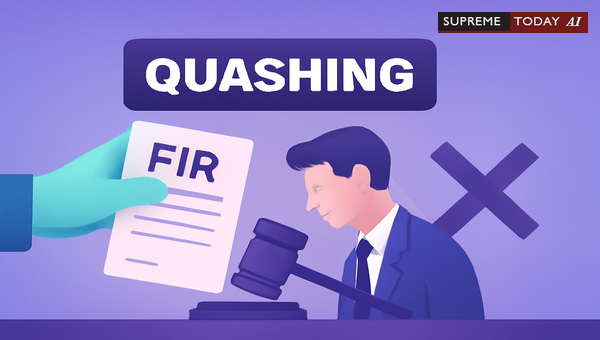
Facing criminal charges can be a nightmare, especially when they stem from misunderstandings, civil disputes, or lack of evidence. In India, courts have the power to quash such proceedings to prevent abuse of the legal process. But under what circumstances? This blog dives into the core principles governing the quashing of criminal proceedings, drawing from landmark judgments and recent cases.

Whether you're dealing with an FIR, charge-sheet, or ongoing trial, understanding these rules can help navigate the system effectively. Note: This is general information based on case law and not specific legal advice—consult a qualified lawyer for your situation.

What Does 'Quashing Criminal Proceedings' Mean?

Quashing refers to a court's order to terminate criminal proceedings at an early stage, typically under Section 482 of the Code of Criminal Procedure (CrPC), 1973. High Courts exercise inherent powers to prevent miscarriage of justice, abuse of process, or secure ends of justice. The Supreme Court can also intervene under Article 142 of the Constitution for complete justice. 2024 0 Supreme(SC) 1291

In Criminal Matters 14, courts outlined when prosecution isn't justified, emphasizing no evidence or improper charges. This power is exercised sparingly, balancing individual rights against public interest in prosecution.

Key Principles for Quashing Criminal Proceedings

Courts follow established guidelines to decide quashing petitions. Here are the primary principles:

  • Prosecution not justified or warranted: If charges lack basis, courts quash proceedings. For instance, The prosecution of the appellant was not justified and warranted, and the court quashed the criminal proceedings against the appellant. 2022 0 Supreme(SC) 1356
  • Absence of specific charges or evidence: Examining statutes like the Foreigners Act, courts found no charge under Section 188 IPC and no abetment evidence, leading to quashing. 2022 0 Supreme(SC) 1356
  • Acquittal must be honorable: Unless the acquittal in a criminal case is honorable, the criminal antecedent of a prospective candidate is not cleansed, and illegality cannot be perpetuated by invoking Article 14 of the Constitution. 2014 8 Supreme 371
  • No reliance on accused's defense documents: Except in very exceptional circumstances, the court would not look to any document relied upon by the accused in support of their defense. 2009 0 Supreme(SC) 418
  • Civil disputes not ground alone: Allegations disclosing a civil dispute don't automatically quash proceedings. 2009 0 Supreme(SC) 418
  • Valid charge-sheet stands: If the order of cognizance has been passed relying on a charge-sheet which prima facie discloses the commission of offences, no exception thereto can be taken. 2009 0 Supreme(SC) 418

These principles ensure quashing isn't routine but reserved for clear injustices.

Limitations and Exceptions to Quashing

While courts can intervene, there are strict limits:

  • Exceptional circumstances only: Quashing may occur if prosecution is unwarranted or allegations reveal a civil dispute. 2022 0 Supreme(SC) 1356 2009 0 Supreme(SC) 418
  • No quashing on accused's documents or mere civil nature: Courts generally avoid defense materials or quashing solely for civil shades. 2009 0 Supreme(SC) 418
  • Delay or settlement not grounds: The court will also not quash criminal proceedings on the ground of delay in trial or settlement of the matter, or the contention that the continuation of such proceedings will increase the load on the criminal justice delivery system. 2015 6 Supreme 659

This prevents misuse of quashing powers, upholding prosecution integrity.

Supreme Court Powers Under Article 142

The Apex Court holds unique authority: The Supreme Court can quash criminal proceedings under Article 142 to ensure complete justice, irrespective of ordinary statutory limitations. 2024 0 Supreme(SC) 1291

In a transfer petition case, despite denying transfer from Haridwar to Delhi, the Court quashed FIR No. 310/2020 upon amicable settlement, noting consensus for closure. This highlights peace maintenance over procedural rigidity. 2024 0 Supreme(SC) 1291

Quashing for Abuse of Process and Civil Disputes

A recurring theme is preventing criminal law from settling civil scores. Criminal proceedings should not be used to settle civil disputes and that the abuse of process of the court can warrant the quashing of criminal proceedings. 2023 0 Supreme(AP) 1373

In a case under Sections 447 and 427 IPC (criminal trespass), the complaint failed to disclose offenses. Civil disputes were already adjudicated by tribunals, holding the complainant not in possession. Proceedings were quashed as abuse of process. 2023 0 Supreme(AP) 1373

Similarly, in a sublease dispute (Sections 420, 406, 120-B IPC), the dispute between the parties was predominantly of a civil nature and could not be allowed to take on a criminal character. The FIR was malicious; investigation quashed. 2024 0 Supreme(Raj) 25

High Courts echo: The High Court have been invested with inherent powers... to achieve a salutary public purpose. A Court proceeding ought not to be permitted to degenerate into a weapon of harassment. 2023 0 Supreme(AP) 1373 2024 0 Supreme(Raj) 25

Other Scenarios: Procedural Lapses and Compounding

Procedural flaws can lead to quashing. Non-compliance with CrPC Section 154(1)(3) and magistrate's lack of application of mind under Section 156(3) warranted quashing an order and FIR. 2024 0 Supreme(Bom) 375

Compounding can deem acquittal: Under Electricity Act Sections 135/136, accepting compounding fees acquitted the accused, quashing proceedings. 2017 0 Supreme(Raj) 1032

Pardon irregularities were set aside, directing fresh hearings. 2017 0 Supreme(Gau) 99

However, valid cognizance under PMLA despite challenges stood, as contentions didn't vitiate process. 2018 0 Supreme(Mad) 4235

Practical Considerations for Filing Quashing Petitions

  • Timing: Preferably pre-trial, at FIR/charge-sheet stage.
  • Evidence: Focus on no prima facie case, not full defense.
  • Jurisdiction: High Court under Section 482; Supreme Court via SLP or Article 142.
  • Settlement: Amicable resolutions aid quashing, especially matrimonial/commercial disputes.

Recent trends show courts wary of NI Act Section 138 misuse or dowry cases without evidence, but each turns on facts. 1995 Supreme(Online)(Bom) 6 2021 0 Supreme(Bom) 91

Conclusion: Key Takeaways

Quashing criminal proceedings safeguards against harassment but is exceptional. Core tests: no offense disclosed, abuse of process, or civil core. Courts prioritize justice without undermining prosecutions.

Key Takeaways:- Prosecution must be justified with evidence. 2022 0 Supreme(SC) 1356- Civil disputes cloaked as criminal may be quashed. 2023 0 Supreme(AP) 1373- Article 142 enables Supreme Court flexibility. 2024 0 Supreme(SC) 1291- Avoid relying on defenses pre-trial. 2009 0 Supreme(SC) 418

If facing proceedings, assess merits early. This overview draws from precedents; professional advice is essential as laws evolve.

Disclaimer: This article provides general insights from public judgments and is not legal advice. Laws vary by facts and jurisdiction.

#QuashingFIR #CriminalLawIndia #LegalInsights
Chat Download
Chat Print
Chat R ALL
Landmark
Strategy
Argument
Risk
Chat Voice Bottom Icon
Chat Sent Bottom Icon
SupremeToday Portrait Ad
logo-black

An indispensable Tool for Legal Professionals, Endorsed by Various High Court and Judicial Officers

Please visit our Training & Support
Center or Contact Us for assistance

qr

Scan Me!

India’s Legal research and Law Firm App, Download now!

For Daily Legal Updates, Join us on :

whatsapp-icon Back to top