Searching Case Laws & Precedent on Legal Query.....!
Scanned Judgements…!



Searching Case Laws & Precedent on Legal Query.....!
Scanned Judgements…!
MO sword and clothes with blood stains - Detected human blood on the sword and clothes recovered from the appellant, but the forensic report did not conclusively establish that the stains were of human blood or linked directly to the deceased's blood group ["1979 0 Supreme(Raj) 381"], ["2025 0 Supreme(Ker) 3175"], ["2022 0 Supreme(HP) 424"], ["
KANJIBHAI BUDHIYABHAI HALPATI vs STATE OF GUJARAT - Gujarat
"], ["2022 Supreme(Online)(DEL) 4105"], ["2022 Supreme(Online)(DEL) 3616"].Discrepancy in blood evidence and clothing - The blood on the recovered shirt worn by the appellant was not necessarily human blood, and the blood group could not be conclusively matched to the deceased. In some cases, the shirt recovered from a different person (e.g., Rajesh Kumar) was not proven to belong to the appellant, and the person who handed over the shirt was not examined during trial ["2022 Supreme(Online)(HP) 2371"], ["2022 0 Supreme(HP) 424"].
Blood reaching laboratory in different condition - The blood stains on the clothes and sword reached the laboratory in a condition that made it difficult to definitively link them to the deceased or establish a direct connection to the crime. Several reports indicated inconclusive results regarding blood group matching and human blood confirmation ["1979 0 Supreme(Raj) 381"], ["2022 Supreme(Online)(HP) 2371"], ["2022 0 Supreme(HP) 424"].
Main insight - While blood was detected on the sword and clothing, the forensic analysis often failed to establish a definitive link between the blood stains, the blood group, or the identity of the blood source, highlighting discrepancies between the physical evidence and the alleged recovery or the prosecution's claims about the deceased's clothing and blood evidence reaching the lab in a different condition.
Analysis and Conclusion:The forensic reports across multiple sources consistently show that although blood stains were present on the recovered items, the evidence was often inconclusive or insufficient to confirm that the blood belonged to the deceased or matched the alleged clothing. The discrepancy in the blood's condition and the provenance of the clothes (e.g., recovery from different persons or locations) weakens the argument that the blood evidence directly links the sword or clothing to the crime scene or the deceased's blood characteristics. This inconsistency raises questions about the reliability of the blood evidence in establishing a definitive connection in the murder case.
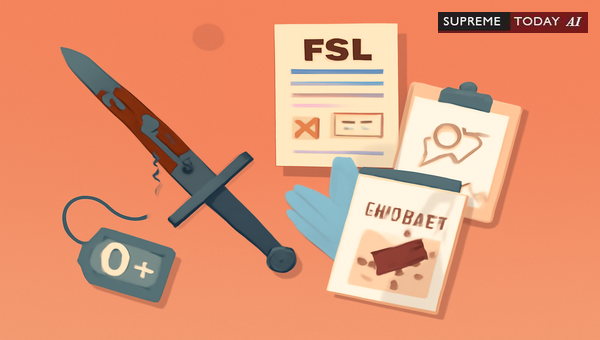
In high-stakes murder trials, forensic evidence often becomes the linchpin determining guilt or acquittal. Imagine a scenario where clotted blood is detected on the alleged murder weapon—a sword—yet the color of the deceased's shirt received at the (FSL) differs from what was supposedly recovered at the scene. Does this strengthen or shatter the prosecution's case?
This blog delves into a critical legal question: MO sword in a murder case having detected clotted blood and the colour of shirt worn by deceased which reached the laboratory is different from what has been allegedly recovered. Drawing from judicial precedents and forensic principles under Indian law, we'll examine how courts evaluate such evidence, emphasizing the balance between corroborative value and evidentiary pitfalls.
Disclaimer: This post provides general insights based on case law and is not legal advice. Consult a qualified attorney for specific cases.
Courts generally view the detection of clotted blood—confirmed as human origin—on a murder weapon like a sword as supporting the prosecution. This holds true even if the blood group cannot be determined due to disintegration or other factors, as long as other circumstances form a complete chain of evidence. However, a discrepancy in the color of the deceased's shirt between recovery and lab receipt undermines its evidentiary value. Such mismatches raise red flags about identification, , or potential tampering, failing to reliably link the accused without blood group matching or additional corroboration. 2018 6 Supreme 294
Human , even if clotted or disintegrated, on weapons such as swords or axes are admissible and serve as valuable support if recovery under is proven. Courts have consistently ruled that the inability to determine blood group does not fatalize the prosecution's case.
For instance, The report discloses that the samples collected from the scene of the offence had of human origin. However, since the were disintegrated by the time the were examined by the , the blood group could not be determined. For the same, the accused cannot be unpunished. 2018 6 Supreme 294 Similarly, Failure of the to detect the origin of the blood due to disintegration of the serum in the meanwhile does not mean that the blood stuck on the axe would not have been human blood at all. 2018 6 Supreme 294 1999 3 Supreme 391
In sword-specific cases, even non-production of the weapon doesn't bar conviction if post-mortem injuries match a sharp-edged weapon: such an injury cannot but be caused by a sharp edged weapon; be it a sword as alleged by the prosecution or some other sharp-edged weapon. 2003 8 Supreme 850 This aligns with broader precedents where blood-stained swords recovered based on accused statements bolster eyewitness accounts. 2017 0 Supreme(Bom) 1073
FSL reports on the deceased's clothes lose without comparing blood groups to the deceased or accused, particularly amid discrepancies like color mismatches. The report of the Assistant Director, Forensic Lab, Agra. This report has miserably failed to link the accused with the crime. The examination conducted only verifies whether the blood found is of human origin... There is no testing undertaken to compare the blood found on the clothes of the deceased with the blood of the accused-appellant. 2025 0 Supreme(SC) 450
Unmatched human blood on apparel is inconsequential: Anybody’s blood on any piece of wearing apparel even if found in the house of the accused would be of no consequence in the event of trial for murder of particular person whose blood has not been matched. 2023 0 Supreme(Pat) 403 Proper protocol requires forwarding blood-stained articles alongside victim/accused blood samples: In such cases, it is necessary that I.O. should send blood stained articles and also the blood sample of the person with whom the blood stains on the articles is to be connected. 2008 2 Supreme 226
Other cases echo this: In one, recovered shirt and pyjama with were identified by witnesses, but discrepancies in handling led to doubts.
Raju vs State
Delays in sending articles to FSL (over three years) and missing items like pants or unstained t-shirts further eroded reliability. 2021 0 Supreme(Guj) 131Unexplained discrepancies, such as shirt color differences, spotlight custody lapses. Courts may overlook minor issues if seals match and no prejudice occurs: the very same sample ... could very well compare the specimen seal available there with the seal impression. 2024 0 Supreme(Ker) 892 Yet, incomplete FSL linkage without group matching fails to prove guilt.
In scenarios with color descriptions like black colour t-shirt and bluish full pant stained with blood, failure to connect via forensics acquitted appellants. IND_Delhi_CRLA-1012_2018 2022_DHC_3650-DB IND_Delhi_CRLA-1012_2018 2022_DHC_3523-DB Witness inconsistencies and poor recovery procedures often tip scales toward acquittal.
Raju vs State
Conversely, unmatched stains or discrepancies don't implicate: Cumulatively, therefore, the contents of this report do not point towards the guilt of the accused. 2025 0 Supreme(SC) 450 Chains break without proven blood links or reliable recoveries. 2016 0 Supreme(Raj) 363
Additional contexts highlight: In fights escalating to stabbings, fetched weapons like knives (analogous to swords) convict starters if eyewitnesses align, but not instigators without direct links. 2016 0 Supreme(Mad) 78 2014 0 Supreme(Del) 2401
While clotted human blood on a MO sword typically corroborates—bolstered by recoveries and injuries—a shirt color discrepancy can unravel clothing evidence, demanding robust . Prosecution must prove ; inconsistencies invite acquittal.
Raju vs State
These principles underscore forensic precision's role in justice.Key Takeaways:- Human blood on weapons: Corroborative, group ID not essential. 2018 6 Supreme 294- Clothes discrepancies: Fatal without matching. 2025 0 Supreme(SC) 450- Always prioritize procedural integrity.
Stay informed on evolving evidence standards—justice hinges on details.
#MurderTrialEvidence, #ForensicDiscrepancy, #IndianCriminalLaw


Later on the sword and the clothes of the appellant were sent to Assistant Director Biology Police forensic Science Laboratory Jaipur for analysis who detected blood on the sword & the clothes. ... He further informed the Dy.S.P. that he had concealed his pentaloon of blue colour and his bush shirt in an iron box lying in the Kota of his residential house and that he was prepared to get the sword and his clothes recovered at his ins....

No reliance can be placed on the report of the Forensic Science Laboratory (Ex.PE) as the T-Shirt alleged to have been worn by the appellant had been recovered from Rajesh Kumar, whereas Rajesh Kumar had not been examined as a witness during trial. ... The Forensic Science Laboratory report also fails to establish that the blood stained stones carried the same blood group as that of the deceased or glass pieces of the broken beer bottle carried the #....

No reliance can be placed on the report of the Forensic Science Laboratory (Ex.PE) as the T-Shirt alleged to have been worn by the appellant had been recovered from Rajesh Kumar, whereas Rajesh Kumar had not been examined as a witness during trial. ... The recovery of the T-shirt worn by the appellant at the time of incident is also not established on record as the person who had handed over the T-shirt allegedly worn by the appella....

Bloodstained clothes worn by A2, A3, A5, A6, and A8 were also recovered, further linking them to the murder. ... The recovery, therefore, stands on firm footing. 17.4 Further, the Forensic Science Laboratory report (Ext.P212), wherein MO11 is item No. 23, confirms the presence of human blood of Group A, the same blood group as that of the deceased, Suraj. ... 7.4 The weapons used in the crime were recovered based on voluntary disclosure statements u....

PW-24 in his testimony states that the recovered shirt and blue color pyjama having blood stains were identified by the brother Vikas PW-4 as the same clothes being worn by the appellant in the night of 12th November, 2012. ... The appellant also recovered one shirt having check prints and blue colored pyjama both having blood stains which was also sealed and seized. ... PW-21 ASI Jagdish Singh who had reached the place of occurrence along with PW-17....

PW-24 in his testimony states that the recovered shirt and blue color pyjama having blood stains were identified by the brother Vikas PW-4 as the same clothes being worn by the appellant in the night of 12th November, 2012. ... blood stained, the blood-stained shirt kept on the face of the deceased, blood- stained dari kept under the head of the dead body and blood-stained plastic slipper. ... PW- 9/B which was a ....

PW-24 in his testimony states that the recovered shirt and blue color pyjama having blood stains were identified by the brother Vikas PW-4 as the same clothes being worn by the appellant in the night of 12th November, 2012. ... blood stained, the blood-stained shirt kept on the face of the deceased, blood- stained dari kept under the head of the dead body and blood-stained plastic slipper. ... PW- 9/B which was a ....

(e) The murder weapon detected presence of human blood. The group thereof, however, could not be ascertained. ... Blood was found from the shirt of the accused and from the bidis which were collected from the shirt was analyzed as of Group A that belonging to the accused. Group of blood that found from the bidis was undecided. ... Combined reading of these documents shows that blood was found from the petticoat of the deceased, fr....
was wearing a black colour t-shirt and bluish full pant and clothes were stained with blood and rigor mortis had passed. ... and t-shirt which the deceased was wearing. ... Further the weapon of offence i.e favda allegedly recovered from the field, vacant plot behind the dairy along with the clothes worn by the appellant did not connect the appellant with the offence and the forensic report ... the pillar which was also blood#HL_EN....
was wearing a black colour t-shirt and bluish full pant and clothes were stained with blood and rigor mortis had passed. ... and t-shirt which the deceased was wearing. ... Further the weapon of offence i.e favda allegedly recovered from the field, vacant plot behind the dairy along with the clothes worn by the appellant did not connect the appellant with the offence and the forensic report ... the pillar which was also blood#HL_EN....

It is also pertinent to note that no arrest memo is prepared which has been admitted by the Investigating Officer in his cross-examination. The Articles were not sent to FSL for more than three years and with the permission of the Sessions Court, were forwarded after examination of seven witnesses (out of eight). Neither the pant which is alleged to have been worn by the appellant is discovered and sent to Forensic Science Laboratory nor the t-shirt which was recovered from the house of the appellant in his absence is having blood stains. Even the Forensic Science Laborator....

Digamber is real brother of Bhimrao and deceased was nephew of Digamber. The sword is recovered and human blood was detected on the sword on the basis of statement given by accused No. Similarly, specific evidence is given against accused No. 9 by PW 10 that he used sword against the deceased. 9. Accused No. 7 - Baburao is son of accused No. 3 - Digamber.

Blood stains on the shirt worn by the deceased and the shirt and pant recovered from the accused tally as it is opined by the State Forensic Science Laboratory in its report (Ex.C2) that the shirt worn by the deceased and the shirt and pant recovered from the accused which he was wearing at the time of occurrence were having stains of human blood group 'B'. The said memo (Ex.P.7) is attested by Man Singh (P.W.4) and Narain (P.W.5). Thus, it is contended that the prosecution has succeeded to prove that the blood group on the clothes of deceased and on the clothes of accused ....

(j) The clothes worn by the deceased, knife, clothes worn by the accused and the soil samples were despatched to the Tamil Nadu Forensic Science Department through Court for examination and report. (o) The Investigating Officer (PW-20) examined the experts and other witnesses and after completing the investigation, filed the Final Report against all the four accused for offences under Section 302, 302 r/w 109 and 506(ii) IPC, before the jurisdictional Magistrate. On showing of A-4, PW-20 recovered the cloths said to have been worn by him viz., blood stained full-hand shirt (MO-13) ....
(xii) Blood of deceased was detected on the shirt worn by appellant Mohd.


An indispensable Tool for Legal Professionals, Endorsed by Various High Court and Judicial Officers
Please visit our Training & Support
Center or Contact Us for assistance

Scan Me!
India’s Legal research and Law Firm App, Download now!


For Daily Legal Updates, Join us on :



 Back to top


