Searching Case Laws & Precedent on Legal Query..!
Scanned Judgements…!



Searching Case Laws & Precedent on Legal Query..!
Scanned Judgements…!
No Separate Court Fee for Declaration of a Deed as Void in Partition Suit - When a suit for partition includes a prayer for declaration that a settlement deed is invalid and not binding on the plaintiff or the schedule properties, separate court fee for the declaration is generally not required. The main suit covers both partition and declaration, and the court fee paid for the partition covers the declaration, unless specific exceptions apply ["2022 Supreme(Online)(KER) 4375"], ["2022 Supreme(Online)(KER) 25482"], ["2022 Supreme(Online)(Ker) 73849"], ["2022 Supreme(Online)(Ker) 79351"].
Court Fee on Declaration of Nullity or Voidness - If a non-executant in possession seeks a declaration that a deed is null or void and does not bind him or his share, he is typically required to pay a fixed court fee (e.g., Rs.19.50 under Article 17(iii) of the Second Schedule). However, if an executant seeks cancellation, ad valorem court fee based on the consideration in the deed is payable ["2022 Supreme(Online)(KER) 4375"], ["2022 Supreme(Online)(KER) 25482"], ["2023 Supreme(Online)(KAR) 15514"].
Specific Case Examples - Courts have held that in suits for partition with a declaration that a deed is invalid, no separate fee is necessary for the declaration unless the declaration is sought independently of partition. In cases where the declaration is a secondary relief within a partition suit, the fee paid for partition suffices ["2022 Supreme(Online)(KER) 4375"], ["2022 Supreme(Online)(KER) 25482"], ["2022 Supreme(Online)(Ker) 73849"].
Additional Considerations - When declaring a document null or void, valuation and court fee depend on whether the document is being challenged as invalid or seeking cancellation. The fee structure varies depending on whether the party is the executant or non-executant and the nature of the relief sought ["2022 Supreme(Online)(KER) 4375"], ["2022 Supreme(Online)(KER) 25482"].
Analysis and Conclusion:In partition suits that include a prayer for declaring a deed as void or invalid, typically, no separate court fee is required for the declaration itself. The fee for the main partition suit covers such declarations unless the declaration is sought independently or under specific circumstances requiring separate valuation and fee. For non-executants seeking declaration of nullity or voidness, fixed fees (e.g., Rs.19.50) generally apply, whereas executants seeking cancellation pay ad valorem fees based on consideration. This aligns with the legal principles established in the cited cases and statutory provisions.
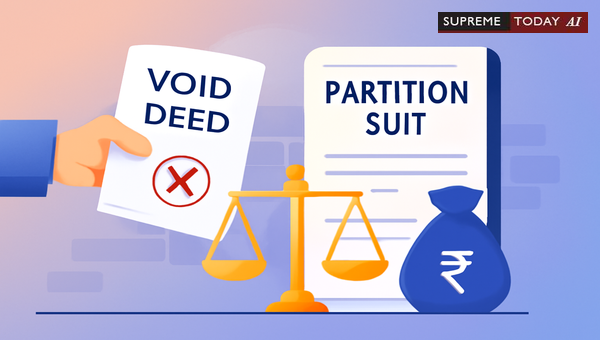
Navigating court fees in partition suits can be tricky, especially when challenging deeds like sale or release documents. Many litigants wonder: No Separate Court Fee for Deed Void Declaration in Partition Suits? The answer hinges on the precise relief sought—declaration of invalidity or outright . Misclassifying this can lead to or additional costs. This post breaks down the legal nuances, drawing from precedents and key judgments, to help you understand when a under Article 17(iii) of the applies versus ad valorem fees. Note: This is general information; consult a legal professional for your specific case.
In partition cases, co-owners often seek to invalidate deeds executed by others that affect their share. The pivotal question is whether the suit requires a for a mere declaration that the deed is void or not binding, or an ad valorem fee based on the property's value for .
Generally, when the suit prays for a declaration that the deed does not bind the plaintiff or is invalid regarding their share, the court fee falls under —a fixed amount, not based on the deed's consideration value. However, if the prayer seeks to cancel the deed itself, ad valorem fees apply on the consideration or property value 2010 0 Supreme(MP) 665 1953 0 Supreme(Raj) 122.
This distinction prevents overpayment and ensures procedural compliance. Let's dive deeper.
Suits where the plaintiff (not the executant) seeks to declare a deed null, void, or are treated as declaratory suits. The in Suhrid Singh @ Sardool Singh v. Randhir Singh (2010 AIR SCW 3308) clarified: where relief is merely declaratory, the court fee is fixed under Article 17(iii), not ad valorem on consideration 1953 0 Supreme(Raj) 122.
The key legal principle is that suits seeking to declare a deed as , when the plaintiff is not the executant and does not seek , are classified as declaratory suits. Such suits require payment of a under Article 17(iii) 1953 0 Supreme(Raj) 122.
Conversely, prayers for annul the instrument itself, constituting substantive relief. In AIR 1980 SC 691, the Court held that such suits demand ad valorem fees based on property value 2018 0 Supreme(Kar) 89.
Suits that seek to cancel the deed itself, i.e., annulment of the instrument, are substantive reliefs that require based on the consideration or value of the property involved 2018 0 Supreme(Kar) 89.
Partition suits typically involve joint family property where one co-owner's deed (e.g., sale deed) is contested. If the plaintiff asserts the deed doesn't bind their share—seeking declaration and partition—the fee is fixed under Article 17(iii) 2010 0 Supreme(MP) 665.
For example, in a case involving : If the prayer is for declaration, that deeds not bind the ‘coparcenery’ and for joint possession, the plaintiff in the suit was not executant of the sale deeds, then the Court fee a deed, he has to seek declaration that deed is invalid that is it is not binding him and under such circumstances, the Court fee.... 2023 Supreme(Online)(KAR) 7696. This reinforces fixed fees for declarations.
However, explicit prayers trigger ad valorem fees. Courts scrutinize pleadings to classify relief accurately 1953 0 Supreme(Raj) 122.
Other judgments echo this:
In a case: A suit for declaration of title and an additional relief of declaration that the adoption deed dated was and for a consequent decree for partition and separate possession... was valued at a sum of Rs.6,675/-
SHARANABASAPPA Vs SANGAMESH AND ORS
. Here, the declaratory aspect aligned with fixed valuation.Addressing challenges: The learned counsel for the respondent submitted that despite there is a prayer of declaration of sale deed is , no court fee is paid; it is not the case of the plaintiff that the second defendant has sold the property for any illegal or immoral purpose... hence, the same will bind the plaintiffs 2022 Supreme(Online)(MAD) 4625
Deivendran vs Hemalatha
. Courts may reject if fees are inadequate for the relief.On partition specifics: partition and separate possession of the share of each of the plaintiffs in the suit property. ... Since, technically, rejection of the plaint in a suit for partition could not be sought by the defendants by targeting a prayer seeking declaration against the deed of relinquishment... 2022 Supreme(Online)(Kar) 37031. This highlights that declarations in partition don't warrant separate ad valorem fees.
| Relief Type | Court Fee | Examples ||-------------|-----------|----------|| Declaration (not binding/invalid) | Fixed under Article 17(iii) 2010 0 Supreme(MP) 665 | Deed doesn't affect plaintiff's share in partition 1953 0 Supreme(Raj) 122 || (annul deed) | Ad valorem on value 2018 0 Supreme(Kar) 89 | Set aside the instrument entirely |
This rule applies generally but depends on framing:- If declaration implies , ad valorem may apply.- Exceptions for illegal/immoral deeds may alter binding nature but not fee structure directly 2022 Supreme(Online)(MAD) 4625.
Courts must carefully examine the relief sought to determine the correct court fee, avoiding misclassification 2010 0 Supreme(MP) 665.
Litigants should align prayers with intended relief to prevent cost escalations.
In partition suits, declaring a deed void typically incurs no separate —opt for fixed under Article 17(iii) if merely asserting status 2010 0 Supreme(MP) 665 1953 0 Supreme(Raj) 122. Only demands value-based fees 2018 0 Supreme(Kar) 89.
Key Takeaways:- Distinguish declaration (fixed) from (ad valorem).- Plaintiff non-executant status favors fixed fees.- Precise pleadings prevent rejections.
This overview draws from established rulings; outcomes may vary by facts. Always seek tailored legal advice.
References:1. 2010 0 Supreme(MP) 665: Fixed fee for void declarations.2. 1953 0 Supreme(Raj) 122: Declaration vs. in partitions.3. 2018 0 Supreme(Kar) 89: Ad valorem for substantive .4. Additional: 2023 Supreme(Online)(KAR) 7696,
SHARANABASAPPA Vs SANGAMESH AND ORS
, 2022 Supreme(Online)(MAD) 4625,Deivendran vs Hemalatha
, 2022 Supreme(Online)(Kar) 37031. #CourtFee #PartitionSuit #LegalInsights


Velukkutty, has been placed to contend that in a suit for partition with prayer for declaration that a settlement deed is invalid and not binding on the plaintiff or plaint schedule properties, separate court fee is not necessary for the said declaration. ... The crux of the matter is that the plaintiffs herein filed Suit#H....

Velukkutty, has been placed to contend that in a suit for partition with prayer for declaration that a settlement deed is invalid and not binding on the plaintiff or plaint schedule properties, separate court fee is not necessary for the said declaration. ... (ii) what is the court fee payable for ....

If the prayer is for declaration, that deeds not bind the ‘coparcenery’ and for joint possession, the plaintiff in the suit was not executant of the sale deeds, then the Court fee a deed, he has to seek declaration that deed is invalid that is it is not binding him and under such circumstances, the Court fee....
Velukkutty, has been placed to contend that in a suit for partition with prayer for declaration that a settlement deed is invalid and not binding on the plaintiff or plaint schedule properties, separate court fee is not necessary for the said declaration. 8. ... The crux of the matter is that the plaintiffs herein filed Sui....

A suit for declaration of title and an additional relief of declaration that the adoption deed dated 18.01.1991 was null and void and for a consequent decree for partition and separate possession and for perpetual relief of declaration of title to the suit properties was valued at a sum of Rs.6,675/-, while the relief of ....

The learned counsel for the respondent submitted that despite there is a prayer of declaration of sale deed is null and void, no court fee is paid; it is not the case of the plaintiff that the second defendant has sold the property for any illegal or immoral purpose; even for the sake of arguments ... to sell the suit property; hence, the same will bind the plaintiffs; ....

The learned counsel for the respondent submitted that despite there is a prayer of declaration of sale deed is null and void, no court fee is paid; it is not the case of the plaintiff that the second defendant has sold the property for any illegal or immoral purpose; even for the sake of arguments ... to sell the suit property; hence, the same will bind the plaintiffs; ....
Velukkutty, has been placed to contend that in a suit for partition with prayer for declaration that a settlement deed is invalid and not binding on the plaintiff or plaint schedule properties, separate court fee is not necessary for the said declaration. ... Thus it appears that when cancellation or declaration of a....
If B, who is a non-executant, is in possession and sues for a declaration that the deed is null or void and does not bind him or his share, he has to merely pay a fixed court fee of Rs. 19.50 under ... at least for a declaration that the same was not binding upon the plaintiffs’ alleged undivided share over the suit schedule property, the present suit#HL....

partition and separate possession of the share of each of the plaintiffs in the suit property. ... Since, technically, rejection of the plaint in a suit for partition could not be sought by the defendants by targeting a prayer seeking declaration against the deed of relinquishment, the defendants ... No. 100186/2016 and the suit ....


An indispensable Tool for Legal Professionals, Endorsed by Various High Court and Judicial Officers
Please visit our Training & Support
Center or Contact Us for assistance

Scan Me!
India’s Legal research and Law Firm App, Download now!


For Daily Legal Updates, Join us on :



 Back to top


