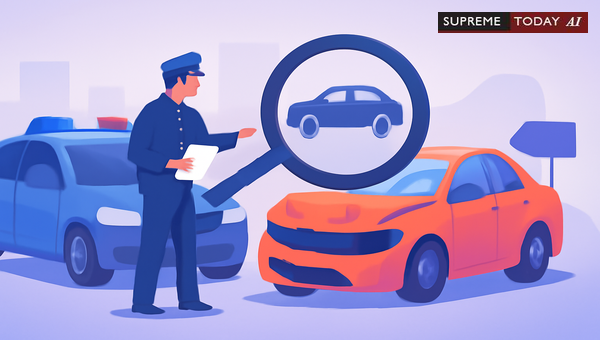
Police Duty: Identify Unknown Vehicles in Accidents?
Road accidents involving unknown vehicles—often called hit-and-run cases—can leave victims devastated and seeking justice. A common frustration is when police register an FIR against an unknown vehicle but fail to trace it, hindering compensation claims. But should police identify the unknown vehicle involved in the accident? Generally, yes, they have a duty to investigate diligently, though challenges persist. This post explores legal expectations, court rulings, and practical steps under India's Motor Vehicles Act, 1988.
Note: This is general information based on case law, not specific legal advice. Consult a qualified lawyer for your situation.
Legal Context of Unknown Vehicle Accidents
In accidents where the offending vehicle's details are unclear, police typically file a First Information Report (FIR) against unknown persons and vehicles. This is standard practice when identity isn't immediately known. For example, FIRs are often registered against unknown vehicles, which is a common practice when the identity of the vehicle is not immediately ascertainable. For instance, in one case, the FIR was lodged against unknown persons and vehicles, and the police later reported that the vehicle causing the accident was not traceable 2023 0 Supreme(Kar) 787.
However, this initial step doesn't end police responsibilities. Courts emphasize thorough investigations to identify the vehicle, as failure can derail prosecutions and Motor Accident Claims Tribunal (MACT) proceedings. The police must conduct a thorough investigation to identify the vehicle. In several cases, it was noted that the police failed to trace the vehicle involved in the accident, leading to challenges in the prosecution of the case 2022 0 Supreme(Ori) 549 2023 0 Supreme(Kar) 787.
Police Investigation Duties and Evidence Collection
Police are expected to gather critical evidence promptly:
- Witness Statements: Eyewitness accounts can pinpoint vehicles later, even if not noted in the initial FIR.
- Mechanical Reports: These verify damage consistency. Mechanical reports indicated no damage to the motorcycle in question, suggesting it was not involved in the accident 2023 0 Supreme(Raj) 346.
- Physical Evidence: Skid marks, debris, or CCTV footage.
- Owner Cooperation: Post-FIR identifications via owners or witnesses, though delays may suggest collusion 2020 0 Supreme(Kar) 1875 2017 0 Supreme(Mad) 4192.
Courts have directed police action: Courts have emphasized the importance of police taking steps to ascertain the truth of the matter when an accident involves an unknown vehicle. For instance, a court directed the police to consider representations from victims and take necessary steps to identify the responsible party 2016 0 Supreme(Mad) 617.
In hit-and-run scenarios, FIRs against unknowns are routine: Merg intimation regarding the unnatural death was registered against an unknown vehicle. An FIR was thereafter lodged against an unknown vehicle 2026 Supreme(Online)(MP) 797. Yet, from examination of record especially abovesaid oral and documentary evidenced, it is crystal clear in the first place that as per FIR Ex.PC the accident had occurred... due to rash or negligent driving of unknown vehicle, by unknown driver 2025 0 Supreme(P&H) 187.
Proving Vehicle Involvement: Balance of Probabilities
Unlike criminal trials requiring proof beyond reasonable doubt, MACT claims use a preponderance of probabilities standard. In motor accident claims, the standard of proof is on the balance of probabilities, not beyond a reasonable doubt, distinguishing it from criminal proceedings 2025 0 Supreme(P&H) 187.
The absence of a registration number in the FIR doesn't bar later proof: The absence of a vehicle registration number in the FIR does not preclude the possibility of establishing the vehicle's involvement later through witness testimony or other evidence. Courts have ruled that the lack of immediate identification does not negate the possibility of proving involvement through subsequent investigations 2017 0 Supreme(Bom) 2228 2017 0 Supreme(Mad) 4192.
Claimants must still provide cogent evidence. In one case, discrepancies led to dismissal: the entire version of the police that this auto was involved in the accident... proved to be false 2024 0 Supreme(Telangana) 3. Courts scrutinize for fabrication, especially with inconsistent testimonies or police collusion claims.
Insurance companies often challenge involvement: Except for a bare assertion that vehicle has been wrongly involved, insurance company which has setup a plea of collusion has done nothing to make good its case 2025 2 Supreme 56. Claimants bear the initial onus, but once met, insurers must rebut.
Challenges and Judicial Interventions
Common hurdles include:- Nighttime or Fleeing Drivers: In road accidents, particularly those occurring at night or where the driver along with offending vehicle flees, it is not uncommon that FIR is registered initially against an unknown 2025 0 Supreme(P&H) 187.- Delayed Identifications: Raises collusion suspicions 2020 0 Supreme(Kar) 1875.- Inadequate Probes: How the police could trace the vehicle involved in the accident is not mentioned Though the owner and driver... have not supported the case of the claimant 2017 0 Supreme(Kar) 752.
Courts intervene: In appeals, they've remanded cases for re-assessment, noting tribunals err by demanding criminal-level proof 2025 0 Supreme(P&H) 187. One ruling restored an award, holding claimants proved involvement on probabilities, with police charge-sheets supporting 2025 2 Supreme 56.
Vehicle owners/drivers denying involvement must be weighed, but witness credibility is key: No cogent reason has been assigned... for discarding evidence of Dheeraj Kumar 2023 0 Supreme(Guj) 337.
Recommendations for Victims and Claimants
To strengthen your case:- Demand Thorough Investigation: Insist on witness interviews, mechanical exams, and evidence preservation immediately.- Document Everything: Photos, medical records, FIR copies.- Seek Judicial Directives: File petitions if police lag 2016 0 Supreme(Mad) 617.- Engage Legal Counsel: Challenge inadequacies or push further probes. Engage legal counsel to challenge any inadequacies in police investigations or to file petitions for further investigation if necessary.- Alternative Claims: For own vehicle damage, consider insurer ombudsman, not always MACT 2020 0 Supreme(Telangana) 53.
In Section 163A claims, ensure no tort-feasor issues; legal heirs can't claim against their vehicle's insurer if deceased was at fault 2021 0 Supreme(Mad) 260 2021 0 Supreme(Mad) 140.
Conclusion and Key Takeaways
Police generally must strive to identify unknown vehicles in accidents to uphold justice and enable compensation. While initial unknown FIRs are acceptable, diligent probes—bolstered by evidence like witnesses and reports—are crucial. Courts support victims via lenient proof standards but demand reliability.
Key Takeaways:- Police duty extends beyond FIR; trace vehicles proactively 2022 0 Supreme(Ori) 549.- Prove claims on balance of probabilities 2025 0 Supreme(P&H) 187.- Use courts for enforcement if needed 2016 0 Supreme(Mad) 617.- Act fast: Document, investigate, litigate.
References: 2023 0 Supreme(Kar) 787 2022 0 Supreme(Ori) 549 2023 0 Supreme(Raj) 346 2016 0 Supreme(Mad) 617 2017 0 Supreme(Bom) 2228 2017 0 Supreme(Mad) 4192 2020 0 Supreme(Kar) 1875 2024 0 Supreme(Telangana) 3 2026 Supreme(Online)(MP) 797 2025 0 Supreme(P&H) 187 2025 2 Supreme 56 2023 0 Supreme(Guj) 337 2021 0 Supreme(Mad) 260 2021 0 Supreme(Mad) 140 2020 0 Supreme(Telangana) 53 2017 0 Supreme(Kar) 752 2017 0 Supreme(P&H) 74.
Stay safe on roads and informed on rights!
#HitAndRunLaw #MotorAccidentClaims #PoliceInvestigation