Searching Case Laws & Precedent on Legal Query.....!
Analysing the retrieved Case Laws
Scanned Judgements…!



Searching Case Laws & Precedent on Legal Query.....!
Analysing the retrieved Case Laws
Scanned Judgements…!
Oral Sale Not Valid for Conveying Title - The court emphasized that an oral sale does not transfer valid title to the property. In the case, the defendant's claim based on oral sale was rightly rejected, and the courts upheld the plaintiffs' documentary proof of title and possession. The defendant failed to establish adverse possession or continuous enjoyment, leading to the conclusion that proof of title is essential for possession rights. ["2021 Supreme(Online)(MAD) 19779"]
Title and Possession Must Be Proven for Decree of Possession - Courts require clear proof of title to grant possession or decree thereof. In cases where title is not established, mere possession or long occupancy cannot substitute for legal ownership. For example, in one case, the Civil Court did not accept the title of the petitioner’s father-in-law, and the property was found to belong to the government, underscoring the importance of proof of title. ["Maheswari vs The Thasildar - Madras"], ["2021 Supreme(Online)(MAD) 51726"], ["2021 Supreme(Online)(Mad) 79914"]
Patta and Title Are Distinct - A Patta (land grant) does not confer ownership or title but merely confirms possession. Even if possession is confirmed, without valid title, the rights to continue occupying the land are limited. Documents like relinquishment deeds, if not registered or proved, do not affect the title or possession rights. Courts have rejected such documents when they lacked registration or legal proof. ["2025 Supreme(Online)(Mad) 44146"]
Long Possession Alone Is Insufficient for Adverse Possession - Adverse possession requires proof of possession against the true owner, not merely long-term occupancy. Courts have held that long possession without establishing adverse intent or legal right does not create title. Defendants' possession, if not proved to be unauthorized or adverse, cannot be deemed as adverse possession. ["IND00085220"], ["2025 Supreme(Online)(Mad) 37693"]
Failure to Prove Title Leads to Rejection of Decree for Possession - Courts consistently dismiss suits where claimants fail to prove ownership or title, even if they are in possession. Evidence such as documents, registered deeds, or legal proof of title is crucial. Without such proof, courts do not grant decrees of possession or declaration of ownership. ["2021 Supreme(Online)(MAD) 19779"], ["2021 Supreme(Online)(Mad) 79914"], ["2025 Supreme(Online)(Mad) 37693"]
Suit for Declaration and Injunction Without Possession Claim May Be Barred - Under the law, a suit seeking declaration of title and injunction without a prayer for recovery of possession may not be maintainable if the defendant is in actual possession. Such suits can be barred by res judicata if previous judgments establish possession rights, emphasizing the necessity of explicitly claiming possession in legal proceedings. ["2025 0 Supreme(Ker) 2296"]
Analysis and Conclusion:The main insight from these sources is that proof of valid title is essential for granting a decree of possession. Mere long possession or oral agreements are insufficient unless accompanied by legal proof of ownership. Courts consistently reject claims based solely on possession without establishing title, especially when documents are unregistered, or the title is doubtful. Therefore, if the title is not proved, a decree of possession cannot be granted, underscoring the importance of establishing clear legal ownership before seeking possession or related relief.
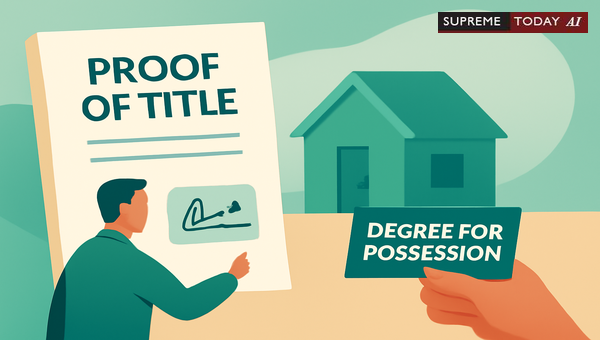
In property disputes, securing a can make or break a claimant's case. Imagine fighting for your land only to lose because you couldn't substantiate ownership. A fundamental question arises: If title is not proved, can a decree of possession be granted? The answer, rooted in established legal principles, is generally no. Courts consistently emphasize that possession follows title, and without robust proof, relief is denied. This blog delves into this principle, supported by case law and practical insights, to help you navigate such claims effectively.
Note: This article provides general information based on legal precedents and is not a substitute for professional legal advice. Consult a qualified lawyer for your specific situation.
Under Indian civil law, particularly the , a plaintiff seeking possession must first establish title to the property. Possession without title is precarious, and courts will not grant a decree for recovery if ownership isn't proven. This principle ensures that only rightful owners reclaim dispossessed property.
As established in key rulings, a cannot be granted if the plaintiff fails to prove their title to the property. The legal principle established is that possession is contingent upon the proof of title. Courts have held that when the plaintiff had failed to prove his title, a decree for recovery of possession cannot be granted 2014 0 Supreme(Mad) 2099.
This isn't merely procedural; it's substantive. Without title, the suit falters at the threshold.
Indian jurisprudence is replete with precedents reinforcing this rule. Here's a breakdown:
Mandatory Proof of Title: Plaintiffs must demonstrate ownership through documents like sale deeds, mutation entries, or inheritance proofs. Failure leads to dismissal. In one instance, the court ruled that title must be proven for possession decrees 2014 0 Supreme(Mad) 2099.
Limitations of Declaratory Decrees: A mere declaration of rights doesn't entitle execution for possession. A decree for mere declaration cannot be executed for recovery of possession. The courts have ruled that if a suit is based on an earlier that is contrary to law, the plaintiff cannot seek possession based on that decree 1991 0 Supreme(Mad) 910. This highlights the need for a comprehensive suit combining declaration and possession.
Title Trumps Possession: Once title is proven, possession cannot be denied unless the defendant establishes . The courts have emphasized that possession cannot be denied to a plaintiff who has proved their title over the suit property. If the plaintiff establishes their title, a decree for recovery of possession must be granted unless the defendant proves a case of
Md. Arbesh Ali VS Md. Aber Ali - Current Civil Cases (2015)
.Require Specific Grounds: For eviction or ejectment, grounds like tenancy breaches must be substantiated. In cases of ejectment, specific grounds must be proved for the court to grant a decree for eviction. If the grounds are not substantiated, the decree cannot be issued 1981 0 Supreme(Raj) 164.
These cases underscore a consistent judicial stance: title is non-negotiable.
Defendants often counter with claims—open, continuous, and hostile occupation for 12 years (or 30 for government land). However, they bear the burden of proof.
Md. Arbesh Ali VS Md. Aber Ali - Current Civil Cases (2015)
.Additional cases echo this: Defendants couldn't establish title or enjoyment, leaving plaintiffs' appeals open to prove ownership
. Similarly, the was unable to accept the title of the petitioner's father-in-law despite admitted possession, as property belonged to the government 2021 Supreme(Online)(MAD) 9380.
Relying on prior declaratory decrees can backfire if they're unenforceable for possession. For instance, under customary laws like the , amendments retrospectively barred suits for possession based on old declarations. They cannot be granted even on the basis of earlier decree 2010 0 Supreme(P&H) 1569 2010 0 Supreme(P&H) 1331. The took away rights to enforce such customary recoveries, rendering decrees non-binding.
In another context, revenue proceedings don't delve into title validity, so civil suits remain essential 2018 0 Supreme(Guj) 928. Even family partitions or gifts require fresh title proof if challenged late.
Prompt action against encroachments preserves rights. When at the time, the defendant attempted to construct a toilet... the plaintiff sent advocate notice dated wherein he requested to vacate the encroached area. Hence, it would necessary to grant a decree for recovery of possession 2022 0 Supreme(Mad) 185. Long, uninterrupted possession claims fail without 12-year proof, as seen in dismissed second appeals where encroachment was recent.
To strengthen your case:- Gather Comprehensive Evidence: Title deeds, revenue records, tax receipts, and witness testimonies are vital. Ensure chain of title is unbroken.- File Appropriately: Avoid standalone declaratory suits if possession is sought; combine prayers.- Counter Defenses: Prepare for by documenting interruptions like notices.- Consider Appeals: If title is contested, appellate courts may allow fresh evidence
.- Seek Separate Suits if Needed: Post-declaration, file for possession if prior decree lacks teeth.
In possession suits without declaration prayers, maintainability hinges on clear title evidence 2022 0 Supreme(Mad) 185.
The legal landscape is clear: without proving title, a remains elusive. Courts prioritize ownership verification to prevent unjust evictions, balancing plaintiff rights with defendant protections like .
Key Takeaways:- Prove title robustly or risk dismissal 2014 0 Supreme(Mad) 2099.- Declaratory decrees alone won't deliver possession 1991 0 Supreme(Mad) 910.- demands strict proof from defendants
Md. Arbesh Ali VS Md. Aber Ali - Current Civil Cases (2015)
2024 0 Supreme(P&H) 789.- Act swiftly against encroachments 2022 0 Supreme(Mad) 185.For property owners facing dispossession, understanding these nuances can guide strategy. Always engage legal experts to tailor approaches to your facts.
References:- 2014 0 Supreme(Mad) 2099 1991 0 Supreme(Mad) 910
Md. Arbesh Ali VS Md. Aber Ali - Current Civil Cases (2015)
1981 0 Supreme(Raj) 164- 2021 Supreme(Online)(MAD) 93802024 0 Supreme(P&H) 789 2022 0 Supreme(Mad) 185 2010 0 Supreme(P&H) 1569 2010 0 Supreme(P&H) 1331 2018 0 Supreme(Guj) 928 #PropertyLaw, #TitleProof, #PossessionDecree


The oral sale is not valid to convey title to the property in favour of defendant. In the present case, the defendant has not pleaded adverse possession. The defendant's claim regarding tittle on the basis of oral sale has been rightly rejected by the trial Court and the appellate Court. ... Having regard to the first question of law, it is not relevant for want of pleadings in the written statement. The ....

Though the petitioner's possession was admitted before the Civil Court, the Civil Court was unable to accept the tittle of the petitioner's father-in-law. In the second suit filed by the petitioner's father-in-law, it was held that the property belongs to Government. ... and enjoyment of the suit property and obtained a decree dated 10.07.1998. ... The petitioner failed to establish her tittle before the Civil Court. ... ....
Ex.A1 overrides grant of patta in favour of the first defendant. A Patta would not grant any title or right to continuously occupy the land. ... The learned counsel stated that since Patta had been granted to the appellant herein and possession has been confirmed, this Court can grant the relief of declaration of title. The suit had been filed for declaration of tittle and for recovery ....

Since the parent document was not proved, there arises a doubt as to the title of the documents and on the factual position also, the above two substantial questions of law do not arise for consideration. ... in O.S.No.871 of 1994 and certified copy of partition deed dated 04.05.1982 respectively and in view of the placing of the title by the defendant, both the Courts below have concurrently held that the defendant has proved#HL_....
While decreeing said suit, the Civil Court has held that the petitioner and the other defendants have not established their tittle or enjoyment. ... It is open to the petitioner to establish her title and possession of the property before the appellate Court. ... The Civil Court granted decree in favour of fourth respondent. The learned counsel appearing for the petitioner states that an appeal has been filed by the writ p....

The permissible possession howsoever long cannot be the basis to grant adverse possession. In fact, the adverse possession implies that it commences from and is maintained against the right. ... However, the possession of the defendants no.1 to 3 cannot be termed as unauthorized occupants entitling them to claim title on the basis of the adverse possession#HL_....
established their tittle or enjoyment. ... The Civil Court granted decree in favour of fourth respondent. ... 6.This Court is unable to find any justification to grant decreeing said suit, the Civil Court has held that the petitioner and the other defendants have not
When he failed to prove the tittle over the possession, mere long possession will not create any adverse tittle in his favour, more particularly, when the tax receipts are being issued in the name of both parties. ... Wherein it has been stated that the plaintiff is in possession of the house site measuring 3 cents in survey No.216/1. So, this will not also confer #HL....
Considering all the evidence and documents, the trial judge held that the 1st plaintiff has not proved her title over the property, but at the time of filing of the suit, she was in possession of the property and in the decree passed in O.S.No.494 of 2000, the 1st plaintiff is not a party to the proceedings ... With regard to issue No.2, though she has not proved her ti....

Specific Relief Act , 1963, is the suit for declaration and injunction without a prayer for recovery of possession maintainable in law? 2. Will not the decree in O.S No.210/2002 operate as res judicata to the plea of possession made by the plaintiff? ... In a case where admittedly the defendants 1 and 2 were found to be in possession of the plaint schedule property, without seeking for a decree....

When at the time, the defendant attempted to construct a toilet, in the property situated on the West of 17 cents, the plaintiff sent advocate notice dated 15.08.2002 wherein he requested to vacate the encroached area. Hence, it would necessary to grant a decree for recovery of possession.

In the suit, not only title to the land as Bhumidar must be proved but also the respondents bad not a tittle of title to retain possession. And respondents can allege and prove that under the very 1950 Act under which appellants became Bhumidars, the respondents have become adhivasis entitled to retain possession against the appellants. This defence was not open to them in the proceeding under Sec. 144. They need not prove title or right to be in possession.

In view of the authoritative pronouncement by the Honble Division Bench of this Court, the substantial question of law is answered in favour of the appellant. They cannot be granted decree for possession even on the basis of earlier decree. There being no contrary view except observation in referring order in Surain Singh, the view taken in Shakuntla Devi has to be followed and the finality of decree has to be held to have been taken away by operation of law and suit of the a....

They cannot be granted decree for possession even on the basis of earlier decree. The question has, thus, to be answered against the appellants and in favour of the respondents. There being no contrary view except observation in referring order in Surain Singh, the view taken in Shakuntla Devi has to be followed and the finality of decree has to be held to have been taken away by operation of law and suit of the appellants is, thus, not maintainable.

( 7 ) PLACING reliance upon a judgement of the Supreme Court in the matter of joginder Singh Sodhi vs. It was submitted that in the said case, the father had parted with possession in favour of the son and the Apex Court held that as there was no privity of contract between the landlady and the son of the tenant, the said son of the tenant was a stranger to the landlady and he was liable to be evicted. Amar Kaur [ (2005) 1 S. C. C. 31], it was submitted that if parting of possession ....


An indispensable Tool for Legal Professionals, Endorsed by Various High Court and Judicial Officers
Please visit our Training & Support
Center or Contact Us for assistance

Scan Me!
India’s Legal research and Law Firm App, Download now!


For Daily Legal Updates, Join us on :



 Back to top


