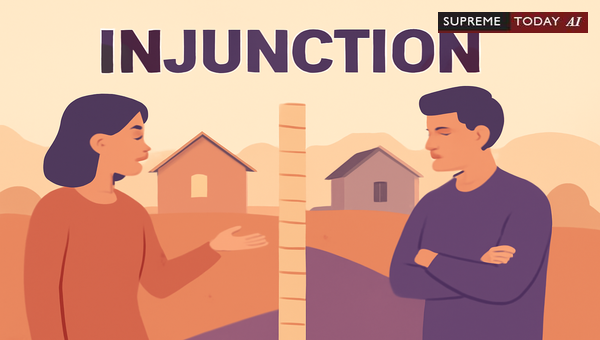
Boundary and Boundary Obliteration - A fundamental requirement for defining boundaries is that there must have been an ascertainable common boundary that previously existed physically on the ground, which has subsequently been obliterated. Without establishing the existence and obliteration of a common boundary, claims for boundary definition or disputes are not maintainable ["
SOMAWATHIE AND OTHERS VS. ILLANGAKOON
"] ["SOMAWATHI AND 5 OTHERS VS. ILANGAKOON
"].Boundary Disputes and Injunctions - Courts generally do not grant injunctions if the plaintiff can be adequately compensated through damages. The principle from both English Equity and Roman-Dutch law emphasizes that injunctions are not granted where damages suffice to remedy the harm. For example, a court refused an injunction where the defendant's actions could be compensated by damages, indicating that boundary disputes do not automatically warrant injunctions unless specific conditions are met ["
SEGO MADAR v. MAKEEN
"].Boundary Fixation and Court Procedure - Suits for fixation of boundaries can be maintained without a prayer for recovery of possession, especially when incidental rights like erecting boundary walls are involved. Courts have exercised inherent powers to prevent lawlessness by fixing boundaries even if the original suit did not explicitly seek boundary fixation, highlighting the flexibility in such proceedings ["2024 0 Supreme(Ker) 92"] ["2024 0 Supreme(Ker) 1707"].
Boundary Identification and Evidence - Proper identification of boundaries requires clear evidence of physical markers or natural boundaries. Courts have dismissed claims where boundaries were not properly identified or where the boundary was shown to be incorrectly depicted in plans. The physical presence of boundary markers like stone pillars or natural features is crucial for establishing boundaries ["2024 0 Supreme(Ker) 1707"] ["2024 0 Supreme(Telangana) 1004"].
Boundary Disputes and Ownership - When boundary boundaries are disputed, courts require that the boundary's existence and obliteration be proven. If the boundary is not physically ascertainable or has not been obliterated, claims for boundary definition or injunctions are unlikely to succeed. Furthermore, in cases where boundaries are disputed, courts have refused to grant injunctions without proper proof of boundary obliteration or prior existence ["
MARIA et al. v. FERNANDO et al.
"] ["2025 Supreme(Online)(Tel) 39724"].Boundary Demarcation Procedures - Demarcation of boundaries involves formal procedures, including notices and hearings, to ensure fair resolution. Revenue authorities and courts follow prescribed rules to facilitate boundary settlement, and disputes are often resolved through survey and demarcation orders that respect existing physical markers and legal rights ["2023 0 Supreme(All) 1223"].
Injunctions and Boundary Disputes - Injunctions are granted only when the plaintiff's title is clear and the boundary is properly identified. Reliefs such as mandatory or prohibitory injunctions require a demonstration that the boundary is ascertainable and that the defendant's actions are unlawful or encroach upon the plaintiff's property ["2022 Supreme(Online)(MAD) 21446"] ["2025 0 Supreme(Ker) 289"].
Analysis and Conclusion:The core principle derived from these sources is that Without boundary, no injunction can be granted. Courts consistently emphasize that for an injunction or any boundary-related relief to be granted, there must be clear evidence of an existing, ascertainable, and physically identifiable boundary that has been obliterated or disputed. If such boundary evidence is absent or unproven, courts are reluctant to grant injunctions, especially if damages can suffice. Proper procedures, including survey and demarcation, are essential before courts can effectively resolve boundary disputes or grant reliefs. This underscores the importance of physical markers and clear evidence in boundary litigation, aligning with the legal maxim that boundary disputes require concrete proof of boundary existence and obliteration before injunctive relief is appropriate.
References:- ["
SEGO MADAR v. MAKEEN
"]- ["2024 0 Supreme(Ker) 1037"]- ["2025 Supreme(Online)(Tel) 39724"]- ["2024 0 Supreme(Ker) 1707"]- ["2024 0 Supreme(Ker) 92"]- ["2023 0 Supreme(All) 1223"]- ["2022 Supreme(Online)(MAD) 21446"]- ["MARIA et al. v. FERNANDO et al.
"]- ["2024 0 Supreme(Telangana) 1004"]- ["2025 0 Supreme(Ker) 289"]