Searching Case Laws & Precedent on Legal Query.....!
Scanned Judgements…!



Searching Case Laws & Precedent on Legal Query.....!
Scanned Judgements…!
Nivritti Pandurang Nale VS Uttam Ganu Nale - Current Civil Cases
"] ["2025 0 Supreme(Bom) 749"] ["2025 Supreme(Bom) 635"]Nivritti Pandurang Nale VS Uttam Ganu Nale - Current Civil Cases
"] ["2025 0 Supreme(Bom) 749"] ["2025 Supreme(Bom) 635"]; None of the documents on record indicate that defendant no. 2’s name was entered as Pandurang’s adopted son during Pandurang’s lifetime. ["Nivritti Pandurang Nale VS Uttam Ganu Nale - Current Civil Cases
"] ["2025 0 Supreme(Bom) 749"] ["2025 Supreme(Bom) 635"]Nivritti Pandurang Nale VS Uttam Ganu Nale - Current Civil Cases
"] ["2025 0 Supreme(Bom) 749"] ["2025 Supreme(Bom) 635"]Nivritti Pandurang Nale VS Uttam Ganu Nale - Current Civil Cases
"] ["2025 0 Supreme(MP) 284"] ["2023 Supreme(Online)(Jhk) 8684"]; Thus, Concrete evidence cannot be expected holds for long-standing, uncontested adoptions where conduct suffices over formal proof. ["2025 0 Supreme(MP) 284"]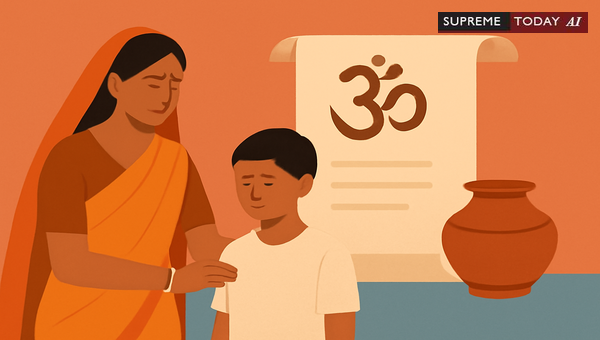
In family disputes over property inheritance, a common question arises: Concrete evidence cannot be expected to prove that he is an adopted son. This is particularly relevant in Indian law under Hindu adoption principles, where direct proof like eyewitness accounts of ceremonies may be unavailable, especially for ancient adoptions. But does this mean such claims fail? Not necessarily. Courts often rely on circumstantial evidence, long-term family recognition, and consistent conduct to validate adoptions. This blog post breaks down the legal framework, key judicial findings, and practical insights to help you understand this nuanced area.
Note: This is general information based on case law and statutes. It is not legal advice. Consult a qualified lawyer for your specific situation.
Under Hindu law, particularly for adoptions predating or governed by , concrete or direct evidence—such as eyewitness testimony of the 'giving and taking' ceremony—is not always expected or required, especially in cases of ancient or long-past adoptions. 1970 0 Supreme(SC) 159 Instead, adoption can be inferred from a , long recognition by family and community, and circumstantial evidence demonstrating the adoptee was treated as a son. This raises a strong presumption of validity, provided the evidence is consistent, probable, and free from suspicion. However, the claimant bears a heavy burden to prove the . 1982 0 Supreme(SC) 217
For instance, courts recognize that in the case of all ancient transactions, it is but natural that positive oral evidence will be lacking. Passage of time gradually wipes out such evidence. 1970 0 Supreme(SC) 159 Human affairs are judged on probabilities, and insisting on rigid proof would render justice impossible in old cases.
Indian courts, applying Hindu law principles, emphasize practicality. In judging adoption claims, the lapse of time between the alleged adoption and the challenge is crucial. The most compelling evidence is often that the adoptive father held out the person claiming to have been adopted as his son; the latter treated the former as his father and their relations and friends treated them as father and son. 1970 0 Supreme(SC) 159 This long creates a strong presumption.
A landmark view holds: Although the person who pleads that he had been adopted is bound to prove his title as adopted son, as a fact yet from the long period during which he had been received as an adopted son, every allowance for the absence of evidence to prove such fact was to be favourably entertained.
Maremmanahalli Nariyappa VS Kadirempalli Thippaiah
2014 0 Supreme(AP) 1208Adoption need not always tie to a distinct and specified occasion. It may be inferred from conduct inconsistent with any other supposition, bolstered by publicity. But in either case publicity must be given to the relationship, and it is evident that the amount of proof of publicity required will be greater in cases of the latter category. 1917 0 Supreme(SC) 44 Examples include pre-dispute documents or unchallenged repute.
Despite allowances, the claimant must prove both factum and validity with reliable evidence: free from all suspicion of fraud and so consistent and probable as to give no occasion for doubting its truth. 1982 0 Supreme(SC) 217 Mere self-serving statements post-dispute fail without corroboration: The statements during the were all after the disputes arose... being self-serving claims... in the absence of any cannot be taken to be conclusive evidence. 2003 1 Supreme 4
This evidentiary flexibility primarily applies to ancient adoptions. For recent ones, especially post- under the (HAMA), stricter proof is demanded.
Essential ceremonies required: The physical act of giving and receiving is absolutely necessary... the natural parent shall hand over the adoptive boy and the adoptive parent shall receive him. 1961 0 Supreme(SC) 125 Failure to prove this, consent of wife/mother, or age compliance often dooms claims. 2024 0 Supreme(Chh) 87 2023 0 Supreme(Chh) 146 In one case, the court dismissed a suit as plaintiffs failed to prove the ... including the age of the adopted person, consent of the mother. 2024 0 Supreme(Chh) 87
Customary adoptions: Once a custom is judicially recognized, it need not be re-proved. 1991 0 Supreme(SC) 39 But performance of ceremonies must still be established. 2023 0 Supreme(Kar) 342 A court noted: Adoption deed or registered document is not must to prove adoption – If conditions of valid adoptions... are established it is sufficient. Yet, lack of evidence on giving/taking and consents led to dismissal. 2023 0 Supreme(Kar) 342
Post-HAMA strictness: Multiple cases highlight failures: No proof of actual giving/taking (Sections 7, 11(vi)), un-rebutted denials by natural mother, or insufficient evidence like mutation entries post-death. 2022 0 Supreme(Raj) 2794 2023 0 Supreme(Raj) 331 2024 0 Supreme(Mad) 889 In a motor accident claim, mere mutation after death was of no value without proving adoption under Sections 6, 11. 2023 0 Supreme(Raj) 331
Other hurdles: Self-serving documents, unrebutted denials, or missing parties (e.g., daughters) cast doubt. 2023 0 Supreme(Chh) 146 2023 0 Supreme(Mad) 1025 For females pre-HAMA, custom proof was often lacking. 2001 0 Supreme(Mad) 532
If claiming an ancient adoption without direct evidence:- Gather circumstantial proof: School records, invitations, witness testimonies of long recognition.- Highlight unchallenged repute: Treatment as son by family, tenants, community.- For recent/HAMA adoptions: Secure witnesses to ceremonies, consents, and register if possible (though not always mandatory). 2023 0 Supreme(Kar) 342
Courts apply presumptions judiciously, forming a consistent mosaic of evidence. In property suits, file for declaration of adoption status if disputed. 2010 0 Supreme(Mad) 1896
Understanding these principles can guide inheritance claims effectively. For tailored advice, reach out to a family law expert.
#HinduAdoption, #ProofOfAdoption, #IndianFamilyLaw



Debi Prasad, defendant no. 1 therein was neither able to establish the custom pleaded by him nor was able to prove actual adoption by adducing satisfactory evidence; however, considerable evidence was produced to prove that for a quarter of a century, he was treated as an adopted son. ... (d) The documents produced on record by the defendants to support adoption cannot be accepted as valid proof in the absence of other cogent evidence to show that....

Debi Prasad, defendant no. 1 therein was neither able to establish the custom pleaded by him nor was able to prove actual adoption by adducing satisfactory evidence; however, considerable evidence was produced to prove that for a quarter of a century, he was treated as an adopted son. ... (d)The documents produced on record by the defendants to support adoption cannot be accepted as valid proof in the absence of other cogent evidence to show that de....

Debi Prasad, defendant no. 1 therein was neither able to establish the custom pleaded by him nor was able to prove actual adoption by adducing satisfactory evidence; however, considerable evidence was produced to prove that for a quarter of a century, he was treated as an adopted son. ... (d)The documents produced on record by the defendants to support adoption cannot be accepted as valid proof in the absence of other cogent evidence to show that de....

A valid adoption once made cannot be cancelled by the adoptive father or the other parties thereto, nor can the adopted son renounce his status as such and return to his family of birth. ... PW 3 also stated in her evidence that the appellant was not adopted by the respondent and her husband. Therefore, the appellant had failed to prove that she had been adopted by the respondent and her husband Narasimhulu Naidu.” ... It is well settled that in the absence of pleadi....

to be the adopted son of Sant Singh and Ram Pyari. ... In the instant case, the statement of the appellant/mother remained un-rebutted that she has not consented to such giving of son in adoption and further says that the ceremony of actual adoption never happened. There is no evidence on behalf of defendant No. 1, the son, to show that he was adopted. ... As per the defence, defendant No. 1 claimed to be adopted son. Being the son ....

PW 3 also stated in her evidence that the Appellant was not adopted by the Respondent and her husband. Therefore, the Appellant had failed to prove that she has been adopted by the Respondent and her husband Narasimhulu Naidu.’ 15. ... The trial court, in order to decide the suit for permanent injunction and counter claim, framed issue No.1 as to whether plaintiff was adopted by defendant and her husband as per hindu rites and plaintiff is adopted son of defendant? ......

adopted son of Kamalachi and Paul Nadar and the plaintiff has also failed to prove that Ex.A1 settlement deed is a true and a valid document. ... As the initial burden of proof to prove the suit claim is vested with the plaintiff and the plaintiff in the instant case has not discharged his initial burden as he has failed to prove through oral and documentary evidence that he is a legally adopted son of Kamalachi and he has also failed to remove ... H....
PW 3 also stated in her evidence that the appellant was not adopted by the respondent and her husband. Therefore, the appellant had failed to prove that she had been adopted by the respondent and her husband Narasimhulu Naidu.” 34. ... Insofar as the prayer is concerned, her specific pleading was that there was no adoption and the plaintiff cannot claim the status of an adopted son. The 2nd defendant also filed a separate written statement which was adopted#....

Cases in which statement of relevant fact by person who is dead or cannot be found, etc., is relevant. – Statements, written or verbal, of relevant facts made by a person who is dead, or who cannot be found, or who has become incapable of giving evidence, or whose attendance cannot be procured without ... It is the act of adoption and not the adoption deed which confers the status of the adopted son. ... A perfectly valid adoption deed can be made without an adoption deed and any statu....
So far as the documentary evidence is concerned, the claimant has produced a Jamabandi (Exhibit-13) indicating Kasana Ram as the adopted son of deceased Smt. Gigi. ... Upon perusal of the evidence and other material available on the record of the Tribunal, in my opinion, the appellant has miserably failed to prove his status as an adopted son/legal heir of the deceased. 27. ... Gigi was transferred in the appellant's name, and simply because no formal adoption deed wa....
Although the person who pleads that he had been adopted is bound to prove his title as adopted son, as a fact yet from the long period during which he had been received as an adopted son, every allowance for the absence of evidence to prove such fact was to be favourably entertained.” “The burden of proving satisfactorily that he was given by his natural father and received the adoptive father as his adoptive son is on the alleged adopted son.

(i) In para 9 of the judgment, it is held as under: "The burden of proving satisfactorily that he was given by his natural father and received the adoptive father as his adoptive son is on the alleged adopted son. In para 10 of the judgment, it is held as follows: "In the case of all ancient transactions, it is but natural that positive oral evidence will be lacking. Although the person who pleads that he had been adopted is bound to prove his title as adopted son, as a fact yet from the long period during which he had been received as an adopted son, every allowance for the absenc....
This burden of proving satisfactorily that he was given by his natural father and received by the adoptive father as his adoptive son is on the alleged adopted son. But although the person who pleads that he had been adopted is bound to prove his title as adopted son, as a fact yet from the long period (nearly 54 years in this case) during which he had been received as an adopted son, every allowance for the absence of evidence to prove such fact is to be favourably entertained. In the case of a Hindu, long recognition as an adopted son, raises a strong presumption in favou....
Further, with respect to the same Dhargah, number of suits have been filed earlier and decisions have been rendered by the Courts. As early as in the year 1956 in O.S.No.273/56 the same rights were agitated; and again in O.S.No.550/1985, the very same point that a Muslim woman cannot perform any religious rites in the Dhargah was agitated. Therefore, he cannot claim any right as an adopted son.

Although the person who pleads that he had been adopted son, as a fact yet from the long period (nearly 54 years in this case) during which, he had been received as an adopted son, every allowance for the absence of evidence to prove such fact is to be favourably entertained."


An indispensable Tool for Legal Professionals, Endorsed by Various High Court and Judicial Officers
Please visit our Training & Support
Center or Contact Us for assistance

Scan Me!
India’s Legal research and Law Firm App, Download now!


For Daily Legal Updates, Join us on :



 Back to top


