Searching Case Laws & Precedent on Legal Query!
Scanned Judgements…!



Searching Case Laws & Precedent on Legal Query!
Scanned Judgements…!
The status of a trust as public is often determined by its purpose, beneficiaries, and whether public donations or offerings are received. For example, a temple used by a sect or open to the public can be deemed a public trust ["1965 0 Supreme(J&K) 31"], ["2023 0 Supreme(Pat) 1012"]].
Private Trust:
For trusts, jurisdiction also depends on whether the suit involves questions of public interest, breach of trust, or scheme settlement, which may require filing in civil courts empowered for such matters ["2024 0 Supreme(All) 1362"], ["2023 0 Supreme(Mad) 1022"]].
Analysis of Jurisdiction in Trust Disputes:
In cases involving religious trusts, authorities like the Religious Trust Board may initially decide whether a trust is public or private, but such decisions are subject to judicial review if contested ["2023 0 Supreme(Pat) 645"], ["2023 0 Supreme(Pat) 1012"]].
Special Provisions:
[Suraj Kumar @ Lal Babu son of Late Babu Narayan Das @ Das Babu VS President, Bihar State Board of Religious Trusts - Patna
"], ["2023 0 Supreme(Pat) 645"]].References:- ["1965 0 Supreme(J&K) 31"]- ["2023 0 Supreme(Mad) 1022"]- ["2023 0 Supreme(Pat) 645"]- ["2023 0 Supreme(Pat) 1012"]- ["1976 0 Supreme(SC) 113"]- ["2025 0 Supreme(Raj) 2006"]- ["2024 0 Supreme(All) 1362"]- ["2024 0 Supreme(All) 1569"]
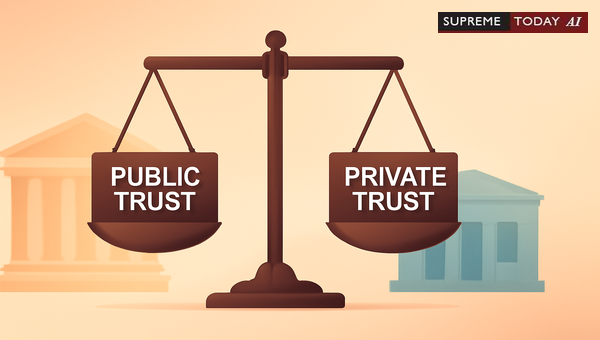
In the realm of Indian trust law, distinguishing between and is crucial, especially when determining the appropriate court for disputes. A common query arises: Differentiate between public trust and private trust and how to analyse jurisdiction of munsiff court and sub court. This blog post breaks down these concepts, drawing from statutory provisions, judicial precedents, and practical guidance to help you navigate trust-related litigation effectively.
Whether you're a trustee, beneficiary, or legal practitioner, understanding these distinctions can prevent jurisdictional errors that could derail your case. We'll explore the fundamental differences, valuation principles, and court hierarchies under the and .
The most fundamental distinction between a public trust and a private trust lies in the character of the beneficiaries for whose benefit they are created. 2020 0 Supreme(Cal) 513 2020 0 Supreme(Cal) 485
: Beneficiaries are uncertain and part of the general public. These trusts are often charitable or religious, aimed at public benefit. In public trust, beneficiaries are uncertain... Public trust and charitable trust are thus notably of equivalent descriptions. 2020 0 Supreme(Cal) 513 may invoke special provisions like , allowing suits for administration with the Advocate General's sanction. 1963 Supreme(Online)(Mad) 2 Whenever there is a public, charitable or religious trust, the jurisdiction of the court could be invoked under S.92 of the C. P. Code.
: Beneficiaries are ascertained or can be made ascertainable, typically specific individuals or families. Governed primarily by the , these do not enjoy the same public oversight. 2016 0 Supreme(Bom) 1996 For instance, civil courts retain jurisdiction to frame schemes for private temple trusts if not public.
This is undoubtedly a private trust but the Civil Courts have jurisdiction to frame a scheme for the management of the temple which is not a public trust.
often fall under state-specific acts like the , involving for permissions. 2023 0 Supreme(Guj) 101 , however, follow general civil jurisdiction rules, emphasizing the lowest competent court.
(lowest civil courts) and (next tier) handle trust matters based on territorial, pecuniary, and . establishes , which remain a single judicial unit even with multiple Munsiffs. 1974 0 Supreme(Kar) 236 When more than one Munsiff is appointed, the Court is a composite entity with multiple officers, but it remains a single judicial unit.
Multiple Munsiffs do not create separate jurisdictions; assignments are administrative. 1974 0 Supreme(Kar) 236 The division of work among Munsiffs does not create separate jurisdictions but is merely administrative.
handle higher-value suits or specific reliefs exceeding Munsiff limits.
Jurisdiction hinges on the suit's valuation, nature of relief, and trust type.
The value of the property or relief sought (e.g., declaration, injunction, partition) determines the forum. 1896 0 Supreme(Cal) 31 In trust suits over immovable property, if the value exceeds Munsiff limits, file in Sub Court or . 1896 0 Supreme(Cal) 31
The lacked jurisdiction and rightly transferred to Sub Court.
Courts emphasize proper valuation to avoid objections. 1896 0 Supreme(Cal) 31 If the suit is undervalued and the undervaluation prejudicially affects the disposal of the suit, jurisdictional objections can be raised.
cases, Munsiffs exercise special powers under . 1966 0 Supreme(Ker) 7
Differentiating public from sets the stage for jurisdiction analysis: often involve specialized oversight, while follow pecuniary norms. suit lower-value matters; handle higher stakes. Always prioritize accurate valuation to select the right forum—errors can lead to transfers or dismissals.
Key Takeaways:- : Uncertain beneficiaries, potential S.92 CPC suits. 1963 Supreme(Online)(Mad) 2- : Ascertainable beneficiaries, lowest court rule.
- Jurisdiction: Valuation-driven, single court unit. 1974 0 Supreme(Kar) 236
This post provides general insights based on statutes and case law; it is not legal advice. Consult a qualified lawyer for your specific situation, as rules may vary by state and evolve with judgments.
, 1963 Supreme(Online)(Mad) 2, 2023 0 Supreme(Guj) 101, 1929 0 Supreme(Cal) 118, 1966 0 Supreme(Ker) 7
Verify latest provisions and precedents.
#TrustLaw, #CourtJurisdiction, #PublicPrivateTrust


C.. and further that the proper court to entertain such a suit was the principal civil court of original jurisdiction or any other court empowered in that behalf by the Government within the local limits of whose jurisdiction the whole or a part of the trust was situate. ... Kaul laid great emphasis on the allegation of the defendants that the mandir was a private trust. It is very well settled that in order to determine whether a particular #HL_STAR....

Section 34 of the Trusts Act will apply only to private trust and not public trust. Since the trust was managed by the petitioner and the duties of the trust is of public interest, it cannot be characterized as private trust. ... , this Court does not hesitate to come to a conclusion that the grant is not a public but a private endowment. ... Hence, the learned trial Co....

However, it was clarified that to say that once a dispute is raised, the Board has no jurisdiction to decide whether a religious trust is public or private, and that it must abdicate its functions and go to the Civil Court, will not be justified by any Authority and will render the provisions of the ... The Two-Judges’ Bench, deciding the matter, held that when the Legislature by the Act created the Board, it also, in effect, conferred on it initial jurisdiction to decide whether a rel....

No. 9 of 1956 was filed in the Court of the Sub-Judge Mayuram, whereas suit No. 71 of 1957 was originally filed in the Court of the District Munsiff, Tiruvarur as O.S. ... In Suit No. 9 of 1956 which was filed in the Court of Sub-Judge, Mayuram, the Court framed the following issues : ... "1. Are the Pallivasal, Durgah, the burial grounds, prayer hall etc. set out in Schedule A public trusts or are they private trusts belonging to t....

18.1 However, the issue faced with by this Court is exercise of jurisdiction under Articles 226/227. ... The scope and ambit of exercise of power and jurisdiction by a High Court under Article 227 of the Constitution of India is examined and explained in number of decisions of this Court. ... Section 50 when read indicates that the suits which relate to public trusts, includes suits where a direction is sought or deemed necessary for the administration of any public ....

The order of President of the Board dated 05.12.2022 (Annexure-7), does not record any findings as to whether the trust is a public trust or a private one. ... [(u) to decide all disputes whether any trust is a public or a private trust in accordance with the definition under Section 2(1) of this Act and the decision of the Board shall remain in force until it is set aside by a competent court.] ... In accordance with the provision....
Whenever there is a public, charitable or religious trust, the jurisdiction of the court could be invoked under S.92 of the C. P. Code. ... 10A. ... Code confers jurisdiction upon a Court in matters relating to administration of public and religious charities with a view to protect the rights of the public; for this purpose it enables the Advocate General as well as the persons interested in the trust with the sanction of the Advoca....

This is undoubtedly a private trust but the Civil Courts have jurisdiction to frame a scheme for the management of the temple which is not a public trust. The Judicial Committee of the Privy Council in Pramatha Nath Mullick v. ... When the I.A was heard, defendants 1 to 3 in the suit raised a contention that the District Court did not have jurisdiction to entertain the suit and that the suit should have been filed before the Munsiff Court#H....
Aggrieved, the Religious Trust Board preferred Title Suit No. 130 of 1964/54 of 1970 which was taken up by the Court of learned Additional Sub Judge II, Patna and vide an order dated 30.08.1974, the learned Court allowed the said suit holding the same to be a Public Trust property and the concluding ... The finding of the trial Court on this point is, therefore, reversed. The authority has therefore, passed the order according to law under Section 43 of the Religious ....

The property of Jain Community/Jain Temple neither constitutes any public trust nor any such trust has been registered. Therefore, the learned Trial Court firstly was under an obligation to decide whether the Trust in question was a ‘Public Trust’ or a ‘Private Trust’. ... If the Court reaches to a conclusion that the Trust in question was a private Trust, the s....

In public trust, beneficiaries are uncertain, whereas in private trust beneficiaries are ascertained or at least can be made ascertainable. The most fundamental distinction between the private and public trust depends upon the character of the person, for whose benefit they are created. Public trust and charitable trust are thus notably of equivalent descriptions. There is, however, difference between a public trust and the private trust.

In public trust, beneficiaries are uncertain, whereas in private trust beneficiaries are ascertained or at least can be made ascertainable. The most fundamental distinction between the private and public trust depends upon the character of the person, for whose benefit they are created. Public trust and charitable trust are thus notably of equivalent descriptions. There is, however, difference between a public trust and the private trust.
These two questions read as under: “In S.A. No.274/2002, following substantial questions of law arise:(i) Whether the suit for declaration that the properties were not of the Public Trust was barred by limitation and, therefore, the impugned judgment of the first appellate Court deserves interference?” Whether the Civil Court has jurisdiction to decide the question whether a particular property is that of a Public Trust or that it is not a property of the Public Trust and belongs to individual claimant?(ii)
The contention which has been raised by counsel for the appellant regarding the expenses, diversion or control by the private people will come only when the assessment has taken place. For the purpose of trust registered and the income used is for the charitable purpose or not and whether income from public trust if it is going for any private use will negative the very object of the Trust Act which is the main intention of the legislation, is not to be considered at this stage. At the time of registration, the authority is required to look whether it is registered under the state Act or und....

The Apex Court as well as various High Courts highlighted the distinguishing features between the Private Trust and the Public Trust.


An indispensable Tool for Legal Professionals, Endorsed by Various High Court and Judicial Officers
Please visit our Training & Support
Center or Contact Us for assistance

Scan Me!
India’s Legal research and Law Firm App, Download now!


For Daily Legal Updates, Join us on :



 Back to top


