Searching Case Laws & Precedent on Legal Query.....!
Analysing the retrieved Case Laws
Scanned Judgements…!



Searching Case Laws & Precedent on Legal Query.....!
Analysing the retrieved Case Laws
Scanned Judgements…!
Standalone Motor Own Damage Policy - The policy covers only damage to the insured vehicle (typically two-wheelers) and does not extend to third-party property damage, injuries, or death. It is a self-contained policy limited to the vehicle owned by the insured, with no additional liability coverage for third parties or third-party injuries/death. ["2025 0 Supreme(Mad) 4183"]
Consequences of Policy Breach - Breach of policy conditions, such as lack of valid insurance at the time of the accident, may be considered a technical breach that does not necessarily contribute to or cause the accident. Such breaches are often deemed as non-fundamental breaches unless they increase insurer’s obligations or are linked to the cause of the accident. Penalties under the Motor Vehicles Act may not automatically result in insurer liability if breach is only technical. ["2023 0 Supreme(Ker) 690"], ["01500075000"]
Personal Accident Coverage - Under the Motor Vehicles Act, securing personal accident coverage is mandatory for vehicle owners, and this coverage cannot be waived. Deduction of amounts received from mediclaim policies for medical expenses is permissible to prevent double compensation. Personal accident policies may provide coverage for owners/drivers, and claims under such policies are governed by policy terms, not just statutory provisions. ["2023 0 Supreme(Ker) 1019"], ["2025 0 Supreme(Ker) 2517"]
Liability and Court Proceedings - Courts can pass awards for compensation and order 'pay and recovery' against insurers if policy conditions are violated, but such recovery is contingent on the guarantee that courts’ awards are recoverable from liable parties. Breaches of policy conditions, unless fundamental or contributory to the accident, generally do not absolve insurers from liability, especially if the breach is only technical. ["
Oriental Insurance Co. Ltd. vs Krishna Batra - Delhi
"], ["2023 0 Supreme(Del) 1846"]Insurance and Motor Accident Victims - It is mandatory for vehicle owners to have valid insurance covering third-party risks. In cases where insurance is invalid or absent, victims often face difficulties in obtaining compensation. The law emphasizes the importance of insurance as a protective measure for accident victims, and courts often hold that insurance coverage is essential for liability. ["2025 0 Supreme(Mad) 2571"], ["2023 0 Supreme(Mad) 523"]
Analysis and Conclusion:A standalone motor damage policy limits coverage to the insured vehicle's damages and does not inherently include third-party liability, which is crucial for motor accident cases. Breaching policy conditions does not automatically negate liability unless such breaches are fundamental or causally linked to the accident. Mandatory personal accident coverage and insurance compliance are vital for ensuring victims’ rights to compensation. Courts have the authority to enforce 'pay and recovery' orders but only when policy breaches are not merely technical or incidental. Overall, the consequences of a standalone policy in motor accident cases hinge on the nature of policy coverage, compliance with legal mandates, and the causal link between breaches and the accident.
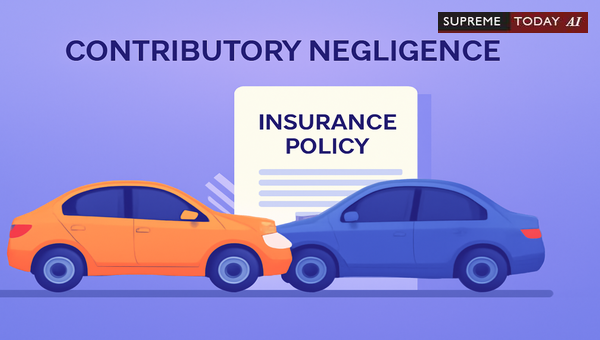
In the chaotic aftermath of a motor accident, determining fault is crucial—especially when comes into play. Both drivers sharing blame can drastically affect compensation claims, insurance payouts, and legal liabilities. But what do rulings say about this in the context of India's ? This post explores key judicial insights, focusing on how intersects with insurance coverage, particularly under versus comprehensive ones. We'll break down precedents, policy limitations, and practical advice.
Note: This is general information based on judicial precedents and not specific legal advice. Consult a qualified lawyer for your situation.
occurs when the injured party's own actions partially contribute to the accident, reducing their claimable compensation proportionally. Courts assess the degree of fault—say, 30% contributory—for both parties. In motor accidents, this principle influences not just victim awards but also under the Motor Vehicles Act.
rulings emphasize a balanced approach, protecting third parties while holding insurers to policy terms. For instance, issues like unlicensed driving or poor vehicle maintenance can establish breach, amplifying contributory factors. As noted in a key case, Issues raised included , insurance coverage authenticity, , and assessment of compensation quantum. 2025 0 Supreme(AP) 793
A standalone Act only insurance policy under the , generally does not cover the risk of injury or death to occupants of a private vehicle unless additional premium is paid for such coverage. Without it, the insurer's liability is limited to , even in accidents involving . 2007 3 Supreme 136 2010 6 Supreme 344
In cases blending with policy breaches, like unlicensed drivers, insurers can recover from owners. Respondent had established breach of policy condition in terms of , which entitles it to seek recovery from owner. 2023 0 Supreme(Ker) 455
Insurance policies fall into two main categories:- Act only policy: Mandatory third-party coverage only. No automatic protection for insured or occupants. An Act only policy does not cover injuries or death of the owner or occupants unless additional premium is paid. 2010 6 Supreme 344- Comprehensive or Package policy: Broader coverage, including occupants and owner-drivers, if premium paid. 2007 3 Supreme 136 2012 8 Supreme 32 2014 0 Supreme(HP) 1017
The in Oriental Insurance Co. Ltd. v. Sunita Rathi ruled: unless explicitly covered with extra premium, liability doesn't extend to owner or passengers. Policy wording and receipts are decisive. 2025 6 Supreme 277
complicates this. In multi-vehicle crashes, courts but uphold policy limits. For single-vehicle accidents due to rider fault, no third-party claim arises unless the rider is an employee. In the case of an accident where the person who is killed or injured is himself responsible for the accident without the involvement of any other vehicle... no liability qua the insured would arise. 2018 0 Supreme(Kar) 333
Rulings highlight how negligence affects insurer defenses:- Rash driving and contributory fault: Compensation adjusted for shared blame, but insurance validity checked first. Found negligence by the offending vehicle's driver; ruled that compensation is due under valid insurance policies. 2025 0 Supreme(AP) 793- Unlicensed drivers: Establishes , allowing recovery despite third-party awards. Courts adopt a liberal approach for victims but not owners. 2023 0 Supreme(Ker) 455- Borrowed vehicles: Borrowers can't claim under as they step into the shoes of the owner. 2020 0 Supreme(Mad) 203 2020 0 Supreme(Mad) 215
Insurance persists if policy valid at accident time, even with premium issues. Insurance liability persists despite premium payment issues if policy was valid at the accident time. 2025 0 Supreme(AP) 793
applies for owner-drivers under both liability and package policies. Compulsory personal accident cover for owner-driver: Compulsory personal accident cover shall be applicable under both liability only and package policies. 2013 0 Supreme(Mad) 4235
However, PA claims require proving accident terms, not disease or natural events. In a policy of insurance which covers death due to accident, peril insured against is an accident: an untoward happening or occurrence which is unforeseen. 2019 0 Supreme(SC) 356
circulars reinforce: Act policies limit to third parties; comprehensive ones cover occupants with premiums. Burden of proof on insurer via policy documents. 2007 3 Supreme 136 2014 0 Supreme(HP) 1017
In scenarios, courts scrutinize:- Degree of fault (e.g., via eyewitnesses). 2025 0 Supreme(AP) 793- Policy compliance (licenses, maintenance). 2023 0 Supreme(Ker) 455 2018 0 Supreme(Kar) 333
rulings underscore strict policy adherence in motor accidents. reduces awards but doesn't expand Act only coverage to occupants. Prioritize for full protection. Recent cases affirm insurer rights to recovery on breaches, balancing victim rights with contract terms.
Stay informed, drive safely, and insure wisely. For personalized guidance, reach out to legal experts.


That apart, the policy issued by the second respondent is named as Standalone Motor Own Damage Policy for two- wheelers covering only damage to the insured motorcycle; it does not cover any damage to properties of third parties, or any injuries or death. ... The policy being a Standalone Motor Own Damage Policy for two- wheelers, it covers only damage ....

The learned Judge debated the question of the consequences of the MV Act being a beneficial piece of legislation. ... of the accident. ... of accidents caused by use of motor vehicles. ... at the time of accident. ... In this regard, this Court will also straight away refer to Section 149(2)(a)(ii) of the Motor Vehicles Act, 1988 as it stood at the time of accident (that is to say prior ....

The said claim petition was submitted by the appellants under Section 163A of the Motor Vehicles Act, seeking compensation for the death of one Wilson due to the injuries sustained to him in a motor accident that occurred on 17.11.2003. ... Thus, even though the application under Section 163A of Motor Vehicles Act was not maintainable, in the light of the observations in Ramkhiladi (supra) the amount covered as per the per....
JUDGMENT : These appeals arise from the award dated 03.03.2014 passed by the Motor Accident Claims Tribunal, Palakkad, in OP(MV) No.278/2010. M.A.C.A. ... Thus, it is evident that to treat a breach of policy conditions as a fundamental breach, such breach must have contributed to the accident to some extent. ... Moreover, the breach of the condition, as such, has not contributed to the accident as well. T....

deductions allowed in cases involving mediclaim insurance. ... Unlike mediclaim insurance, which is optional and voluntary, it is mandatory for every owner of a motor vehicle to secure an insurance policy that includes personal accident coverage. It is not open to the vehicle owner to waive or opt out of this component. ... MOTOR VEHICLES ACT . ... In such cases, to prevent duplication ....

The present appeal has been preferred by the Appellant under Section 173 of the Motor Vehicles Act, 1988 ("M.V. Act") against the Award dated 24.01.2008 passed by the Court of learned Presiding Officer, Motor Accident Claims Tribunal, Patiala House Courts, Delhi ("impugned Award"). ... However, such protection would remain a protection on paper unless there is a guarantee that the compensation awarded by the courts would be recoverable from....

, the Motor Accident Claims Tribunal can pass orders for 'pay and recovery'. ... subject to which the policy is issued and of any other prescribed matters; and different forms, particulars and matters may be prescribed in different cases. ... This Court should also take note of the fact that in most of the Motor Accident Claims cases, the insured/owner of the vehicle wi....
This practice holds good even in cases where there has been a breach of terms and conditions of the insurance policy by the insured, wherein the insurance company first satisfies the claimants and thereafter gains recovery right against the insured. ... However, such protection would remain a protection on paper unless there is a guarantee that the compensation awarded by the courts would be recoverable from the persons held liable for the conseque....

This Court need not cite all the judgments as many of the cases are relating to cases where the vehicle involved was a goods carrier. ... Taking note of the number of cases coming before the Court and the road accident victims are helpless to get compensation in the absence of any valid insurance policies at the time of accident, the Division Bench held that steps need to be taken by the Government to mak....

Both cases are arising out of same accident. 3. ... Injured Nos.1 and 2 in both cases has taken witness stand and deposed about the occurrence of accident. They are eye witnesses to the accident. ... which compensation can be awarded to a victim of a motor vehicle accident. ... MOTOR VEHICLES RULES , 1989 are applicable in deciding the cases#....

A of the Act and even in cases of claim of Personal Accident Policy (not a statutory coverage in terms of Section 147 of the Act), then also the mandatory conditions under the Personal Accident Policy are to be established by the claimant. Thus the fact remains that in all such cases, where a vehicle was borrowed from the registered owner by any person and such vehicle met with an accident and the rider of the vehicle sustained injury or it resulted in death, then no claim pe....

This being the principles to be followed, this Court is of the considered opinion that in the present case, the claim petition is unsustainable and not entertainable and liable to be rejected. A of the Act and even in cases of claim of Personal Accident Policy (not a statutory coverage in terms of Section 147 of the Act), then also the mandatory conditions under the Personal Accident Policy are to be established by the claimant. Thus the fact remains that in all such cases, w....

However, in a given case or circumstance, the affliction or bodily condition may be regarded as an accident where its cause or course of transmission is unexpected and unforeseen. Hence, it has been postulated that where a disease is caused or transmitted in the natural course of events, it would not be covered by the definition of an accident. A motor car accident may, for instance, result in bodily injuries, the consequence of which is death or disability which may fall within the ....

In the case of an accident where the person who is killed or injured is himself responsible for the accident without the involvement of any other vehicle or agency, no liability qua the insured would arise except where the person who is killed or injured is an ‘employee’ of the insured and the accident arises out of his employment. It was categorically held that the basis for actionable negligence and the need to indemnify the insured arises from Section 147 of the M.V.Act. It, inter alia, env....
Personal accident (P.A.) cover under motor policy (not applicable to vehicles covered under sections E, F and G of tariff for commercial vehicles). A. Compulsory personal accident cover for owner-driver: Compulsory personal accident cover shall be applicable under both liability only and package policies.


An indispensable Tool for Legal Professionals, Endorsed by Various High Court and Judicial Officers
Please visit our Training & Support
Center or Contact Us for assistance

Scan Me!
India’s Legal research and Law Firm App, Download now!


For Daily Legal Updates, Join us on :



 Back to top


