


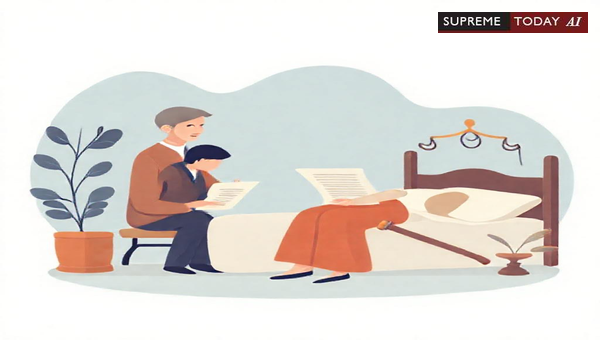
When a Deathbed Testator Leaves Property to a Caregiver How Indian Courts Examine the Will
A common question in Indian succession disputes is whether a will is generally executed in favour of the person who took care of the testator during his or her final days, and whether such a bequest can stand against challenges from excluded heirs. It is true that a testator often chooses to reward the person who provided care, maintenance, and companionship when death was near. At the same time, courts recognise that a person confined to the deathbed is vulnerable, and any will benefiting the caregiver attracts heightened judicial scrutiny. Balancing these two realities is the core of the law on proving such wills.
The Legal Answer
Yes, Indian courts have repeatedly acknowledged that it is natural for a testator to execute a will in favour of the person who looked after him before his death. In , the Supreme Court held that it is natural for the testator to execute the will in favour of the person who looked after him before the death of the testator, and that the propounder of the will discharges the onus by proving and attestation 2021 0 Supreme(Mad) 510. Similar reasoning appears in cases where a caregiver who cultivated the testator's land and looked after her was rewarded with a validly executed will 2021 Supreme(Online)(Chh) 2655.
However, the general principle comes with an important qualification: the propounder bears the burden of proving the will's validity and of dispelling any surrounding its execution 1954 0 Supreme(SC) 169 and 2023 6 Supreme 633. must be real, germane, and valid — not merely the fantasy of a doubting mind — and the propounder must remove all legitimate suspicions before the will is accepted as the testator's last will 2023 6 Supreme 633.
Why the Deathbed Context Triggers Heightened Scrutiny
When the beneficiary is also the caregiver, courts look for indicators that may suggest , such as:
- The testator's illiteracy or frail condition at the time of execution
- The beneficiary's active involvement in preparing or registering the will
- The absence of independent legal or medical advice
- The complete exclusion of dependents who had a claim to care 2025 0 Supreme(HP) 1384 and 2025 0 Supreme(HP) 480
A bedridden condition alone does not invalidate a will. In one case, a 64-year-old ailing testator could not leave her bed and had to pass stools in bed, yet the court found nothing to prove she was unconscious when the will was executed 2026 Supreme(Online)(MP) 65128. Medical evidence — or the lack of it — matters: contestants who allege incapacity must produce specific proof, and general allegations of are insufficient 2025 0 Supreme(HP) 480.
How Courts Treat the
The foundational rule is that once a will has been executed with due solemnities by a person of competent understanding who appears to be a free agent, the burden of proving lies on the party alleging it 1954 0 Supreme(SC) 169. The distinction between and onus of proof is significant: the initial burden lies on the propounder to establish , but once prove the signature and attestation process, the onus shifts to the contestant to prove invalidity 2026 0 Supreme(Telangana) 754.
Registration of the will does not, by itself, attach a stamp of validity. A registered will must still be proved under and through 2026 2 Supreme 299 and 2014 0 Supreme(Mad) 4280.
When Care Justifies the Bequest
Evidence of care, maintenance, education, and marriage expenses provided by the beneficiary can justify the exclusion of other heirs, including , and can rebut suspicions of 2025 0 Supreme(HP) 1384. Courts have held that a daughter-in-law who maintained the testator for 8–9 years was a natural beneficiary, and her presence at the execution of the will was not suspicious 2025 0 Supreme(HP) 1813.
Equally, the exclusion of natural heirs in favour of an outsider does not by itself render a will invalid or suspicious. The testator is not required to state reasons for , and those reasons may be gathered from extrinsic evidence. A cannot be rejected merely on the ground that the will was not executed out of love and affection, if the will fulfils all legal requirements and the propounder offers a reasonable and plausible explanation that appeals to the 2019 0 Supreme(All) 738
Veena Chawla VS Mahendra Singh
.What Can Invalidating Factors Look Like
Conversely, courts may invalidate a will where:
- The propounder fails to prove the testator's and 2026 0 Supreme(SC) 787 and 1954 0 Supreme(SC) 169
- The will excludes family members who were dependent and in need of care, without explanation 2022 0 Supreme(Mad) 2275
- The beneficiary dominated the testator or orchestrated the execution 2025 0 Supreme(HP) 1384
Interestingly, where transfers are made by senior citizens, the allows authorities to examine whether the transfer was made under or subject to implied conditions of care, and to cancel such transfers even if the condition is not written into the document 2025 0 Supreme(Del) 506.
Key Takeaways for Both Sides
For propounders (those defending the will):- Prove execution and attestation through at least one attesting witness as mandated by law 2014 0 Supreme(Mad) 4280- Gather evidence of the testator's and voluntariness 2025 0 Supreme(HP) 1813- Document the care, maintenance, and affection that justify the bequest 2025 0 Supreme(HP) 1384
For contestants (those challenging the will):- Plead with specific particulars rather than general allegations 2025 0 Supreme(HP) 480- Produce medical evidence if incapacity is alleged, since a bedridden state alone does not invalidate a will 2026 Supreme(Online)(MP) 65128- Focus on real, germane rather than unfounded suspicion, which cannot defeat a duly proved will 2023 6 Supreme 633
Conclusion
Generally, a will executed in favour of a person who cared for a deathbed testator is legally valid and even considered natural, provided the propounder proves , attestation, and the testator's , and dispels any genuine 2021 0 Supreme(Mad) 510 and 1954 0 Supreme(SC) 169. The presence of the caregiver during execution, minor contradictions, or exclusion of natural heirs are not fatal by themselves, but unexplained suspicion combined with proof failures can invalidate the will. Readers should treat this as general legal information, and individual cases may turn on their own facts, so consulting a qualified advocate for a specific dispute is typically advisable.
#WillDispute #UndueInfluence #TestamentaryCapacity #InheritanceLaw #Probate












