
 Back
Back


Subject :



New Delhi
– Within hours of the Indian Armed Forces announcing "Operation Sindoor," a retaliatory military action against terror camps in Pakistan and Pakistan-occupied Kashmir (PoK) on May 7, 2025, a flurry of trademark applications were filed with the Indian Trade Marks Registry.
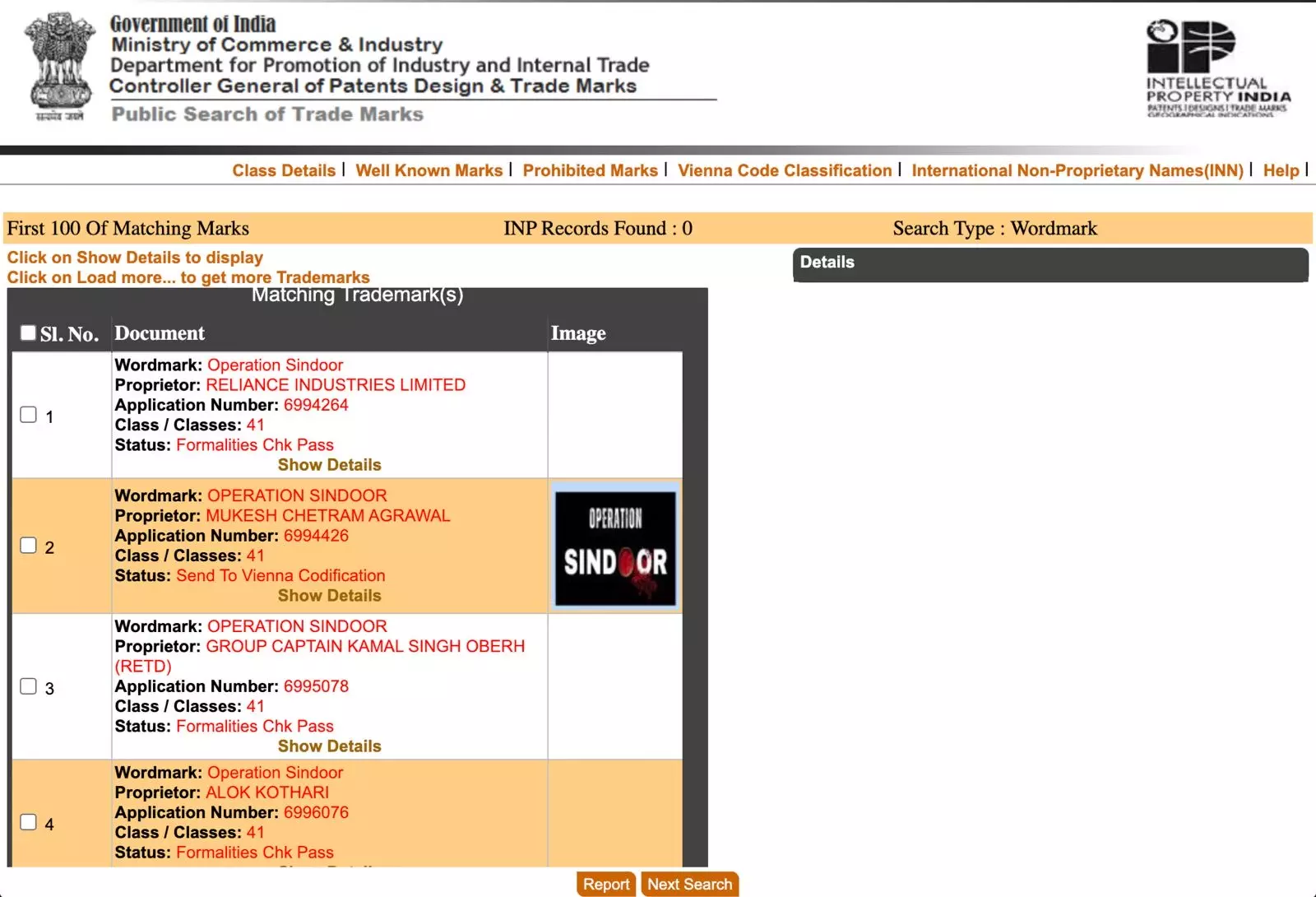
The swift actions by the applicants underscore a growing trend of attempting to capitalize on names and phrases that capture national attention, but the unique context of a military operation presents complex challenges for the Trade Marks Registry under the Trade Marks Act, 1999.
"Operation Sindoor" was launched by the Indian Armed Forces on the intervening night of May 6-7, 2025, targeting nine terror infrastructure sites. The Ministry of Defence, in a press release, stated the operation was a "focused, measured and non-escalatory" response to the Pahalgam terror attack on April 22, which resulted in the deaths of 25 Indian nationals and one
According to reports, four separate applications to trademark "Operation Sindoor" were filed on May 7, 2025, between 10:42 am and 6:27 pm. The applicants are: 1.
Reliance Industries Limited:
The conglomerate owned by
All applications were filed under Class 41 of the Nice Classification , which covers "education; providing of training; entertainment; sporting and cultural activities." The applications list "Operation Sindoor" as "proposed to be used," indicating an intention to develop media, entertainment, or educational ventures around the name, potentially including films, documentaries, or other content.
The primary legislation governing trademarks in India is the Trade Marks Act, 1999 , along with the Trade Marks Rules, 2017. The Act provides for the registration of marks that are capable of distinguishing the goods or services of one person from those of others and can be represented graphically.
Crucially, as highlighted in the news sources, "In India, military operation names are not automatically protected intellectual property. The Ministry of Defence does not generally register or restrict commercial use of such names, leaving them open to trademark filings." This vacuum means that, unlike certain national emblems or names protected under the Emblems and Names (Prevention of Improper Use) Act, 1950, military operation names are not inherently barred from registration.
However, the Trade Marks Act, 1999, lays down several absolute and relative grounds for refusal of registration . Section 9 of the Act, detailing absolute grounds, is particularly relevant here. A mark shall not be registered if: * It is devoid of any distinctive character (Section 9(1)(a)). * It consists exclusively of marks or indications which may serve in trade to designate the kind, quality, quantity, intended purpose, values, geographical origin or the time of production of the goods or rendering of the service or other characteristics of the goods or service (Section 9(1)(b)). * It consists exclusively of marks or indications which have become customary in the current language or in the bona fide and established practices of the trade (Section 9(1)(c)). * It is of such nature as to deceive the public or cause confusion (Section 9(2)(a)). * It contains or comprises of any matter likely to hurt the religious susceptibilities of any class or section of the citizens of India (Section 9(2)(b)). * It comprises or contains scandalous or obscene matter (Section 9(2)(c)). * Its use is prohibited under the Emblems and Names (Prevention of Improper Use) Act, 1950 (Section 9(2)(d)).
Furthermore, Section 11 outlines relative grounds for refusal, primarily concerning conflicts with earlier trademarks.
The applications for "Operation Sindoor" will now undergo examination by the Trade Marks Registry. The process is not merely a "first-come, first-served" race, although filing date priority (Section 18(1)) is a factor. The Registrar will scrutinize each application based on several criteria:
The news sources also indicate, "When multiple similar applications are filed in a short span, examination may be paused, and disputes resolved through formal opposition or coexistence agreements." Given the four identical applications, the Registry will likely examine them concurrently. If one or more applications pass the initial examination, they will be published in the Trade Marks Journal, opening a four-month window for opposition proceedings (Section 21). Any interested party, including potentially the Ministry of Defence or concerned citizen groups, could file an opposition.
Beyond the strict legal provisions, the rush to trademark "Operation Sindoor" raises profound ethical questions. Is it appropriate for private entities to seek commercial monopolies over names associated with military actions, national sacrifice, and emotionally charged events? The very name, chosen as a tribute to victims of terrorism, carries a weight that commercial exploitation might diminish or disrespect.
The public outcry, as captured by one of the news sources, highlights this tension. Phrases like "Aapada mein avasar talashti esi giddh nazrein pehchaniye!" (Recognize these vulture eyes that search for opportunity in disaster!) and "Sena ke jawan aur aam insan ki laashon ki kamai karta reliance ka mukesh ambani" (
While the law may not explicitly prohibit such applications, the Registrar of Trade Marks has a duty to consider public order, morality, and the potential for a mark to be deceptive or cause offense. The emotional and symbolic significance of "Operation Sindoor" will undoubtedly play a role in this assessment.
There isn't a long list of established case law in India specifically on trademarking military operation names for commercial entertainment. However, the Registry has previously dealt with marks that touch upon national sentiment or public figures. The outcome of these "Operation Sindoor" applications could set a significant precedent.
If the trademarks are granted, it might encourage more entities to swiftly file for trademarks on names of significant national events, operations, or even tragedies, potentially leading to a 'land grab' of terms that many feel should remain in the public domain or be treated with greater solemnity.
Conversely, if the applications are rejected on grounds of public sentiment, descriptiveness, or lack of distinctiveness in this specific context, it could signal a more cautious approach by the Registry towards allowing the monopolization of terms deeply embedded in the national consciousness and related to sensitive state functions.
The Trade Marks Registry faces a complex task. It must balance the applicants' commercial interests and their right to seek trademark protection against the broader public interest, the inherently sensitive nature of a military operation's name, and the provisions of the Trade Marks Act, 1999, that guard against deceptive, offensive, or non-distinctive marks.
The fact that the Ministry of Defence does not proactively trademark these names leaves a legal gray area that commercial entities are quick to explore. The "Operation Sindoor" trademark saga will be closely watched by legal professionals, intellectual property practitioners, and the public alike. It serves as a potent case study on the intersection of intellectual property law, national sentiment, and the ethics of commercialization in an era of rapid information dissemination and event-driven marketing. The decisions made by the Registry, and any subsequent legal challenges, will significantly shape the contours of what is considered registrable and appropriate in the Indian trademark landscape.
Operation Sindoor

Kerala High Court Salutes R. Rajesh's Supreme Sacrifice, Urges Vigilance in Kochi Flood Prevention
08 Aug 2026
Supreme Court Backs Balanced Calcutta High Court Order on TMC Frozen Accounts in ED Probe
12 Aug 2026
Subsisting Contract Cannot Create Continuing Cause of Action for Time-Barred Debt: Supreme Court
13 Aug 2026
Supreme Court Records Centre's Assurance That Pre-2026 Transgender Identity Cards Stay Valid
17 Aug 2026
Allahabad High Court Grants Bail to Javed Akhtar in GST ITC Fraud Case, Citing Undue Delay
19 Aug 2026
SC Collegium Recommends Appointing Advocate, Judicial Officer to Gauhati High Court
19 Aug 2026
Supreme Court Rules Caste Abuse Inside Closed Room Not Public View Under SC/ST Act
21 Aug 2026
Bombay High Court Pulls Up BMC for Defying Assurance on Bandra Football Ground
21 Aug 2026
RPNLUP Denies Recruitment Irregularities, Files Police Complaint Amid State Law Department Inquiry
21 Aug 2026

An indispensable Tool for Legal Professionals, Endorsed by Various High Court and Judicial Officers
Please visit our Training & Support
Center or Contact Us for assistance

Scan Me!
India’s Legal research and Law Firm App, Download now!


For Daily Legal Updates, Join us on :



 Back to top


