IN THE HIGH COURT OF KARNATAKA AT BENGALURU
SACHIN SHANKAR MAGADUM, J.
D.L. Ramesh S/o Lingegowda – Appellant
Versus
Marilingaiah S/o Lingegowda @ Karigowda – Respondent
Regular Second Appeal No. 151 of 2016
Decided On : 21-11-2023
Promissory Note - Negotiable Instruments Act - Section 4 - Summary: The court discussed the definition and elements of a promissory note as per Section 4 of the Negotiable Instruments Act, emphasizing the requirement of an unconditional undertaking by the maker to pay a certain sum of money. The court interpreted the provisions and highlighted that a conditional undertaking would destroy the negotiability of the instrument. The judgment focused on the absolute commitment of the maker to honor the payment obligation without any contingencies or conditions, safeguarding the interests of the payer.
Fact of the Case:
The plaintiff sought recovery of Rs. 66,000 based on a promissory note, while the defendant denied the existence of the promissory note and claimed misuse of signatures.
Finding of the Court:
The Trial Court dismissed the suit based on a conflict with Section 4 of the Negotiable Instruments Act, but the Appellate Court reversed the decision, emphasizing the unconditional nature of the undertaking in the promissory note.
Issues: Dispute over the existence and nature of the promissory note, interpretation of Section 4 of the Negotiable Instruments Act.
Ratio Decidendi: The court emphasized the requirement of an unconditional undertaking in a promissory note as per Section 4 of the Act, highlighting the absolute commitment of the maker to honor the payment obligation without any contingencies or conditions.
Final Decision: The second appeal was dismissed, and the Appellate Court's decision to decree the plaintiff's suit was upheld.
JUDGMENT :
SACHIN SHANKAR MAGADUM, J.
1. The captioned Second Appeal is filed by the unsuccessful defendant questioning the judgment and decree rendered by the Appellate Court in R.A. No. 74/2014, wherein the Appellate Court has reversed the decree of the Trial Court and plaintiff’s suit, seeking recovery of Rs. 66,000/- based on a promissory note, is decreed.
2. For the sake of brevity, the rank of the parties are referred as they are ranked before the Trial Court.
3. Facts leading to the case are as under:
4. Defendant, on receipt of summons, tendered appearance, filed written statement and stoutly denied the entire averments made in the plaint. The defendant seriously disputed the alleged promissory note and contended that the plaintiff has misused the signatures obtained by him on blank papers by giving a false assurance that he would help him secure bail in C.C. No. 70/2010. The defendant claimed that his signatures on blank papers were given to accused No. 1 in C.C. No. 70/2010 and accused No. 1 in collusion with the present plaintiff, concocted the documents styled as promissory note. The defendant stoutly denied the claim of the plaintiff that he had availed hand loan from plaintiff. On these grounds, sought for dismissal of the suit.
5. Plaintiff to substantiate his respective claim has examined himself as PW-1 and both the witnesses as PWs. 2 and 3 and produced a demand promissory note, which was marked as Ex.P.1. The defendant’s signature was identified and marked as Ex.P.1(a) while the signatures of both witnesses were identified and marked as Ex.P.1(b) and (c). The defendant, to support his defence, placed reliance on the charge-sheet filed in C.C. No. 70/2010, which is marked as Ex.D.1.
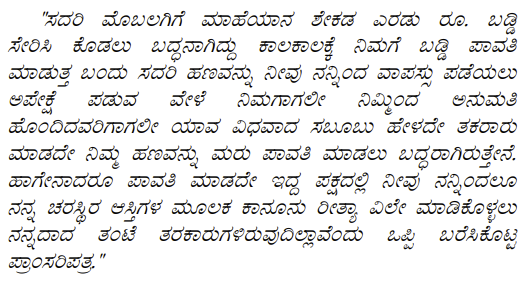
6. The Trial Court dismissed the suit on the ground that the demand promissory note relied on by the plaintiff is found in conflict with Section 4 of the Negotiable Instruments Act, 1881 (for short ‘Act’). While reproducing the relevant portion of the demand promissory note at paragraph No. 14, the Trial Court held that, in terms of definition and explanation to Section 4, the undertaking given by the payer should be unconditional, and since the pronote contemplates right to seek recovery in the event the defendant/maker failed to repay the hand loan of Rs. 66,000/- the Trial Court was of the view that Ex.P.1 cannot be treated as a demand promissory note. On these set of reasonings, the Trial court dismissed the suit.
7. Plaintiff feeling aggrieved by the judgment and decree of the Trial Court, preferred an appeal before the appellate Court. The Appellate Court has independently assessed the entire material on record. The Appellate Court has also given anxious consideration to the definition of Section 4 of the Act and has also examined the recitals found in the pronote. On re-assessing the recitals in the pronote and having examined Section 4 of the Act, the Appellate Court was of the view that the undertaking given by the defendant/maker is not in any way contrary to Section 4 of the N.I. Act. It is in this background, the Appellate Court was not inclined to concur with the reasons assigned by the Trial Court while applying Section 4 of the Act in the present case on hand. The Appellate Court also held that the reasons assigned by the Trial Court are patently erroneous and accordingly reversed the reasonings as well a
AI
The central legal point established in the judgment is the requirement of an unconditional undertaking in a promissory note as per Section 4 of the Negotiable Instruments Act, emphasizing the absolut....
The central legal point established in the judgment is the requirement to prove the execution and genuineness of a promissory note under the Negotiable Instruments Act 1881.
The burden of proof lies on the defendant to dispute the execution of a promissory note and the validity of an assignment, and mere denial without valid evidence cannot be accepted.
The main legal point established is that no attesting witness is mandated for a promissory note, and the formulation of substantial questions of law is mandatory for admitting a second appeal.
The burden of proof on the plaintiff to establish consideration for the promissory note and the standard of proof required in cases involving the genuineness of signatures and endorsements.
Login now and unlock free premium legal research
Login to SupremeToday AI and access free legal analysis, AI highlights, and smart tools.
Login
now!
India’s Legal research and Law Firm App, Download now!

Copyright © 2023 Vikas Info Solution Pvt Ltd. All Rights Reserved.