
 Back
Back





IN THE HIGH COURT OF KARNATAKA AT DHARWAD
Sachin Shankar Magadum, J.
J. Ramappa S/o. J. Ramachandrappa - Appellant
Vs.
J. Venkatramana Setty - Respondent
W.P. NO. Of 100282 2021
Decided On : 05-10-2023
Stamp Duty - Agreement of Sale - The court held that the agreement to sell falls within the scope of Article 5(e)(i) of the Karnataka Stamp Act, and even if the intending purchaser claims to be in possession prior to the agreement of sale, the purchaser has to pay stamp duty as if possession is delivered under the agreement. The provisions of Section 20 of the Karnataka Stamp Act read with Article 5(e)(i) would come into play, and an agreement holder is bound to pay stamp duty as indicated in Article 5(e)(i) of the Karnataka Stamp Act.
Fact of the Case:
The plaintiff filed a writ petition assailing the order passed by the learned Judge calling upon the plaintiff to pay duty and penalty on an agreement of sale dated 10.09.2000. The plaintiff claimed that possession was already delivered to him by the defendant much prior to the execution of the suit agreement.
Finding of the Court:
The court found that the order under challenge is legal and does not suffer from any illegality and infirmity, and accordingly dismissed the writ petition.
Issues: The issues revolved around the possession of the suit schedule properties, the applicability of Article 5(e)(i) of the Karnataka Stamp Act, and the obligation of the agreement holder to pay stamp duty.
Ratio Decidendi: The court held that the agreement to sell falls within the scope of Article 5(e)(i) of the Karnataka Stamp Act, and even if the intending purchaser claims to be in possession prior to the agreement of sale, the purchaser has to pay stamp duty as if possession is delivered under the agreement.
Final Decision: The writ petition being devoid of merits stands dismissed.
ORDER :
The captioned writ petition is filed by the plaintiff assailing the order passed by the learned Judge calling upon the present petitioner to pay duty and penalty on agreement of sale dated 10.09.2000.
2. Facts leading to the case are as under:
Petitioner/plaintiff instituted a suit for specific performance in O.S.No.266/2014. The suit for specific performance is based on an agreement of sale dated 10.09.2000 and family settlement dated 20.04.1994. Learned Judge having found that both the documents are not sufficiently stamped, has impounded the documents and under the impugned order plaintiff is called upon to pay deficit stamp duty and penalty.
3. The grievance of the petitioner is that respondent/defendant who is his brother has delivered possession much prior to execution of suit agreement and therefore, plaintiff claims that Article 5(e)(i) is not applicable and therefore, learned Judge erred in impounding the document. To buttress his arguments, he has relied on following judgments.
(i) D.S.Manjunath Vs M.Krishnaiah Setty [(2016) 08 KAR CK 102.
(ii) Vijay Kumar Vs S.S.Ashoka and Another [W.P.No.52902/2016].
4. I have given my anxious consideration to the order under challenge. I have also taken cognizance of the pleadings in the plaint and defence set up by respondent/defendant in the suit. It is not in dispute that plaintiff and defendant admit that suit schedule properties are allotted to respondent/defendant by way of settlement deed dated 20.04.1994. The relevant portion of the settlement deed which is produced at Annexure-C, reads as under:
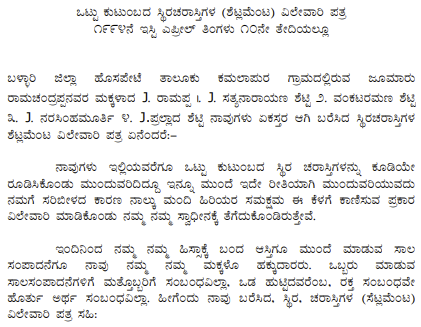
5. If the recitals in the settlement deed are accepted, what emerges is that all the four brothers in terms of family settlement are allotted specific portions and they are put in exclusive possession. The settlement deed is dated 20.04.1994. The present petitioner/plaintiff under the suit agreement claims that possession was already delivered to him. Respondent/defendant is disputing the recitals in the suit agreement. He is also disputing handing over possession. Therefore, the question that requires consideration at the hands of this court is, as to whether plaintiff who is basing his right in terms of settlement deed 20.04.1994 and suit agreement to sell dated 10.09.2000 can assert possession de hors the suit agreement. My answer is emphatic no. If under the settlement deed dated 20.04.1994, respondent/defendant is put in possession of the suit schedule property which is subject matter of the suit agreement, in absence of documents indicating that petitioner/plaintiff was put in possession cannot contend that possession was not delivered under the suit agreement. On examining the material on record, this court would find that petitioner/plaintiff has no other documents to trace his possessory rights. If under the settlement deed, respondent/defendant was exclusively put in possession of the suit schedule properties, the fact that there is recital in the suit agreement indicating that possession was already delivered, has to be construed that petitioner/plaintiff is asserting possessory rights and the same emanates from the suit agreement and not from any other source. Therefore, it is in this background, I am of the view that the suit agreement has to be deemed to be coupled with possession and therefore, plaintiff cannot avoid payment of stamp duty as indicated in Article 5(e)(i) of Karnataka Stamp Act.
6. The material on record does not substantiate the petitioner’s claim in regard to possession of the suit schedule properties. After execution of settlement deed and before execution of the suit agreement, no independent documentary evidence is placed on record to substantiate that he was put in possession of the suit schedule property much prior to execution of suit agreement. In the instant case, the agreement entered into between the parties, which is a basic document for claiming relief of specific performance, clearly provides for sale of immovable property and it also r
AI
The main legal point established in the judgment is that an agreement holder is bound to pay stamp duty as indicated in Article 5(e)(i) of the Karnataka Stamp Act, even if the intending purchaser cla....


Agreements evidencing delivery of possession are liable for stamp duty as conveyances under the Stamp Act.

An agreement of sale with possession requires stamp duty, and prior tenant status does not exempt the agreement from this requirement.
The possession to be handed over in the future does not make the document insufficiently stamped. The trial court cannot delegate the duty of calculating the stamp duty payable to the office attached....


Suit for Specific Performance – Liability to pay stamp duty – Stamp duty is on instrument and not on transaction – It is immaterial, whether possession of property has been handed over at the time of....



An indispensable Tool for Legal Professionals, Endorsed by Various High Court and Judicial Officers
Please visit our Training & Support
Center or Contact Us for assistance

Scan Me!
India’s Legal research and Law Firm App, Download now!


For Daily Legal Updates, Join us on :



 Back to top


