
 Back
Back





IN THE HIGH COURT OF KARNATAKA
K.S.Mudagal, C.M.Joshi, JJ.
Anasuya Bai – Appellant
Versus
B.R. Raghunath Rao – Respondent
Regular First Appeal No. 272/2009 (Par)
Decided On : 13-10-2023
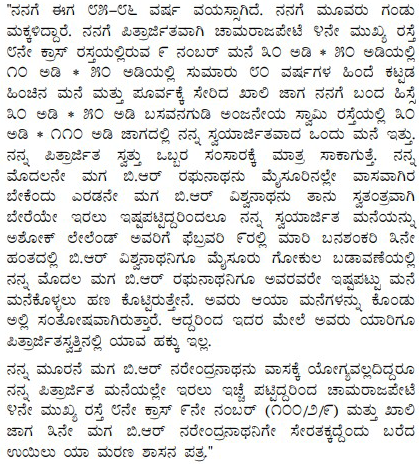
WILL - Partition and Inheritance - Sec. 96 CPC, Sec. 63 Indian Succession Act, Sec. 68 Indian Evidence Act - The court discussed the validity of a holographic will executed by B.M. Rama Rao, emphasizing that the will was properly attested and reflected the testator's intention to settle family property. The court interpreted the provisions of the Indian Succession Act regarding the execution of wills and the Evidence Act concerning the burden of proof, ultimately concluding that the will was binding and that the property had been effectively settled, influencing the decision to dismiss the plaintiff's claim for partition.
Fact of the Case:
The plaintiff sought partition and separate possession of his 1/4th share in a property inherited from their father, B.M. Rama Rao, claiming that the property was ancestral and that a will executed by the father was invalid. The defendants contended that the will was valid and that a family settlement had been made, which excluded the plaintiff from claiming a share in the property.
Finding of the Court:
The court found that the will executed by B.M. Rama Rao was valid and binding, having been properly attested and reflecting the testator's intention to settle the property among his children. The court concluded that the property was no longer ancestral due to the family settlement established by the will.
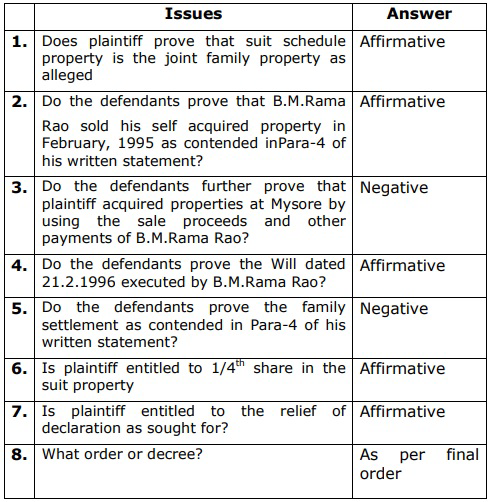
Issues: 1. Whether the will of B.M. Rama Rao is valid and binding? 2. Was there a family settlement regarding the property? 3. Does the property remain ancestral after the will?
Ratio Decidendi: The court held that a holographic will, when properly executed and attested, is valid and can effectively settle property among heirs. The intention of the testator, as expressed in the will, can alter the status of property from ancestral to settled, provided that the heirs consent to the terms of the will.
Final Decision: The appeal was allowed, the trial court's judgment was set aside, and the plaintiff's suit for partition was dismissed.
JUDGMENT
C.M.JOSHI, J. - This Regular First Appeal is filed by the defendants under Sec. 96 of CPC against the judgment and decree dtd. 24/10/2008 passed in O.S.No.94/2002 by the learned XXII Additional City Civil Judge, Bangalore, whereby the suit filed by the plaintiff for partition and separate possession of his 1/4th share in the suit schedule property and for declaration that Wills are not binding on him came to be decreed.
2. The parties would be referred to as per their rankings before the trial Court in the original suit.
3. The suit schedule property is the premises bearing No.9, 4th Main, 8th Cross, Chamarajpet, Bangalore-18, measuring 30 x 50 feet with constructed area of 10 x 50 feet.
4. In brief, the case of the plaintiff is as below: The plaintiff and the defendant Nos.2 and 3 are the brothers. Defendant No.1-Anasuya Bai is their mother and one B.M. Rama Rao was the husband of defendant No.1 and father of plaintiff and defendant Nos.2 and 3. He had ancestral properties. The suit schedule property had fallen to the share of their father B.M. Rama Rao under a registered partition deed dtd. 18/3/1953 entered into between B.M.Rama Rao, his father and brothers.
5. The plaintiff contended that he and the defendants were coparceners of the hindu undivided family and B.M.Rama Rao, was the Kartha of the family. He further contended that even though the plaintiff and defendants are residing separately for their convenience and to eke out their lively hood at different places, there was no partition in the joint family properties. It is stated that the plaintiff was serving in Forest Department as a Ranger at different places till his retirement.
6. The plaintiff also contended that the deceased B.M. Rama Rao was working in KEB as Assistant Engineer and out of his self earnings he had purchased the property at Basavanagudi, Bengaluru. The said property was sold by B.M.Rama Rao, during his life time for a valuable consideration and he distributed the money among the plaintiff and the defendants according to his wish and that major portion of sale proceeds was paid to the defendants. After the death of B.M.Rama Rao, the plaintiff and defendants succeeded to the suit schedule property as joint owners. The plaintiff further contended that defendant No.3 with fraudulent intention filed an application to the Assistant Revenue Officer of the Bangalore City Corporation, Chamarajpet, Bengaluru, for effecting transfer of the khatha of the suit property to his name on the basis of alleged unregistered Wills dtd. 2/2/1996 and 21/2/1996 executed by B.M. Rama Rao, which were not valid in the eye of law. The plaintiff, having come to know about the act of the defendant No.3 enquired further and came to know that on the basis of a joint affidavit of no objection, the defendant No.3 had got his name entered in the khatha. It was alleged that the signature of the plaintiff was forged and as such, an objection was filed to the Bangalore City Corporation. It was stated that the defendants made request for a settlement through their relatives but thereafter, they did not come forward for any settlement and as such, he was constrained to file a criminal complaint to the jurisdictional Magistrate on 20/12/2000 in PCR No.731/2000. In the meanwhile, the objections filed to the Bangalore City Corporation went in vain. Thereafter, again, the defendants came up with a proposal for partition in respect of the suit schedule property and accordingly, the plaintiff had also agreed for receiving the value of his 1/4th share in the suit schedule property and as such made necessary preparations by valuing the suit schedule property through a registered valuer. The defendants again resiled from the compromise proposal and changed their minds. The plaintiff also contended that the suit schedule property was all along in the joint possession and enjoyment of the plaintiff and defendant Nos. 1 to 3; with an intention of grabbing entire property, they are trying t
AI
A holographic will executed by the Kartha of a Hindu Undivided Family can effectively settle family property, altering its status from ancestral to settled, provided the will is validly executed and ....

The main legal point established in the judgment is that the presumption of a property being joint family property arises when there is sufficient joint nucleus capable of contributing to the purchas....

The burden of proof in establishing joint family nucleus and self-acquisition of properties lies with the plaintiff and defendants respectively. The due execution of a Will can be established through....

The validity of a Will executed by a testator in sound mind is upheld, establishing self-acquisition of property over claims of joint family ownership.

A Karta under Mitakshara law cannot alienate joint family property via a Will; it is a family arrangement. Possession under a void document can lead to adverse possession if maintained for the requis....

A party must prove joint ownership and the existence of a Kartha for partition claims; individual ownership negates claims of joint family property.


The burden of proof lies on asserting self-acquisition when joint family property is claimed, as evidenced in the judgment affirming the trial court's findings on property character.



An indispensable Tool for Legal Professionals, Endorsed by Various High Court and Judicial Officers
Please visit our Training & Support
Center or Contact Us for assistance

Scan Me!
India’s Legal research and Law Firm App, Download now!


For Daily Legal Updates, Join us on :



 Back to top


