
 Back
Back





IN THE HIGH COURT OF KARNATAKA
C.M.Joshi, J.
Oriental Insurance Co Ltd – Appellant
Versus
Mahadevamma – Respondent
M.F.A. No. 2863 of 2018 (Mv-D), M.F.A No. 5421 of 2018 (Mv-D)
Decided On : 10-11-2023
NEGLIGENCE - MOTOR VEHICLE ACCIDENT - Motor Vehicles Act, 1988, Section 166; Indian Evidence Act, 1872, Section 114 - The court discussed the principles of actionable negligence and contributory negligence in the context of a motor vehicle accident. It highlighted that mere consumption of alcohol by the deceased does not automatically imply contributory negligence unless an overt act is established. The court emphasized the need for evidence to support claims of negligence and the importance of eyewitness accounts in determining liability. The interpretations of the relevant sections influenced the court's decision to uphold the Tribunal's findings regarding negligence and compensation.
Fact of the Case:
The deceased, Shivakumar, fell from a moving bus and died due to injuries sustained. The petitioners, his family, claimed compensation from the bus driver, owner, and insurance company, alleging negligence. The insurance company contended that the deceased was under the influence of alcohol, contributing to the accident.
Finding of the Court:
The court found sufficient evidence of actionable negligence on the part of the bus driver. It rejected the insurance company's claims of contributory negligence, stating that mere alcohol consumption does not equate to negligence without evidence of an overt act. The court upheld the Tribunal's compensation amount but adjusted the interest rate.
Issues: 1. Whether the driver of the bus was negligent in operating the vehicle. 2. Whether the deceased's alcohol consumption constituted contributory negligence. 3. Whether the compensation awarded was adequate.
Ratio Decidendi: The court established that contributory negligence must be proven with evidence of an overt act. The mere presence of alcohol in the deceased's system does not automatically imply negligence. The court also affirmed the importance of eyewitness testimony in assessing liability.
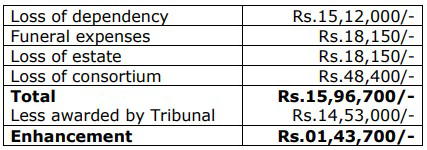
Final Decision: The appeal by the insurance company was dismissed, while the petitioners' appeal was allowed in part, increasing the compensation awarded to Rs.15,96,700 with interest at 6% per annum.
JUDGMENT
1. Being aggrieved by the judgment and award passed in MVC No.5/2015 dtd. 17/1/2018 by learned Senior Civil Judge & MACT, T.NARASIPURA, the insurance company has approached this Court in appeal in MFA No.2863/2018 and the petitioners have approached this Court in appeal in MFA No.5421/2018.
2. The parties would be referred to as per their ranking before the Tribunal.
3. The brief facts are as below:
That on 23/12/2013 at 12.00 p.m. near Lakshmi theater, Mysuru city the deceased Shivakumar and Raju were boarding the Ravindra bus bearing Reg.No.KA-19-A2499 to reach Metagalli. At that time the driver of the bus drove the same at high speed and in a rash or negligent manner, as a result deceased Shivakumar had fallen down from the bus and sustained grievous injuries and succumbed to the injuries at the spot itself.
4. The deceased was hale and healthy prior to the accident and he was a plumber and doing agriculture and earning Rs.15, 000.00 per month. Petitioner No.1 is the wife and petitioner No.2 & 3 are children and petitioner No.4 is mother of the deceased. It is alleged that the accident in question had taken place due to rash or negligent driving of respondent No.1/ driver. Respondent No.2 is the owner and respondent No.3 is insurer of the offending vehicle.
5. Respondent No.2 has filed written statement denying all the averments made in the petition and called upon the petitioners to prove the same. He has admitted that the he is the owner of the offending vehicle. According to him as per the medical report, the deceased succumbed to the death due to consumption of alcohol and poison and in view of that, the petition is not maintainable. However he has contended that the offending vehicle has been insured with 3rd respondent which was in force as on the date of accident. As such he is not liable to pay the compensation. Accordingly he prays to dismiss the petition with cost.
6. The respondent No.3 has filed written statement denying all the material averments found in the petition and has called upon the petitioners to prove the same. It is admitted that 2nd respondent is the owner of the offending vehicle but it was not insured with 3rd respondent. It is stated that the accident is caused due to rash or negligent act of the deceased Shivakumar himself as he fell down to the ground while boarding the moving bus and succumbed to the injuries. He had consumed alcohol at the time of alleged accident. The 1st respondent was not holding a valid and effective driving license to drive the offending vehicle as such the owner has violated the terms and conditions of the policy by entrusting the offending vehicle to the 1st respondent. Therefore, the 3rd respondent is not liable to indemnify the insured. Accordingly, the respondent No.3 prayed for dismissing the petition.
7. The Tribunal framed the appropriate issues and the petitioner No.1 was examined as PW1 and one witness was examined as PW2, Ex.P1 to Ex.P14 were marked and received in evidence. The official of the respondent No.3 insurance was examined as RW1 and Ex.R1 to Ex.R3 were marked during evidence.
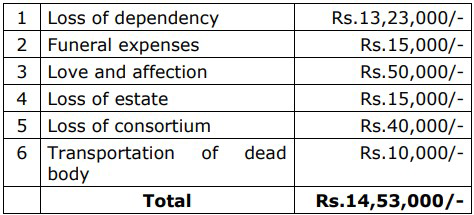
8. After the hearing the arguments by both the sides, the Tribunal held that there is sufficient material to show that there was actionable negligence on the part of the driver of the bus and the contentions raised by the respondent No.3 were not proved and as such awarded the compensation of Rs.14, 53, 000.00 to the petitioners under the following heads.
9. Being aggrieved by the said judgment and award the respondent No.3 insurance company has come up in appeal in MFA No.2863/2018. The insurance company has contended that the PM report of the deceased show that the percentage of alcohol in the body of the deceased was 36.73 Mg per 100 ml of the blood and the permitted level is 30 mg per 100 ml blood and therefore he was under high influence of the alcohol much beyond the permitted limits and he was solely responsible for the accident. Secondly the insurance company co
AI
Contributory negligence must be established through evidence of an overt act; mere alcohol consumption does not suffice to prove negligence in the context of a motor vehicle accident.


The court ruled that attributing contributory negligence to the deceased was unjustified and emphasized the principle of just and fair compensation under the Motor Vehicles Act.

The main legal point established in the judgment is the interpretation and application of contributory negligence and compensation calculation guidelines under the Motor Vehicles Act, 1988.

The court upheld the principle of awarding just compensation based on the multiplier method, emphasizing the need for future prospects and proper deductions for personal expenses.

Principle of contributory negligence has been discussed time and again. A person who either contributes or author of the accident would be liable for his contribution to the accident having taken pla....


Liability of insurance company and assessment of compensation under the Motor Vehicles Act 1988.



An indispensable Tool for Legal Professionals, Endorsed by Various High Court and Judicial Officers
Please visit our Training & Support
Center or Contact Us for assistance

Scan Me!
India’s Legal research and Law Firm App, Download now!


For Daily Legal Updates, Join us on :



 Back to top


