Back
Back





2023 Supreme(Kar) 1140
IN THE HIGH COURT OF KARNATAKA
Ashok S.Kinagi, J.
M. Nanjunda Reddy – Appellant
Versus
Malathi – Respondent
Regular Second Appeal No. 25 of 2015 (Sp)
Decided On : 24-08-2023
M.S.Varadarajan, Advocate
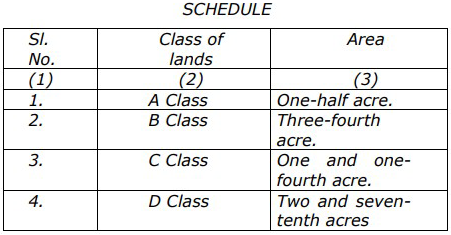
An agreement for the sale of land that contravenes the provisions of the Karnataka Prevention of Fragmentation and Consolidation of Holding Act, 1966, is void ab initio and unenforceable.
Headnote:
KEYWORD - Specific Performance - ACT SECTION LIST - Karnataka Prevention of Fragmentation and Consolidation of Holding Act, 1966 (Sections 2(g), 3, 4, 5, 39) - The court interpreted the provisions of the Karnataka Prevention of Fragmentation and Consolidation of Holding Act, 1966, which prohibits the sale of land fragments without adherence to specific conditions. The court found that the agreement of sale was void ab initio due to non-compliance with the Act, influencing its decision to dismiss the appeal for specific performance.
Fact of the Case:
The plaintiff filed a suit for specific performance of a contract to purchase land from Late Gopalakrishna, who had allegedly agreed to sell the property and received payment. After Gopalakrishna's death, the defendants, his heirs, refused to execute the sale deed, prompting the plaintiff to seek legal recourse.
Finding of the Court:
The trial court and the appellate court found that the plaintiff failed to prove the execution of the sale agreement and the payment of the sale consideration. The courts also determined that the agreement was void under the Karnataka Prevention of Fragmentation and Consolidation of Holding Act, 1966.
Issues: 1. Whether the plaintiff proved the existence of a valid sale agreement? 2. Whether the plaintiff was ready and willing to perform his part of the contract? 3. Whether the suit was time-barred? 4. Whether the agreement was void under the Act of 1966?
Ratio Decidendi: The court held that the agreement of sale was void ab initio due to its violation of the Karnataka Prevention of Fragmentation and Consolidation of Holding Act, 1966, which prohibits the sale of land fragments without compliance with specific legal requirements. The plaintiff's failure to prove the execution of the agreement and payment further supported the dismissal of the appeal.
Final Decision: The appeal was dismissed, affirming the lower courts' judgments that the plaintiff failed to establish a valid claim for specific performance.
JUDGMENT
1. This second appeal is filed by the appellant challenging the judgment and decree dtd. 4/9/2014 passed by the III Addl. District and Sessions Judge, Bengaluru Rural District, sitting at Anekal, in R.A.No.20/2006 dismissing the appeal by confirming the judgment and decree dtd. 1/4/2003, passed by the Principal Civil Judge (Jn.Dn.) and JMFC, Anekal in O.S.No.192/1996.
2. Parties are referred to as per their ranking before the trial Court. The appellant is the plaintiff and respondents No.1 and 2 are defendants No.1 and 2.
3. Brief facts leading rise to filing of this appeal are as under:
Plaintiff filed a suit for specific performance of contract. It is the case of the plaintiff that defendant No.1 is the wife and defendant No.2 is the minor son of Late Gopalakrishna. The said Gopalakrishna was the absolute owner of the suit schedule property. He offered to sell the suit schedule property bearing Sy.No.30 measuring 3 guntas and plaintiff accepted the said offer. He entered into an agreement of sale in favour of the plaintiff on 2/2/1984 for a sale consideration of Rs.2, 130.00. He also received the entire sale consideration and put the plaintiff in possession of the suit schedule property in part performance of the contract. Further, at the time of executing an agreement of sale, since the Karnataka Prevention of Fragmentation and Consolidation of Holding Act, 1966 (hereinafter referred to as 'the Act of 1966' for short) was in force, the sale deed could not be executed by Late Gopalakrishna in favour of the plaintiff. Further, it is contended that the said Gopalakrishna, husband of the defendant No.1 and father of defendant No.2, died leaving behind them as his legal heirs. After the demise of Gopalakrishna, the plaintiff requested defendant No.1 to execute the sale deed. But, defendants declined to execute the sale deed. It is the case of the plaintiff that he was ready and willing to perform his part of contract, but the defendants were not ready to perform their part of the contract. It is the case of the plaintiff that since there is a breach of contract, the plaintiff got issued legal notice to the defendants on 22/1/1996, calling upon them to perform the obligation under the sale agreement by executing the registered sale deed. The said notice was served on defendant No.1. But the defendant No.1 failed to execute register sale deed and she has not replied the said legal notice and hence cause of action arose to the plaintiff to file a suit for specific performance. Hence the suit.
4. The defendant No.1 filed written statement denying the averments made in the plaint and it is the case of the defendant No.1 that her husband did not offer to sell the suit schedule property in favour of the plaintiff for a consideration of Rs.2, 130.00 and it is also denied that plaintiff has paid a sum of Rs.2, 130.00 to her husband Late Gopalakrishna. The defendant No.1 further denied that the plaintiff was put in possession of the suit schedule property. It is contented that the plaintiff created the alleged agreement of sale and that there is no privity of contract between the plaintiff and her husband Gopalakrishna. Further, it is contended that the suit is barred by law of limitation. During the pendency of the suit the plaintiff got amended the suit. The defendant filed additional written statement denying the amendment portion of the plaint. Hence on these grounds the defendants prayed to dismiss the suit.
5. The Trial Court, on the basis of the above said pleadings, framed the following issues and additional issue:
1. Whether the plaintiff proves that father of D1 and D2 agreed to sell the suit properties for Rs.2, 130.00 and received Rs.2, 000.00 executed agreement of sale on 2/2/84 putting the plaintiff in possession of the suit property?
2. Whether the plaintiff is ever ready and willing to perform his part of contract?
3. Whether the defendant proves that the agreement of sale is forged concocted document?
4. Whether t