


 Back
Back





2024 Supreme(Kar) 522
IN THE HIGH COURT OF KARNATAKA AT BENGALURU
M. NAGAPRASANNA, J.
Sri. Krishnappa M.T, S/o. Sri. Thimmaiah and Anr. – Petitioners
Versus
State Of Karnataka, By Turuvekere Police, Represented By State Public Prosecutor and Anr. - Respondents
Criminal Petition No. 13215 Of 2023
Decided On : 07-11-2024
For the Petitioners: Smt. Nandini B. Adv. for Sri. Bhargav G., Adv.
For the Respondents: Sri. B.N. Jagadeesha, Addl. SPP, Served, Unrepresented.
IMPORTANT POINT
A Magistrate's order permitting the registration of a non-cognizable offence must reflect application of mind; failure to do so renders the proceedings invalid.
Headnote:
Indian Penal Code, 1860 - Sections 34 and 504 - Criminal Procedure Code, 1973 - Section 155(2) - Petition challenging proceedings for non-cognizable offences - The learned Magistrate's order permitting registration of a crime lacked application of mind, rendering the subsequent proceedings a nullity - The court emphasized the necessity of a reasoned order reflecting true application of mind in such cases. (Paras 10, 11, 12)
Facts of the case:
The petitioner challenged the registration of a crime for intimidation under Section 504 of IPC, alleging that the Magistrate's order lacked necessary application of mind, leading to a nullity in the proceedings.
Findings of Court:
The court found that the Magistrate's order did not reflect application of mind, resulting in the obliteration of the crime.
Issues: The main issue was whether the Magistrate's order permitting the registration of a non-cognizable offence bore application of mind as required by law.
Ratio Decidendi: The court ruled that mere length of an order does not equate to application of mind; substantive reasoning is essential for legal validity.
Result: Criminal Petition allowed; proceedings quashed.
ORDER :
(M. Nagaprasanna, J.)
The petitioner is before this Court calling in question the proceedings in C.C.No.372/2020 arising out of crime No.181/2020 for offences punishable under Sections 34 and 504 of the Indian Penal Code, 1860 ('the IPC' for short).
2. Heard learned counsel Smt. Nandini B., for learned counsel, Sri. Bhargav G., appearing for the petitioner and learned Additional SPP, Sri. B.N. Jagadeesha, appearing for respondent No.1.
3. Respondent No.2 though served, remains unrepresented throughout the proceedings and even today.
4. The second respondent is the complainant and claims to be the president of a political party. After the elections, it is the allegation of the complainant that the petitioners on loosing their elections seek to undermine the dignity of the party by derogatory statements or intimidating the complainant. Since the offence was only for intimidation, as obtaining under Section 504 of the IPC, the police on receipt of the complaint render a non cognizable report and place the complaint before the learned Magistrate for obtaining permission to register a crime on a non cognizable offence 504 read with 34 of the IPC. The learned Magistrate permits registration of a crime. It is then, the crime in crime No.181/2020 comes to be registered. The police conduct investigation and file a charge sheet in C.C.No.372/2020 for the afore-quoted offences. The concerned Court takes cognizance of the offence and registers C.C.No.372/2020 for offence punishable under Sections 504 and 34 of the IPC and issue summons to the petitioners. The issuance of summons is what has driven the petitioners to this Court in the subject petition.
5. The learned counsel appearing for the petitioners taking this Court through the order granting permission to register a crime would submit that it would cut at the root of the matter, as it bears no application of mind, as is necessary in law. The learned counsel would submit, everything in the aftermath of the registration of a crime would be a nullity on account of the effect at the foundation.
6. The learned Additional State Public Prosecutor, on the other hand, would submit that how the order of learned Magistrate does bear application of mind permitting the registration of the crime. He would take this Court through the order to defend the action and submit that the police have filed the charge sheet and it is for the petitioners to come out clean in a full bloom trial.
7. I have given my anxious consideration to the submissions made by the respective learned counsel and have perused the material available on record.
8. The afore-narrated facts are a matter of record. The registration of the crime is triggered by presentation of the complaint by the second respondent. Therefore, it becomes necessary to notice the complaint. The complaint dated 24.08.2020 reads as follows:
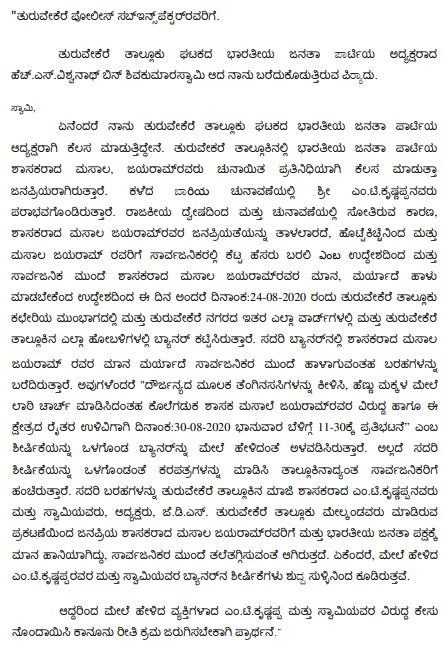
9. The offences alleged are the ones punishable under Section 504 and 34 of the IPC. They are admittedly non cognizable. Therefore, a non-cognizable report was rendered by the jurisdictional police, after interaction on 24.08.2020. The Station House Officer then travels to the Court of the Magistrate seeking permission for registration of a crime for offences punishable under Sections 504 and 34 of the IPC, since the offences alleged were non-cognizable, the nod of the Magistrate under Section 155(2) of the Cr.P.C. was imperative. The learned Magistrate passes the following order:
"The PSI of Turuvekere Police Station approached with requisition seeking permission to proceed with the investigation of non-cognizable case.
It is mentioned that the complainant lodged the written information about alleged insult caused by the proposed accused persons.
As per Section 155(2) of Cr.P.C., there is a bar for the police officer to proceed with the investigation of the non-cognizable case without the order of a Magistrate having jurisdiction to try the case or commit the case for trial.
When, police officer received, the












