
 Back
Back





IN THE HIGH COURT OF KARNATAKA AT BENGALURU
M. Nagaprasanna, J.
Mr. Sourish Bose S/o Indranil Bose - Appellant
Vs.
State Of Karnataka By Hennur Police Station Bengaluru City Represented By Learned State Public Prosecutor High Court Of Karnataka Bengaluru - Respondent
Criminal Petition No. 10546 Of 2024
Decided On : 22-11-2024
ORDER :
M.Nagaprasanna, J.
The petitioners/accused 1 and 2 are knocking at the doors of this Court calling in question proceedings in C.C.No.50666 of 2019 pending before the XI Additional Chief Metropolitan Magistrate, Bengaluru arising out of a crime in Crime No.153 of 2017 registered for offences punishable under Section 420 r/w 34 of the IPC.
2. Heard Sri. Hashmath Pasha, learned senior counsel appearing for the petitioners and Sri B. N. Jagadeesha, learned Additional State Public Prosecutor appearing for respondent No.1.
3. Facts, in brief, germane are as follows:-
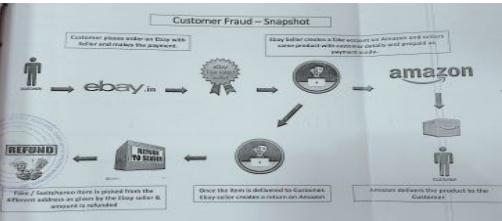
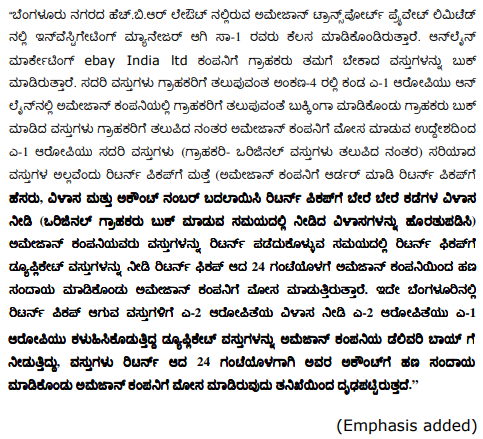
A crime comes to be registered on 25-04-2017 in Crime No.153 of 2017 for offence punishable under Section 420 of the IPC. The 2nd respondent is the complainant. It is the case of the prosecution that the complaint alleged that a company by name Amazon Seller Services Limited (‘Amazon’ for short) is in the business of providing online market to customers across the country. Its website is Amazon India. Customers can order for the product by login into Amazon India Website and those who would order can either pay in advance or cash on delivery or any other mode. If there is any complaint, the customer will have the option for return of the product which is called ‘C’ return (customer return). The company/Amazon has a tie up with other business companies one of which is E-Bay. The customers who want to buy the product from Amazon can book it through E-Bay. The E-Bay will place the order to Amazon for the product to be delivered to the door step of the customers. Therefore, the chain is this way. A customer places his order for a product in Amazon through E-Bay and the product will be delivered by Amazon to the customer. The C-return option that is available to the customer is return of articles to be picked up by Amazon at the delivered address and after approval and acceptance of the delivered goods back, the amount that was paid will be refunded back to the customer who had booked the product through an account.
4. The allegations sprang during the period from 01-12-2016 to 21-04-2017 to an extent of 104 orders with C-return option. Those items which were defective when the customers receive, they would initiate C-return and the items were collected at different address and refund was credited to a different person. This resulted in huge loss to Amazon in a sum of Rs. 69,91,940/-. The gist of the complaint is as narrated hereinabove. The Police after investigation filed a charge sheet against the two petitioners for offences punishable under Section 420 read with 34 of the IPC. Filing of the charge sheet and taking of cognizance by the concerned Court has driven these petitioners to this Court in the subject petition.
5. The learned senior counsel Sri. Hashmath Pasha representing the petitioners would vehemently contend that the crime is erroneously registered. These are online transactions. Therefore, Section 66D of the Information Technology Act, 2000 (‘the Act’ for short) is what had to be laid against these petitioners and not Section 420 of the IPC. He would further elaborate this contention by submitting that if Section 66D of the Act had to be invoked which is a non-cognizable offence, permission of the learned Magistrate would be required and, therefore, it has vitiated the entire proceedings. He would take this Court through the documents appended to the petition, seeking to demonstrate that the delivery address, billing address and shifting address are all noted in the transaction. When C-return has to be processed, it cannot be picked up from any other address nor delivered to any other address. The refund will be processed and paid to the account from which the transaction has taken place. It is his submission that there cannot be a fraud in such process at all. He would further contend that, at best even if this Court were to consider that it is a matter of trial, it would be against accused No.1, and accused No.2 has not done anything to be tried.
6. Per c
AI
The court affirmed that online fraud involving deceptive return practices constitutes cheating under IPC, emphasizing the necessity of a full trial for disputed facts.


Offence of Cheating - Complaint quashed - Under Section 420 of IPC, it must be shown that Complainant parted with his property, acting on a representation, which was false to knowledge of accused; AN....
The court emphasized that allegations of cyber fraud, which involve criminal culpability, cannot be dismissed as mere civil disputes, thereby mandating continuance of criminal proceedings.
Civil disputes should not be framed as criminal offences when no fraudulent intent is evident, as it constitutes an abuse of legal processes.

The court held that distinctions between civil and criminal transactions may not bar criminal proceedings when fraud or wrongdoing is alleged, requiring an investigation into the claims.
The court established that allegations of forgery and cheating can coexist with civil disputes, allowing for criminal proceedings to continue.

A breach of contract does not constitute cheating unless fraudulent intent is proven at the outset of the agreement, as established in relevant legal precedents.



An indispensable Tool for Legal Professionals, Endorsed by Various High Court and Judicial Officers
Please visit our Training & Support
Center or Contact Us for assistance

Scan Me!
India’s Legal research and Law Firm App, Download now!


For Daily Legal Updates, Join us on :



 Back to top


