Back
Back





2025 Supreme(Kar) 1162
IN THE HIGH COURT OF KARNATAKA, AT DHARWAD
S.R. Krishna Kumar, C.M. Poonacha, JJ.
Ajmuddin and Ors. - Appellants
Versus
Bindurao Kristarao Karkun, (Since Deceased By His Lr’s) And Ors. - Respondents
Regular First Appeal No. 699 of 1999
Decided On : 10-09-2025
For the Appellant :Sri. V.M. Sheelvant, Advocate
For the Respondent:Sri. Ahamed Ali Rahiman Shah, Advocate, Sri. Jagadish Patil, Advocate
The re-grant of property to one descendant did not confer rights to other family members due to established individual ownership and significant delay in claiming rights.
Headnote:(A) Partition Act, 1908 - Relevant sections regarding partition of property - The trial Court decreed a suit filed by plaintiffs for partition and separate possession of immovable properties - Appellants, being defendants, contested ownership of Schedule A and B properties, claiming them as separate property of a deceased ancestor - Court upheld that re-grant of properties to one descendant did not enure to benefits of other family members based on evidence presented. (Paras 10, 21, 23)
(B) Legal Principles of Joint Family Property - The principle that a grant in favor of one family member ordinarily benefits other members was not upheld due to lack of evidence showing common ownership after a significant time lapse. (Paras 19, 20)
(C) Jurisdictional Matters - The delay in claim from 1968 to 1996 led to a dismissal of claims to Schedule A and B properties. (Paras 20, 24)
Facts of the case:
The plaintiffs sought partition of properties once owned by a common ancestor, contending ownership against defendants claiming individual ownership through a re-grant from the government.
Findings of Court:
The re-grant to one descendant did not provide a claim for the other family members due to evidence of individual ownership and delay affecting rights.
Issues: The trial Court's justification of the re-grant's benefits to all family members was questioned, alongside the right to claim properties after an extended period of inaction by plaintiffs.
Ratio Decidendi: The court found that the evidence indicated exclusive ownership which was properly documented; hence, the trial Court erred in awarding joint rights.
Result: Appeal allowed and trial Court decision set aside regarding Schedule A and Schedule B properties.
| Table of Content |
|---|
| 1. initiation of partition suit by plaintiffs. (Para 1 , 4 , 5 , 6 , 7) |
| 2. defendants' contesting claims regarding property ownership. (Para 8 , 11) |
| 3. trial court's conclusion on joint ownership and delay in claim. (Para 10 , 20) |
| 4. court’s examination of re-grant effects on property ownership. (Para 13 , 14 , 19) |
| 5. final determination of exclusive rights over property. (Para 21 , 23) |
| 6. outcome of the appeal dismissing plaintiffs' claims. (Para 24 , 25) |
JUDGMENT :
S.R. KRISHNA KUMAR, J.
This appeal is by the defendant Nos.1 to 5 in OS No.33/1996 is directed against the impugned judgment and decree dated 12.08.1999 passed by the Civil Judge, Senior Division, Bailhongal (for short, ‘the trial Court’), whereby the said suit filed by the respondents-plaintiffs for partition and separate possession of their alleged share in the suit schedule immovable properties was decreed by the trial Court in favour of the respondents-plaintiffs and against the appellants-defendants.
2. Heard learned counsel for the appellants and learned counsel for respondent No.3 and perused the material on record.
3. The learned counsel for the respondent No.1(a), 1(b) and respondent No.2(c) and 2(e) remained unrepresented and did not appear in the matter despite grant of several opportunities.
4. The respondent Nos.1 and 2-plaintiffs have instituted the aforesaid suit for partition and separate possession against the appellants-plaintiffs seeking partition and separate possession of their alleged share in the suit schedule immovable properties.
5. It is a matter of record that the suit schedule properties comprised of 3 items viz., schedule-A and schedule-B which are landed properties and schedule-C which is the house property.
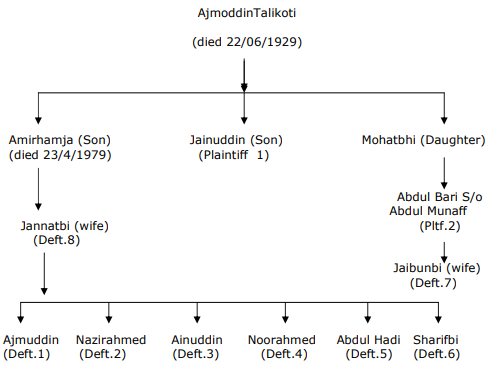
6. The plaintiffs contended that one Ajmoddin Talikoti had two sons and one daughter viz., Amirhamja, Jainuddin and daughter by name Mohatbhi respectively. The aforesaid Jainuddin, second son of Ajmoddin Talikoti is plaintiff No.1, while Abdul Bari, S/o Mohatbi, sister of Jainuddin and daughter of Ajmoddin is plaintiff No.2. The aforesaid Amirhamja, brother of Jainuddin and Mohatbi expired on 23.04.1979 leaving behind the defendant Nos.1 to 8 to succeed to his estate as his heirs and legal representatives. The defendant No.6 is the wife of plaintiff No.2. The respondent No.3(a) and (b) in the present appeal is said to be the purchaser of a portion of schedule-A from the appellants.
7. The plaintiffs contended that the suit schedule properties originally belonged to the propositus Ajmoddin Talikoti and upon his demise on 22.06.1929, the plaintiffs and defendants became entitled to their legitimate share in the suit schedule properties and since the requests/demands made by the plaintiffs to the defendants to effect partition and division of the suit schedule properties and put the plaintiffs in separate possession of their legitimate share in the suit schedule properties were not acceded to, the suit was filed.
8. The appellants-defendants filed the written statement specifically disputing and denying the various allegations made by the plaintiffs while the defendants admitted that schedule-C (house property) property originally belonged to Ajmoddin Talikoti and that the parties are entitled to their legitimate share in the same. Defendants specifically contended that schedule-A and schedule-B properties being landed properties had been granted in favour of the Amirhamja son of Ajmoddin Talikoti by the Assistant Commissioner, upon abolition of the village offices and said property was a separate exclusive and self acquired property of Amirhamja, upon whose demise, the defendants became the absolute owners being lawful and peaceful possession and enjoyment of Schedule-A and Schedule-B properties. It was contended that the plaintiffs do not have any share or right over Schedule-A and Schedule-B properties and that the suit of the plaintiffs was liable to be dismissed.
9. Based on the aforesaid pleadings, the trial Court framed the fo