
 Back
Back





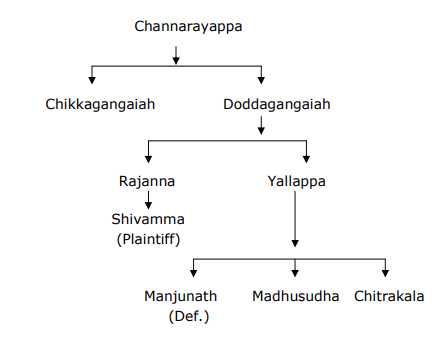
IN THE HIGH COURT OF KARNATAKA AT BENGALURU
K.S. HEMALEKHA, J.
Y. Manjunath, S/o Yallappa - Appellant
Versus
Smt. Shivamma @ Rudramma, W/o Rajanna - Respondent
Regular First Appeal No.1953 of 2023 (INJ)
Decided On : 20-08-2025
| Table of Content |
|---|
| 1. claim of title and possession based on sale deed. (Para 2 , 3 , 4) |
| 2. court observations on joint family property and standards for injunction. (Para 5 , 9 , 11 , 12) |
| 3. arguments on lack of evidence for possession and partition. (Para 7 , 8) |
| 4. court ruling on the appeal and dismissal of the trial court's decision. (Para 10) |
JUDGMENT :
K.S. HEMALEKHA, J.
The present appeal is preferred by the defendant assailing the judgment and decree dated 19.09.2023 passed in OS No. 7755/2019 on the file of the XX Additional City Civil and Sessions Judge (CCH-32), Bengaluru, (hereinafter referred to as ‘the trial Court’). By the judgment and decree, the trial Court decreed the suit, restrained the defendant by way of permanent injunction from interfering with the plaintiff's peaceful possession and enjoyment of the suit property.
2. The plaintiff is the wife of Rajanna. The plaintiff claims title and possession over the suit property based on a registered sale deed dated 05.08.1999-Ex.P2 executed by Gangamma as the GPA of G.Yallappa. It is stated that there was a palupatti (partition) on 10.04.1989 between Rajanna and Yallappa, under which the suit property fell to the share of Yallappa and later he has sold the suit property to the plaintiff through his GPA. It is the case of the plaintiff that from that day onwards the plaintiff is in possession and enjoyment of the suit property.
3. The case of the defendant is that the suit property is the joint family property jointly owned by Rajanna and Yallappa. Further that the defendant has filed O.S.7860/2014 for partition of 13 guntas in Sy. No. 105/3 and the schedule property of 5 guntas is a part of larger extent of 13 guntas. The defendant denied partition and contended that the documents under which the plaintiff claim possession is fabricated.
4. Before the trial Court, the plaintiff examined the General Power of Attorney Holder who is none other than her husband as PW1 and marked documents at Exs. P1 to P7. The defendant examined himself as DW1 and marked documents at Exs.D1 to D10.
5. The trial Court upon consideration of the oral and documentary evidence observed that though the documentary evidence indicate that the suit for partition and separate possession in respect of the schedule property is pending consideration, however Ex.P2-the registered sale deed and Exs.P3, P4-the encumbrance certificates and Ex.P5-the RTC stand in the name of the plaintiff and arrived at a conclusion that these documents have presumptive value with respect to the possession of the suit property and, by the impugned judgment and decree decreed the suit.
6. Heard the learned counsel appearing for the appellant and the learned counsel appearing for the respondent.
7. Learned counsel appearing for the appellant submits that the alleged palupatti dated 10.04.1989 was never produced before the Court. PW1 in his cross- examination has categorically admitted that there was no partition. Rajanna himself had filed O.S.368/2001 which was withdrawn for want of jurisdiction and later filed O.S.No. 8570/2004 seeking partition, which clearly shows that there was no partition effected earlier. It is argued that the suit schedule property forms part of 13 guntas in Sy. No.105/3, which is the joint family property of Rajanna and Yallappa. Hence, the plaintiff cannot claim exclusive right or possession over the suit property. It is contended that Ex.P2-the alleged sale deed is executed by Gangamma as a GPA holder, but neither the GPA was produced nor was Gangamma examined. Without proving the authority under the GPA, the sale deed is not valid in law. Further it is argued that the RTC extracts and the encumbrance certificates placed reliance by the plaintiff would not confer right, title or possession over the suit property. It is further argued that the defendant has filed O.S.7860/2014 for partition of the very schedule property and when the partition suit was pending, suit for injunction by one alleged co-owner is
In a joint family property, a permanent injunction against a co-owner is unjustified unless exclusive possession can be established.
The main legal point established is that the plaintiff must prove the validity of the Will in accordance with the Evidence Act and that no injunction can be granted against co-owners.
A claimant must establish legal ownership to obtain an injunction; granting an injunction based on a dismissed declaration suit is contrary to established legal principles.

Injunction against co-owners is not maintainable without proof of partition; remedies lie in seeking partition instead.

A permanent injunction cannot be granted against co-owners without establishing clear possession or valid title, especially when title is disputed.


In a property injunction suit, a plaintiff must demonstrate current possession, irrespective of competing title claims, to obtain relief.

In a suit for permanent injunction, the plaintiff must establish lawful possession and title, as incidental findings on title are permissible.

Injunction - Mere occupation of a portion or entire joint family property by one co-owner does not amount to ouster of other co-owner from said property.
The main legal point established in the judgment is that a co-owner who is not in exclusive possession of any part of the property is not entitled to seek an injunction against another co-owner, unle....



An indispensable Tool for Legal Professionals, Endorsed by Various High Court and Judicial Officers
Please visit our Training & Support
Center or Contact Us for assistance

Scan Me!
India’s Legal research and Law Firm App, Download now!


For Daily Legal Updates, Join us on :



 Back to top


