
 Back
Back





IN THE HIGH COURT OF KARNATAKA AT BENGALURU
E.S. Indiresh, J.
Smt. Nagalakshmamma @ Nagarathnamma, W/O Late G. Thimmappa And Ors. - Appellants
Versus
Sri. Thyagaraju, W/O Late G. Thimmappa - Respondent
Regular Second Appeal No. 413 OF 2015 (PAR)
Decided On : 12-08-2025
JUDGMENT :
E.S. Indiresh, J.
This appeal is preferred by the plaintiffs assailing the judgment and decree dated 20.11.2014 in R.A.No.87/2014 on the file of Additional Senior Civil Judge and JMFC, Chikkaballapura, allowing the appeal in part and decreeing the suit of the plaintiffs in respect of item No.1 in O.S.No.143/2010 on the file of Civil Judge, Bagepalli, dismissing the suit of the plaintiffs as per the judgment and decree dated 13.03.2014.
2. For the sake convenience, parties are referred to as per their ranking before the Trial Court.
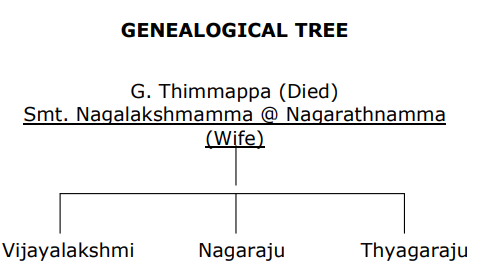
3. It is the case of the plaintiffs that, late Sri. G. Thimmappa and Smt. Nagalakshmamma (plaintiff No.1) are the parents of plaintiff Nos.2, 3 and the defendant.
4. It is the case of the plaintiffs that, the suit schedule properties are the ancestral properties of the plaintiffs and the defendant and as such, the plaintiffs are entitled for share in the suit schedule properties. It is also stated that, the plaintiffs filed a suit in O.S.No.160/2009 which came to be dismissed for non-prosecution on 02.11.2010. Further it is stated that, the plaintiffs have been advised to file a suit in O.S.No.143/2010 based on new cause of action and accordingly the plaintiffs have filed a suit seeking partition and separate possession in respect 3/4 share in the suit schedule properties.
5. After service of notice, the defendant entered appearance and admitted the relationship between the parties.
6. It is the specific case of the defendant that, the father of the plaintiffs had acquired the schedule properties as per the Partition Deed dated 05.09.1973 registered on 14.09.1973. It is also stated in the written statement that, the suit schedule properties are not the joint family properties of the plaintiffs and the defendant. It is further contended that, there was an oral partition in the family and accordingly, sought for dismissal of the suit.
7. The appellants have filed I.A.No.1/2018 and produced two documents i.e., certified copies of the Partition Deed dated 14.09.1973 and the proceedings of the order dated 04.04.2013 by Revenue Divisional Officer, Penukonda.
8. Based on the pleadings and record, the Trial Court has formulated the issues for its consideration.
9. In order to establish their case, the plaintiffs have examined four witnesses as P.W.1 to P.W.4 and got marked twenty four documents as Exs.P1 to P24. The defendant has examined six witnesses as D.W.1 to D.W.6 and got marked nine documents as Exs.D1 to D9.
10. The Trial Court after considering the material on record, by judgment and decree dated 13.03.2014 dismissed the suit of the plaintiffs. Feeling aggrieved by the same, the plaintiffs have preferred R.A.No.87/2014 and same was resisted by the defendant. The First Appellate Court after re-appreciating the material on record by judgment and decree dated 20.11.2014 allowed the appeal in part, holding that the plaintiffs are entitled for 1/4 share each in item No.1 of the suit schedule property, confirmed the judgment and decree passed by the Trial Court in respect of the remaining suit items. Feeling aggrieved by the same, the plaintiffs have preferred this Regular Second Appeal.
11. This Court vide order dated 28.06.2018 has formulated the following issues for consideration:
"i) Whether the first appellate court erred in holding that the appellants have not proved that item Nos.3 to 7 of the suit schedule properties are joint family properties and therefore available for partition, contrary to the evidence on record?
ii) Whether the Courts below erred in not granting relief to the third defendant in view of the amended provisions of Section 6 of the HINDU SUCCESSION ACT , 1956 and Section 6 A of the Karnataka (Amendment) Act, 1990 and there being no registered partition or decree of the Court after the registered partition deed dated 05.09.1973?
iii) Whether the Courts below erred in concluding that item No.2 of the suit schedule property was separate property of late G.Thimmappa?"
12. Heard Sri.
AI
The court established that evidence must substantiate claims of oral partition, prioritizing the registered Partition Deed as definitive proof for ancestral property entitlements under the Hindu Succ....

The court reaffirmed that properties allotted in a partition retain ancestral status, entitling descendants with rights despite claims of separate property post-partition.
A joint family property remains so despite claims of prior partition; a coparcener retains rights to inheritance under the Hindu Succession Act.

Daughters are entitled to equal share in ancestral joint family property under Sec. 6 of the Hindu Succession Amendment Act 2005.
The court affirmed that partition shares from ancestral property remain joint family property for descendants, entitling them to assert claims over the inherited property.

Widow's right to claim share in ancestral property established under Hindu Succession Act, where properties purchased through ancestral nucleus retain joint family character.
The heavy burden of proof upon the proponent of oral partition before it is accepted, as per the settled principle of law by the Apex Court.

The court affirmed that properties devolving under Section 8 of the Hindu Succession Act are absolute and not ancestral, emphasizing that mere assertions cannot establish joint family character witho....



An indispensable Tool for Legal Professionals, Endorsed by Various High Court and Judicial Officers
Please visit our Training & Support
Center or Contact Us for assistance

Scan Me!
India’s Legal research and Law Firm App, Download now!


For Daily Legal Updates, Join us on :



 Back to top


