


 Back
Back





2025 Supreme(Kar) 1569
IN THE HIGH COURT OF KARNATAKA, DHARWAD BENCH
S.R. Krishna Kumar, C.M. Poonacha, JJ.
Sri. Praveen Annasaheb Gijavani - Appellant
Versus
Sri. Appasaheb Bharmappa Gijavani And Ors.- Respondents
Regular First Appeal No. 100143 of 2022 (DEC/PAR-)
Decided On : 12-08-2025
For the Appellant :Sri. H.R. Deshpande, Advocate
A consent decree, valid under CPC rules, cannot be challenged in independent suits; remedy lies only in the court that recorded the compromise.
Headnote:(A) Code of Civil Procedure, 1908 - Section 96 - Preliminary issue - Dismissal of suit as not maintainable due to the plaintiff being born after the compromise decree was passed - Suit challenging compromise decree must be dismissed on grounds of maintainability as the compromise was lawful and binding unless set aside in the original suit. (Paras 1, 11, 15)
(B) Consent Decree - Validity and binding nature - Consent decrees operate as estoppels and cannot be challenged in independent suits unless established as invalid in the original suit court. (Paras 13, 14)
(C) Legal Principle - A party cannot challenge a consent decree resulting from a lawful compromise, highlighting the necessity to seek remedy in the court that recorded the compromise. (Paras 13, 14)
Facts of the case:
The plaintiff filed a suit challenging a compromise decree from 1992, claiming it was inequitable and sought fresh partition despite being born after the decree was issued. The trial court dismissed the suit finding it not maintainable.
Findings of Court:
The plaintiff was not entitled to challenge the compromise decree as he lacked standing, given he was born post-decree, thus rendering the suit not maintainable.
Issues: Whether the suit challenging a consent decree was maintainable given the plaintiff's birth occurring after the decree.
Ratio Decidendi: The court ruled that since the plaintiff was not a party to the original compromise decree, he had no standing to challenge it, and the remedy lies in the court that passed the decree, not through an independent suit.
Result: Appeal dismissed.
JUDGMENT :
C.M. POONACHA, J.
This Regular First Appeal is filed under Section 96 of the Code of Civil Procedure, 1908, [Hereinafter referred to as the ‘CPC’], by the plaintiff challenging the judgment and decree dated 27.10.2021 passed in O.S.No.78/2019 on the file of Senior Civil Judge, Hukkeri, [Hereinafter referred to as the ‘Trial Court’], whereunder, the suit filed by the appellant/plaintiff was dismissed as not maintainable by the Trial Court, having answered Preliminary Issue No.1 in the affirmative.
2. The parties will be referred to as per their ranking before the Trial Court, for the sake of convenience.
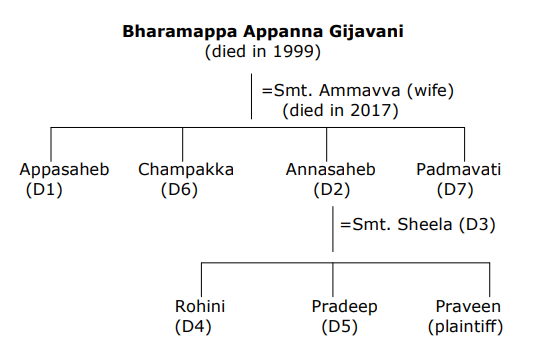
3. The factual matrix in a nutshell leading to the present appeal is that the plaintiff filed the suit for a relief of declaration, that the compromise decree dated 25.04.1992 passed in O.S.No.99/1992 by the Munsiff Court, Hukkeri as inequitable, unfair, unjust and for reopening the partition as also seeking for fresh partition in the suit properties by awarding 1/10th share of the plaintiff in the suit properties. It is the case of plaintiff in the suit that the propositus was one Bharmappa Appanna Gijavani. The genealogy of the family of the plaintiff and defendants from their propositus is as under:
4. It is the case of plaintiff that the joint family of plaintiff and defendants headed by the propositus owned the suit properties, and that the propositus personally cultivated the joint family properties and managed the joint family out of the said joint family income. That the propositus, being karta of the joint family, was also running a Kirana (Grocery) shop in one of the suit properties as also purchased a goods truck, which he used to give on hire basis to transport goods and was thus earning a good income from all the said sources. That, from and out of the joint family income, further properties were purchased. That the propositus died in the year 1990-91 and the elder son, namely Appasaheb (defendant No.1), was managing the affairs of the joint family as well as the suit properties. That the father of the plaintiff i.e., Annasaheb (defendant No.2), was mentally retarded, incapable of taking independent decisions and was doing work only under the supervision and directions of others and he used to blindly follow the directions of defendant No.1. That defendant No.1 acquired a dominant position in the joint family. That the plaintiff having attained majority, a few months prior to the suit, after making enquiries realized that, defendant No.1, taking advantage of the situation, appropriated various joint family properties for himself. That defendant No.1 filed a suit in O.S.No.99/1992 on the file of I Additional Civil Judge and C.J.M., Hukkeri, for partition and separate possession of the joint family properties on 24.04.1992 and on the next day itself, i.e., on 25.04.1992, he took his parents as well as defendant No.2 (Annasaheb) to Hukkeri, by stating that their presence is required for executing power of attorney in his favour for managing the affairs of the joint family properties. That, since his parents and brother were fully depending upon him and his direction, they accompanied him to Hukkeri and affixed their signatures and thumb impression wherever required by the defendant No.1. That defendant No.1 got their signatures on vakalath and compromise petition on 25.04.1992, whereunder, he took half share of the suit properties, although he was entitled to only 1/4th share. That it was falsely mentioned in the compromise petition that he had given Rs.75,000/- cash to his brother i.e., defendant No.2, when he had no independent income for giving the said amount. That the compromise petition was obtained without the knowledge and consent of his parents and his brother Annasaheb and hence, is not binding on the plaintiff. That defendant No.1 also got executed a registered mortgage deed in respect of the joint family lands in favour of the bank and also under the guise of getting registered mortgage deed, got r















