
 Back
Back





IN THE HIGH COURT OF KARNATAKA AT BENGALURU
RAVI V.HOSMANI, J.
Preethipriya Enterprises – Appellant
Versus
Sadashiva Rao S/o Late Baburao – Respondent
Criminal Revision Petition Nos. 1493, 1520, 1521, 1523 of 2023
Decided On : 06-01-2026
| Table of Content |
|---|
| 1. revisions based on section 138 of ni act. (Para 1 , 2 , 3) |
| 2. defenses presented by the accused. (Para 4 , 5 , 6) |
| 3. opposition to revision petitions. (Para 7 , 8) |
| 4. basis for considering contentions. (Para 9 , 10) |
| 5. examination of evidentiary burden and presumptions. (Para 11 , 12 , 13 , 14) |
| 6. imposition of interest and legality of accused no.2's conviction. (Para 15 , 16) |
| 7. partial allowance of revision petitions. (Para 17) |
ORDER :
1. Sri KA Chandrashekar, learned counsel for petitioners (accused) in all these matters, submitted that revision petitions were against concurrent erroneous judgments, convicting accused for offence punishable under Section 138 of Negotiable Instruments Act, 1881 ('NI Act' for short) as follows:
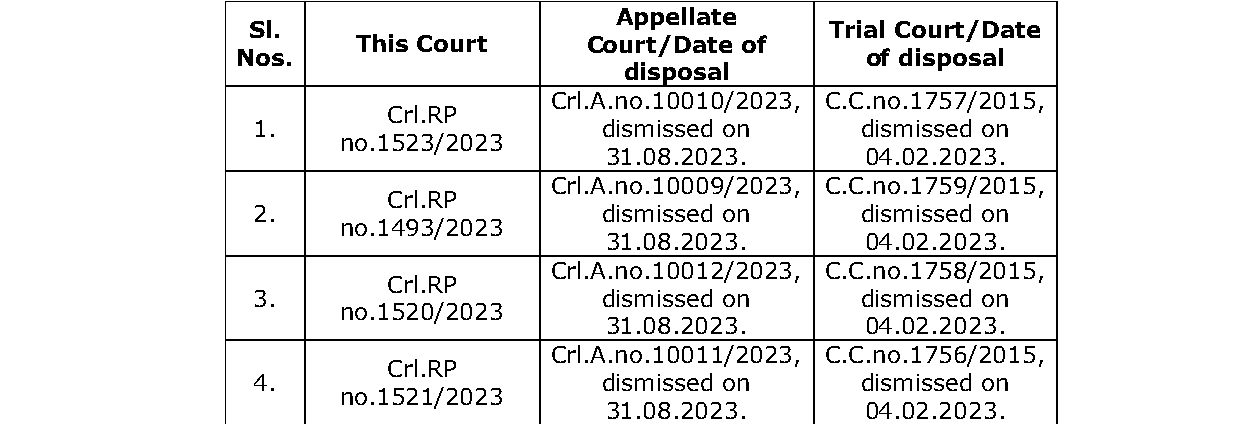
2. It was submitted, Revision petitions arose out of similar facts and circumstances and that challenge was on similar grounds. Therefore reference would be made to particular facts in Crl.R.P.no.1523/2023 only for sake of convenience.
3. It was submitted, present proceedings arose out of a private complaint filed by respondent (complainant) under Section 200 of Code of Criminal Procedure, 1973 (‘CrPC’ for short) alleging that accused Firm was due to complainant a sum of Rs.10 Lakhs and for discharge of same, issued cheque bearing no.122968 dated 30.03.2015 drawn on State Bank of Mysuru, Tipturu Branch, which when presented returned dishonored with endorsement ‘funds insufficient' on 12.04.2015 and thereafter, demand notice dated 23.04.2015 got issued by complainant returned with postal shara 'addressee absent for seven days' and accused failed to repay cheque amount within time and thereby committed offence punishable under Section 138 of NI Act.
4. It was submitted, on appearance, accused denied charges and sought trial, wherein, complainant examined himself as PW.1 and got marked Exs.P1 to P5. On appraisal of incriminating material, accused denied same as false, which was recorded as his statement under Section 313 of CrPC. Accused did not lead defence evidence. It was submitted, accused had raised several defences and substantiated same in cross-examination of complainant, but trial Court convicted accused without appreciation of entire material. Even appeal filed against same was dismissed without proper re- appreciation, leading to this revision. Thus, impugned judgments suffered from perversity calling for interference.
5. It was submitted, accused had denied having any financial transactions with complainant and consequently contended that cheque in question was not issued towards any legally enforceable debt. It was submitted, complainant had failed to disclose even minimum particulars such as date, time and place of lending to accused, which would be a material omission, when accused had denied any transaction with complainant. It was submitted, in cross-examination complainant examined as PW.1 admitted that there was no agreement for payment of interest on amount lent. Despite same, while passing impugned judgment, trial Court had directed return of cheque amount with 12% interest p.a., which would be contrary to law.
6. It was submitted, while above contentions were common to all revision petitions, there were specific additional contentions insofar as Crl.R.P.no.1493/2023 and Crl.R.P.no.1521/2023 only, namely that in cross-examination, PW.1 - complainant admitted that only accused no.1 had come for borrowing money and that Accused no.2 was not a signatory to cheques in question. Therefore, arraignment of Accused no.2 was challenged relying on ratio laid down in following decisions:
(i) Aparna A. Shah v. Sheth Developers Pvt. Ltd. (2013) 8 SCC 71
(ii) Upasana Mishra v. Trek Technology India Pvt. Ltd. 2023 SCC OnLine SC 1740
(iii) Dilip Hariramani v. Bank of Baroda, (2024) 15 SCC 443
(iv) Susela Padmavathy Amma v. Bharti Airtel Ltd. (2024) 12 SCC 131
(v) Smt. Veenashri v. Sri Shankar, 2022 KHC 35359
(vi) Parveen Kumar v. Devki Nandan Jain, AIR OnLine 2021 Kar 2777
7. On above grounds, learne
AI
The omission of particulars in lending does not negate a conviction for dishonor of a cheque if sufficient evidence of issuance exists; excessive interest imposition may be modified.


To convict under Section 138 of the NI Act, it is essential to establish the signature and due execution of the cheque, with the burden resting on the accused to disprove after admission.
The burden to prove financial capability lies on the complainant when the accused raises a probable defense, not requiring proof beyond reasonable doubt.

When a complainant discharges their initial burden under Sections 138 and 139 of N.I. Act, presumptions in their favor come into play, which can be rebutted by preponderance of probabilities.



An indispensable Tool for Legal Professionals, Endorsed by Various High Court and Judicial Officers
Please visit our Training & Support
Center or Contact Us for assistance

Scan Me!
India’s Legal research and Law Firm App, Download now!


For Daily Legal Updates, Join us on :



 Back to top


