
 Back
Back





IN THE HIGH COURT OF KARNATAKA AT BENGALURU
G.BASAVARAJA
State Of Karnataka By Soladevanahalli Police Station – Appellant
Versus
Manjunatha B. S/o. Basavaraju – Respondent
| Table of Content |
|---|
| 1. overview of the case and charges (Para 1 , 3 , 4 , 5) |
| 2. arguments of parties regarding acquittal (Para 7 , 8) |
| 3. court's analysis of trial court's decision (Para 9 , 10 , 11 , 31) |
| 4. witness testimonies and evidence evaluation (Para 19 , 30) |
| 5. final order of appeal dismissal (Para 32) |
JUDGMENT :
G.BASAVARAJA, J.
1.The State has preferred this appeal against the judgment of Acquittal dated 31st December, 2014 passed in SC.No.82 of 2013 by the Fast Track Court-III, Bengaluru Rural District, Bengaluru (for short "the trial Court").
2. For the sake of convenience, the parties herein are referred to as per their rank before the trial Court.
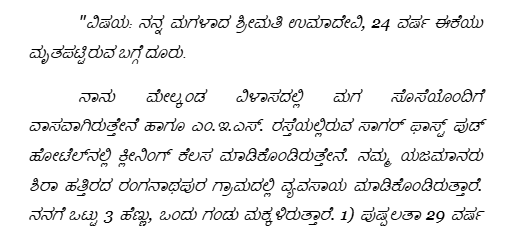
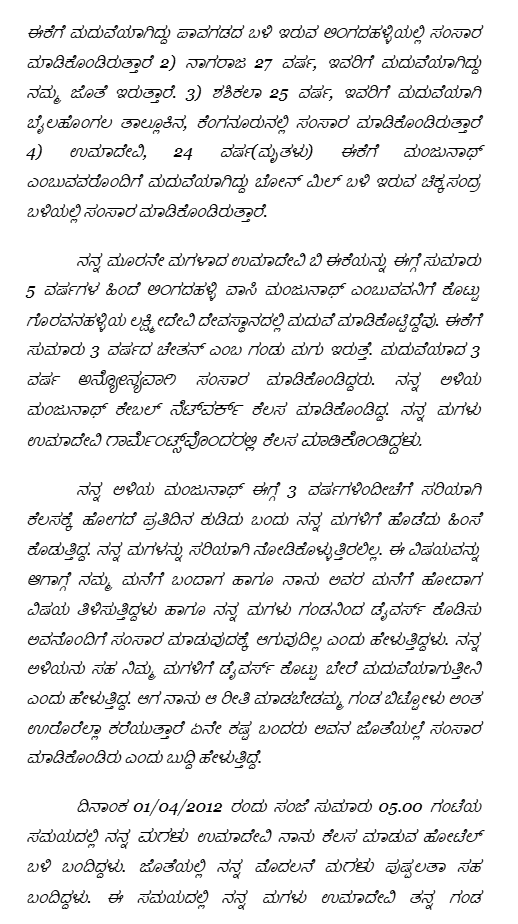
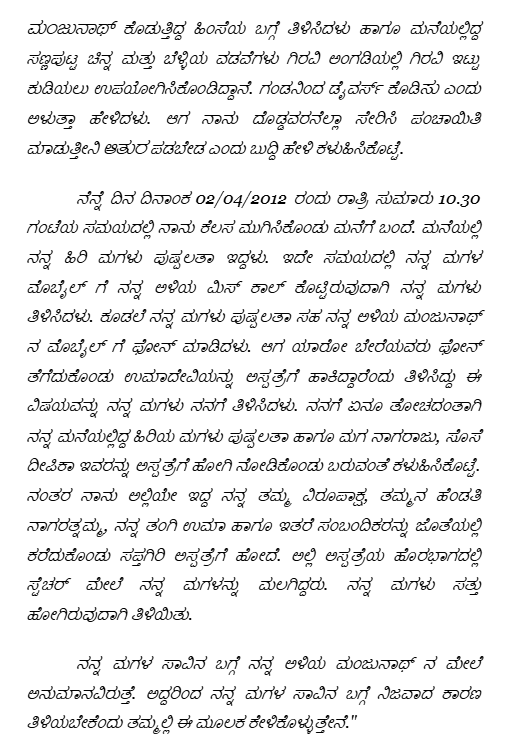
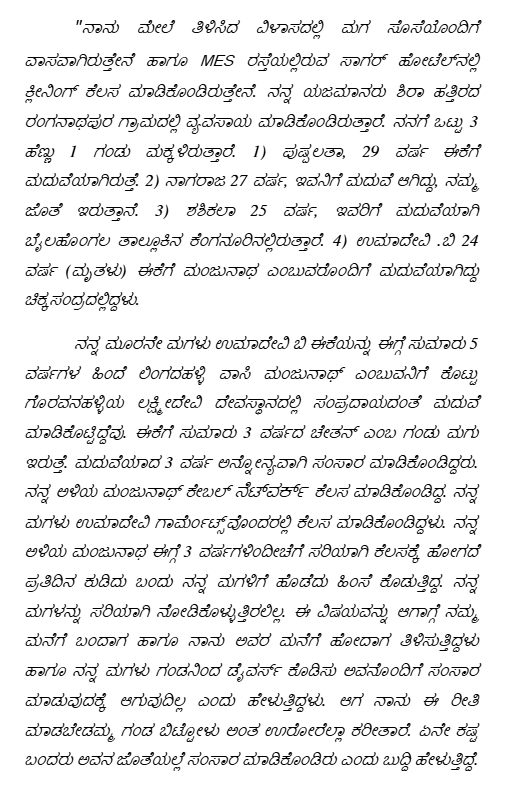
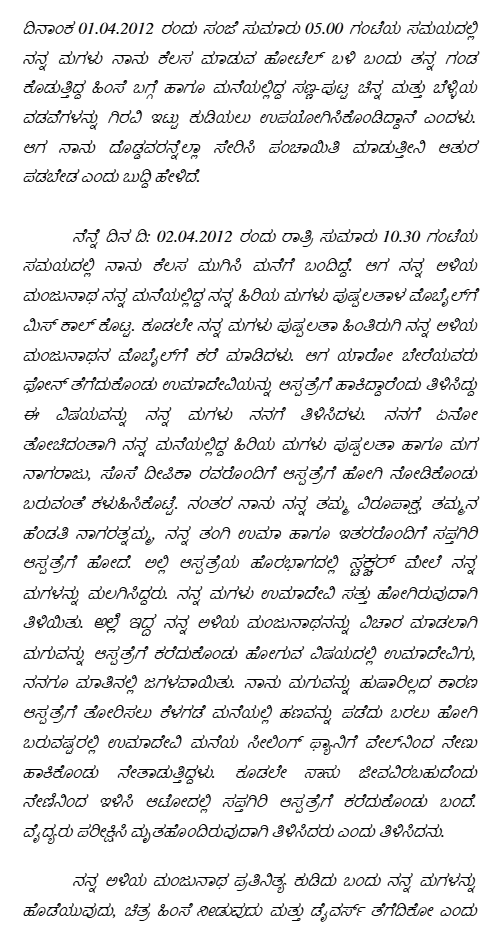
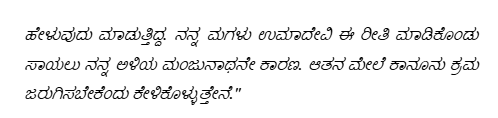
3. Brief facts leading to this appeal are that, Sub-Inspector of Police, Soladevanahalli, has submitted charge-sheet against the accused for the offence under sections 498-A and 306 of Indian Penal Code. It is alleged by the prosecution that, the deceased Smt. Umadevi @ Uma was married to accused- respondent herein on 28th October, 2007. After their marriage, the accused and deceased were living together at Soladevanahalli in the building of CW11 and for a period of 3 years they were living amicably. In their wedlock they had begotten a b
The acquittal of the accused was upheld due to lack of cogent evidence for Sections 498-A and 306 IPC, reaffirming the principle of presumption of innocence and standards governing appellate review o....

The court affirmed that for a conviction under Section 306 IPC, there must be clear evidence of intent to abet the suicide, which was lacking in this case.

Point of law : where the minimum punishment is prescribed for an offence and the Court proposes the impose the minimum punishment only, in that case the Court is not required to hear the accused on t....

The court emphasized that mere allegations of harassment are insufficient to establish abetment of suicide; clear evidence of intent and coercion is required.

The appellate court must respect the presumption of innocence and the trial court's reasonable conclusions in acquittal appeals, intervening only when the trial court's decision is unreasonable or pe....
In acquittal appeals, the presumption of innocence is paramount, and the appellate court should not interfere unless the trial court's conclusions are unreasonable or perverse.
To sustain a conviction under Section 306 IPC for abetment of suicide, there must be clear evidence of instigation or active involvement by the accused, which was not established in this case.
The appellate court must respect the presumption of innocence and not interfere with acquittal unless the trial court's conclusion is unreasonable.
The prosecution must prove guilt beyond a reasonable doubt in cases of acquittal, emphasizing the presumption of innocence and the need for reliable evidence linking alleged cruelty to suicide.
Prosecution failed to provide sufficient evidence to substantiate claims of dowry harassment leading to suicide, rendering conviction under IPC Sections 498A and 306 unsustainable.



An indispensable Tool for Legal Professionals, Endorsed by Various High Court and Judicial Officers
Please visit our Training & Support
Center or Contact Us for assistance

Scan Me!
India’s Legal research and Law Firm App, Download now!


For Daily Legal Updates, Join us on :

 Back to top


