
 Back
Back





IN THE HIGH COURT OF KARNATAKA AT BENGALURU
G.Basavaraja, J.
Muthu, S/O Poomale - Appellant
Versus
The State By Hal Police Rep. By The Govt. Pleader - Respondent
Criminal Appeal No.2207 of 2022
Decided On : 13-01-2026
| Table of Content |
|---|
| 1. background of the appeal against conviction. (Para 1 , 3 , 4) |
| 2. arguments regarding deficiencies in prosecution evidence. (Para 5 , 6) |
| 3. court's examination of evidence and procedural lapses. (Para 7 , 8 , 10 , 11 , 12 , 13 , 21 , 22) |
| 4. modification of conviction and sentencing. (Para 23) |
| 5. final order of appeal and sentencing decision. (Para 25) |
JUDGMENT :
G BASAVARAJA, J.
Appellant is before the court in this appeal, challenging the judgment of conviction dated 30th March 2022 and order on sentence dated 31st March 2022, passed in Special CC No.546 of 2015 by the Additional City Civil and Sessions Judge-FTSC-II, Bengaluru (for short “the trial Court”).
2. For the sake of convenience, the parties herein are referred to as per their status and rank before the trial court.
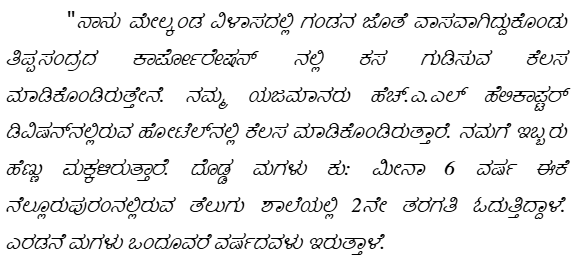
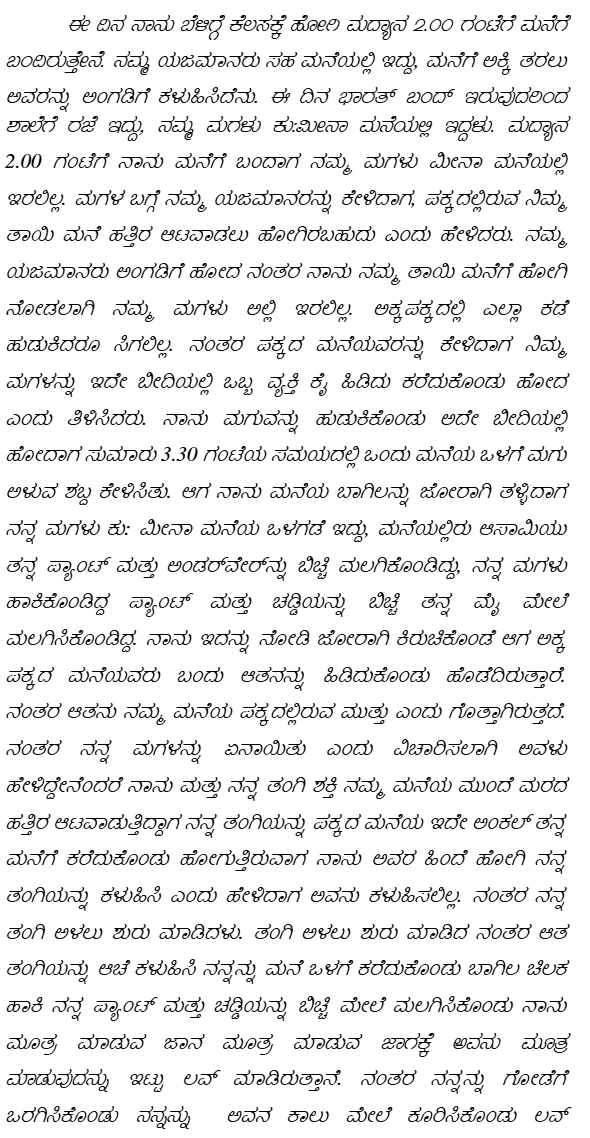
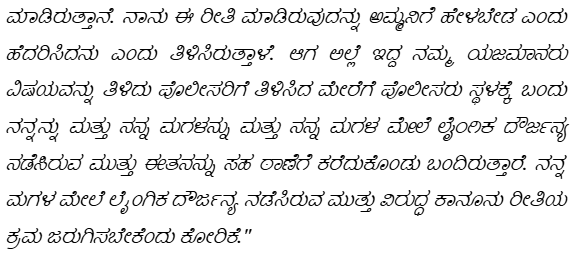
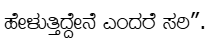
3. Brief facts leading to this appeal are that Police Inspector of HAL Police Station, filed charge-sheet against the accused for the offences punishable under Sections 376 and 506 of Indian Penal Code and Section 6 of Protection of Children from Sexual Offences Act, 2012 (for short “the POCSO Act”). It is alleged by the prosecution that CW1 is the wife of CW3 and the victim minor girl who is aged 8 years and studying in 2nd standard, is the daughter of CW1 and CW3. The said family is residing in the house No.26, Munibachappa Colony, Jagadish Nagar, HAL. The house of the accused is situated opposite to the house of CW1. On 2nd September 2015, the Government had declared a holiday on account of Bharat Bandh. The victim was in her house on that day. At about 2.00 pm when the victim minor girl was playing in front of her house, the accused took her to the house, closed the main door and forcibly had physical contact with the minor girl without her consent, and he also asked her not to disclose the said fact to anybody and posed a life threat to the victim minor girl. Thus, the accused committed the alleged offences. After filing charge-sheet, case was registered in Special CC No.546 of 2015. Accused was enlarged on bail.
4. Upon hearing on charges, the trial court framed charges against the accused for the commission of alleged offences. The same were read over and explained to the accused. Having understood the same, accused pleaded not guilty and claimed to be tried. To prove the guilt of the accused, the prosecution has examined thirteen witnesses as PWs1 to 13, seven documents were marked as Exhibits P1 to P7 and 12 material objects were marked as MOs1 to 12. On closure of prosecution evidence, statement of the accused under Section 313 of Code of Criminal Procedure was recorded. Accused has totally denied the evidence of prosecution witnesses appearing against him. However, he did not choose to lead any defence evidence on his behalf. Having heard the arguments on both sides, trial court has convicted the accused for the offence punishable under Sections 376 and 506 of Indian Penal Code and Section 6 of POCSO Act and passed sentence to undergo rigorous imprisonment for a period of 20 years with fine of Rs.10,000/-, in default of payment of fine, the accused shall undergo simple imprisonment for a period of six months. Further, the accused is sentenced to undergo simple imprisonment for a term of one year for the offence punishable under Section 506 of Indian Penal Code. Being aggrieved by the impugned judgment of conviction and order on sentence, the appellant has preferred this appeal.
5. Sri Rakshit R, learned Counsel appearing for the appellant would submit that the prosecution has failed to prove that the appellant had physical contact with the victim girl. Though the prosecution has not established the said fact, the trial Court has the convicted the appellant and sentenced him for aforesaid offences. He would submit that in order to convict the accused under Section 6 of POCSO Act, the prosecution has to prove that the accused was involved in the commission of offence as per the provisions of the said act, i.e. the penetrative aggravated s

AI
The necessity of corroborative evidence in sexual assault cases is critical, and the failure to provide medical evidence raises reasonable doubt, impacting the legality of convictions.

The court emphasized the reliability of the victim's testimony while clarifying that mere sexual assault does not meet the threshold for aggravated charges under POCSO, which necessitates proof of pe....


The prosecution must prove guilt beyond reasonable doubt, and the quality of evidence is essential in criminal law.


The conviction under the POCSO Act requires substantial evidence beyond mere suspicion; failure to prove such evidence necessitates acquittal.
The court held that the prosecution failed to prove its case beyond a reasonable doubt due to delays, inconsistencies, and lack of corroborative evidence.

The competence of child witnesses, scrutiny of hostile witnesses' testimony, and the significance of corroborative evidence and the presumption under Section 29 of the POCSO Act are central legal pri....



An indispensable Tool for Legal Professionals, Endorsed by Various High Court and Judicial Officers
Please visit our Training & Support
Center or Contact Us for assistance

Scan Me!
India’s Legal research and Law Firm App, Download now!


For Daily Legal Updates, Join us on :



 Back to top


