
 Back
Back





IN THE HIGH COURT OF KARNATAKA AT BENGALURU
G.BASAVARAJA, J.
Sri T Prakash S/o Late Thimmashetty - Appellant
Vs.
Smt. Drakshayeni W/o Ramesh - Respondent
Criminal Appeal No. 1511 of 2023 (A)
Decided On : 26-11-2025
| Table of Content |
|---|
| 1. facts regarding loan and cheque issuance. (Para 1 , 3) |
| 2. arguments from appellant and respondent. (Para 7 , 8) |
| 3. court's analysis of evidence and presumption. (Para 10 , 11) |
| 4. statutory presumption under n.i. act. (Para 12) |
| 5. dismissal of appeal and conclusion. (Para 14) |
JUDGMENT :
G.BASAVARAJA, J.
The appellant/complainant has preferred this appeal against the judgment of acquittal passed by the Prl. Civil Judge and JMFC at Malur in CC No.25/2022 dated 12.07.2023.
2. For the sake of convenience, the parties herein are referred to as per their status before the trial Court.
3. Brief facts leading to this appeal are that the appellant has filed complaint under Section 138 of NI Act. It is alleged by the complainant that, during the 1st week of September-2021, the accused has borrowed a loan of Rs.10,00,000/- for payment of her father's hospital expenses and for her family necessities. She agreed to repay the said loan within three months and towards repayment, the accused has issued a cheque bearing No.877480 on 06.11.2021 drawn on State Bank of India, Malur Branch. When the said cheque was presented by the complainant for encashment before Karnataka Gramina Bank, Kudiyanur Branch, same returned with endorsement "Funds Insufficient". Thereafter, the complainant issued legal notice dated 01.12.2021 to the accused through RPAD and the same was duly served on 08.12.2021. Inspite of legal notice, accused did not pay the cheque amount. Hence, the complainant has lodged the complaint. After filing the complaint, the case was registered in PCR No.1/2022. After taking cognizance case was registered in CC No.25/2022.
4. The summons was issued to the accused. In response to summons, the accused appeared before the trial Court and enlarged on bail. The substance of plea was recorded. Having understood the same, the accused pleaded not guilty and claimed to be tried.
5. To prove the guilt of the accused, the complainant examined himself as PW1 and 7 documents were marked as Exhibits P1 to P7. On the other-hand, the accused examined herself as DW1 and marked 4 documents as Exhibits D1 to D4. On closure of complainant side evidence, statement under Section 313 of Code of Criminal Procedure was recorded. Accused has totally denied the evidence of PW1.
6. Having heard the arguments on both sides, the trial Court has acquitted the accused. Being aggrieved by this judgment of acquittal, complainant/appellant has preferred this appeal.
7. The learned counsel for the appellant would submit that, the trial Court erred in not considering that when the signature and issuance of cheque is admitted, the presumption is that there is a legally enforceable debt. It is for the accused to rebut presumption. In the instant case, the trial Court has imposed burden on complainant to prove that there is legally recoverable debt by overlooking the concept of presumption contemplated under the provisions of Negotiable Instruments Act. The trial Court has committed an error in giving contrary finding that, respondent has not disputed that she has no knowledge about the issuance of notice as per Exhibit P3. Same was duly served on the respondent and she has not issued any reply to the demand notice. When this being the fact, presumption in favour of the appellant that the respondent has admitted that legally enforceable debt is available. The respondent did not reply to the demand notice issued by the appellant. Exhibits D1 to D3 do not support the case of the respondent since the said documents are not accompanied by Section 65B of the Indian Evidence Act. The accused has not produced any materials to rebut the presumption under the Negotiable Instruments Act.
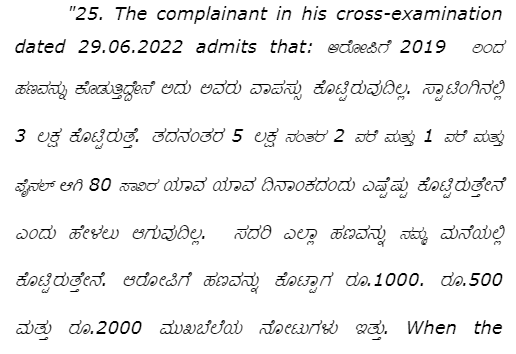
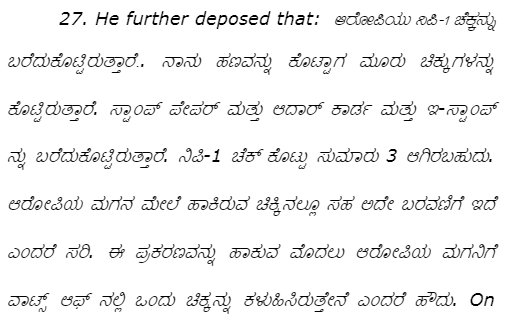
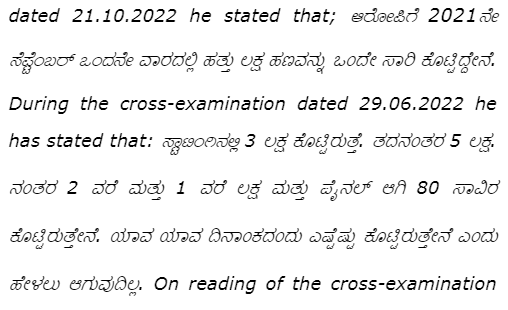
8. The trial Court has not properly appreciated the evidence on record in its proper perspective. Further, it is also submitted that the accused have taken defence that the signed cheque was misused by the complainant. But the accused has not taken any legal steps against this complainant till t
AI
The burden of proof in Section 138 NI Act cases shifts to the complainant when the accused challenges their financial capacity, emphasizing that presumption of innocence protects the acquitted party.
The presumption of the issuance of a cheque in discharge of a debt under Sections 138 and 139 of the NI Act must be upheld in the absence of substantial evidence to the contrary from the accused.

The appeal was dismissed as the trial court found inconsistencies in evidence and upheld the presumption of innocence in favor of the acquitted accused.

Presumption under Sections 118(a) and 139 of NI Act rebutted on preponderance of probabilities where cross-examination shows complainant's lack of financial capacity as housewife with unproven remitt....

The presumption of consideration for a cheque does not negate the complainant's burden to prove the existence of a legally recoverable debt, which can be rebutted by the accused.

The presumption under Section 139 of the Negotiable Instruments Act mandates that once a cheque's execution is admitted, it is presumed to be for a legally enforceable debt, and the burden to rebut t....
Cheque for time-barred debt not liable under Section 138 NI Act; Sections 118/139 presumption rebutted by prior stop payment on lost cheque and lack of financial capacity proof; acquittal interferenc....
The appellant must establish the monetary transaction and discharge the initial burden to raise the presumption under sec. 139 of N.I. Act to succeed in a case under sec. 138 of N.I. Act.

Dishonour of cheque – When Complainant has not established his financial status, presumption is not available in his favour.

The burden is on the complainant to prove financial capacity when questioned; a mere presumption does not suffice if evidence is lacking.



An indispensable Tool for Legal Professionals, Endorsed by Various High Court and Judicial Officers
Please visit our Training & Support
Center or Contact Us for assistance

Scan Me!
India’s Legal research and Law Firm App, Download now!


For Daily Legal Updates, Join us on :



 Back to top


