Back





2026 Supreme(Kar) 414
IN THE HIGH COURT OF KARNATAKA AT BENGALURU
Mohammad Nawaz, G Basavaraja, JJ.
V. Amaresh @ Ambarish, S/o Late Venkateshappa - Appellant
Versus
State Of Karnataka By Kolar Women Police Station - Respondent
Criminal Appeal No.366 of 2021
Decided On : 27-08-2026
Important Points
Subject
Criminal Law - Sexual Offences
Act Referred
PROTECTION OF CHILDREN FROM SEXUAL OFFENCES ACT : S.2(d), S.29, S.30, S.6
SCHEDULED CASTES AND SCHEDULED TRIBES PREVENTION OF ATROCITIES ACT : S.3(2)(v)
CRIMINAL PROCEDURE CODE : S.161, S.164, S.164(5), S.207(iv), S.211, S.228, S.238, S.313, S.357(a), S.464
EVIDENCE ACT : S.114(g), S.35
BHARATIYA NAGARIK SURAKSHA SANHITA : S.183(5), S.189, S.230, S.230(iv), S.234, S.251
CONSTITUTION OF INDIA : Art.21
Headnote
(B) POCSO Act - Age of victim - Proof - The best evidence for determining the age of a child is that of his/her parents, if supported by unimpeachable documents - School register/certificate requires to be proved in accordance with law - Where the date of birth in school records is belied by unimpeachable evidence of reliable persons and contemporaneous documents like the date of birth register of the Municipal Corporation or Government Hospital, the school entry may be discarded - Non-collection of the best available evidence (e.g., SSLC marks card, birth certificate) by the Investigating Officer leads to an adverse inference under Section 114, Illustration (g) of the Evidence Act that the withheld evidence would be unfavourable to the prosecution. (Paras 9, 14, 15, 16)
(C) Criminal trial - Fair trial - Right of accused - An accused is entitled to know the precise nature of the accusation - A conviction for an aggravated offence without a specific charge framed for that offence violates the right to a fair trial under Article 21 - A conviction for an offence graver than the one charged, without affording the accused an opportunity to defend against its specific ingredients, is unsustainable. (Paras 20, 21)
(D) Criminal trial - Section 207(iv) Cr.P.C. (Section 230(iv) BNSS) - Mandatory furnishing of documents - The obligation to furnish a copy of the statement recorded under Section 164(5) Cr.P.C. (Section 183(5) BNSS) to the accused is mandatory - Non-compliance violates the accused's right to a fair trial under Article 21 - The trial court has no discretion to withhold such documents. (Paras 25-31) (E) Investigation - Investigating Officer's duty - Before filing a charge-sheet, it is the duty of the Investigating Officer to peruse the statement recorded under Section 164(5) Cr.P.C., apply his mind to it, and be satisfied that sufficient material exists to proceed against the accused - Acting mechanically without such application of mind is contrary to the mandate of the law. (Paras 41, 42) (F) Evidence - Witness testimony - Contradiction and corroboration - A statement recorded under Section 164(5) Cr.P.C. can be used for corroboration or contradiction - Where the victim's Section 164 statement omits the core allegation of rape, it falsifies her later trial testimony, rendering her evidence untrustworthy. (Paras 23, 24, 33) (G) Kidnapping - Section 363 IPC - Essential ingredients - The prosecution must prove forceful compulsion or deceitful inducement to take a person out of lawful guardianship - The victim's voluntary departure negatives the ingredients of this offence. (Para 22)
Facts of the case:
The appellant/accused was convicted by the trial court for kidnapping and raping a minor victim from a Scheduled Caste. The prosecution alleged that the accused enticed the victim away from her home on 08.05.2019, took her to a house in a different village, and had sexual intercourse with her. The victim's mother filed a missing person complaint. The victim was traced and her statement under Section 164(5) Cr.P.C. was recorded. The trial court convicted the accused under Sections 363 and 376(2)(n) IPC, Section 6 of the POCSO Act, and Section 3(2)(v) of the SC/ST Act.
Findings of Court:
The High Court found that: (i) the prosecution failed to prove the victim was a 'child' under the POCSO Act as the best evidence for her age (like her SSLC marks card and birth certificate) was not produced; (ii) the victim's statement under Section 164(5) Cr.P.C. contained no allegation of rape, contradicting her trial testimony and making her evidence unreliable; (iii) a conviction under Section 376(2)(n) IPC (repeat rape without a charge) was illegal; (iv) the mandatory requirement of Section 207(iv) Cr.P.C. to furnish the Section 164 statement to the accused was not complied with, violating the right to a fair trial; and (v) there was no evidence to prove the accused knew the victim's caste. The court set aside the conviction and acquitted the accused.
Issues: The main issues were the proper proof of the victim's age under the POCSO Act, the reliability of the victim's evidence in light of contradictions with her Section 164 statement, the legality of convicting an accused under a more aggravated offence without a specific charge, and the breach of the accused's fair trial rights due to non-compliance with Section 207 Cr.P.C.
Ratio Decidendi: The Supreme Court clarified that the findings on age of a victim require the production of the best available evidence; that the mandatory procedural requirement to furnish a Section 164 statement to the accused under Section 207 Cr.P.C. is a facet of the right to a fair trial under Article 21; and that convicting an accused for a graver offence than the one charged violates the fundamental right to a fair trial.
Result: Appeal allowed; conviction and sentence set aside; accused acquitted; guidelines issued for trial courts and investigating officers.
For the Appellant : Sri. Tigadi Veeranna Gadigeppa, Adv.
For the Respondent: Sri. Vijay Kumar Majage, SPP-II, Sri. N.S. Sampangiramaiah, Adv.
JUDGMENT :
G BASAVARAJA, J.
This appeal is preferred by the Appellant/accused against the judgment of conviction and order on sentence dated 20.10.2020 passed in Special SC No.11/2019, by the Additional District and Sessions Judge, Kolar (for short "the trial Court") whereby the accused was convicted and sentenced for the offences punishable under Section 363, Section 376(2)(n) of Indian Penal Code, Section 6 of Protection of Children from Sexual Offences Act (for short "POCSO Act") and Section 3(2)(v) of the Scheduled Castes and Scheduled Tribes (Prevention of Atrocities) Act, 1989 (for short the "SC/ST (PoA) Act").
2. For the sake of convenience, the parties herein are referred to with their status and rank before the trial Court.
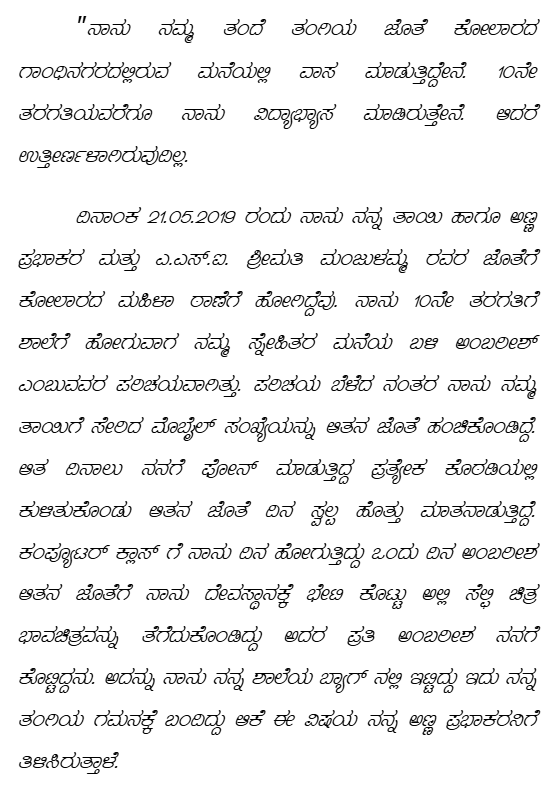
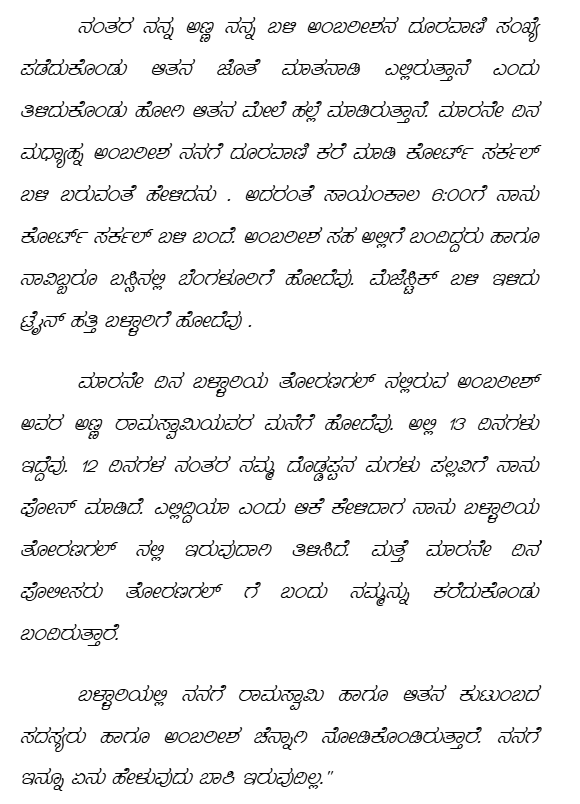
3. The facts giving rise to this appeal are that, the appellant/accused came into contact with the victim girl while he was deputed for maintaining law and order in Gandhinagar, Kolar. Acquaintance during this period developed into conversations between them, and they fell in love. On 08.05.2019, the accused called the victim to the Court Circle in Kolar and enticed her to accompany him to Bengaluru. From Bengaluru, he took her to Thoranagal in Bellary District by the Hampi Express. On 09.05.2019, he took her to the house of CW-9 Ramaswamy and had sexual intercourse with her, despite being aware that she was a minor. Thereafter, the victim's father, suspecting the accused's involvement, lodged a missing person complaint, pursuant to which investigation commenced. The accused and the victim were traced and found together. The victim's statement was recorded by the Investigating Officer under Section 161 Cr.PC, and she was subjected to medical examination, during which she narrated her history to the Medical Officer. She subsequently deposed before the jurisdictional Magistrate under Section 164(5) Cr.PC. The Investigating Officer, along with the victim, visited Ramaswamy's house at Thoranagal Village, where she pointed out the place at which she was subjected to sexual intercourse by the accused, and the requisite mahazar was drawn up accordingly. Upon collecting all necessary material, including a caste verification certificate obtained from the concerned Executive Magistrate, the Investigating Officer filed the charge sheet.
4. Upon receipt of the charge sheet, the Court took cognizance of the offences alleged. The Accused was arrested and remanded to custody on 22.05.2019. Subsequently, he was enlarged on bail by this Court by Order dated 04.03.2020 passed in Criminal Petition No.7260 of 2019. Upon hearing, charges were framed. The charges were read over and explained to the accused in the language known to him. However, he pleaded not guilty and claimed to be tried. To establish the guilt of the accused, the prosecution examined 19 witnesses as PWs1 to 19, marked 33 documents as Exs.P1 to P33 and sixteen material objects as MOs.1 to 16. On closure of prosecution side evidence, statement of accused under Section 313 Cr.PC was recorded, wherein he denied all incriminating evidence and did not present any defence evidence. Having heard the arguments on both sides, the trial Court convicted the accused and sentenced him to undergo rigorous imprisonment for a period of seven years and to pay fine of Rs.5,000/- for the offence punishable under Section 363 of IPC and in default to pay fine, to undergo simple imprisonment for a period of six months. The accused is further sentenced to undergo rigorous imprisonment for a period of ten years with fine of Rs.25,000/- for the offence punishable under Section 6 of POCSO Act read with Section 376(2)(n) of IPC and in default to pay fine, to undergo simple imprisonment for a period of six months. The accused is further sentenced to undergo imprisonment for life with fine of Rs.5,000/- for offence punishable under Section 3(2)(v) of SC/ST (PoA) Act. In default to pay fine, to undergo simple imprisonment for a period of three months. Further, the trial Court ordered t