1. Writ petition against rejection of application to recall compromise decree — stranger to proceedings — Order XXIII Rule 3, CPC. (Para 1 , 2 , 3 , 4 , 5 , 6 , 7 , 9 , 10 , 11 , 12 , 13 , 14 , 15 )
 Back
Next 





2026 Supreme(Kar) 823
IN THE HIGH COURT OF KARNATAKA AT DHARWAD
Sachin Shankar Magadum, J.
Sri. S. Indushekhar, S/O Late Sanna Sharanappa - Petitioner
Versus
Sri. S. Channanagouda, S/O Late Sanganakal Dodda Sharanappa - Respondent
Writ Petition No. 105935 OF 2022 (GM-CPC)
Decided On : 08-07-2026
Important Points
The court distinguished between derivative and independent strangers to a compromise decree. Where a non-party's interest is recognized in the original suit's pleadings and the decree clouds their title, they may seek recall before the recording court to avoid conflicting judgments and multiplicity of proceedings.
Subject
Civil Law - Code of Civil Procedure
Act Referred
Headnote
(A) Code of Civil Procedure, 1908 - Order XXIII Rule 3, Rule 3A and Section 151 - Scope and ambit of challenges to compromise decrees - Rule 3A aims to attach finality to compromise decrees and prevent multiplicity of litigation by requiring the court that recorded the compromise to determine its lawfulness, thereby barring independent collateral suits (Paras 21-23).
(B) Distinction between Derivative and Independent Strangers - A "derivative stranger," who claims title through a party to the compromise, cannot circumvent the statutory scheme and must approach the court that recorded the compromise (Para 31). Conversely, an "independent stranger" asserting a title wholly dehors the parties to the compromise may generally maintain an independent civil suit (Paras 28-32).
(C) Intra-family disputes and Necessary Parties - Where a compromise decree purportedly deals with properties of non-parties, and the original pleadings acknowledge such interests, the original court should resolve the composite controversy to avoid parallel proceedings and conflicting findings (Paras 42-48).
Facts of the case:
A partition suit was filed between family members. A compromise decree was subsequently recorded, which included properties that a non-party to the suit claimed as his exclusive estate or self-acquired property of his branch of the family. Although one of the defendants in the original suit had specifically pleaded in the written statement that certain suit properties belonged to this non-party, the non-party was never impleaded. Upon learning of the compromise, the non-party applied to the trial court to recall the decree under Order XXIII Rule 3 and Section 151 of the Code of Civil Procedure, alleging fraud and collusion. The trial court rejected the application on the grounds that as a stranger to the proceedings, the applicant's only remedy was to institute an independent suit.
Findings of Court:
The trial court proceeded on an erroneous premise that a non-party is invariably relegated to an independent suit. In cases where the dispute is an intra-family matter and the compromise decree directly clouds the title of a person whose interest was already recognized in the original pleadings, the court that recorded the compromise is the appropriate forum for adjudication.
Issues: (i) Whether the Trial Court was justified in relegating a non-party to institute an independent suit on the premise that he was not a party to the original proceedings; (ii) Whether a person whose proprietary rights are affected by a compromise decree may seek adjudication before the court that recorded it by invoking Order XXIII Rule 3 read with Section 151 of the Code of Civil Procedure.
Ratio Decidendi: The court held that the decisive test is not whether the claimant was formally a party, but the nature and source of the right asserted. Where the legality of the compromise, the inclusion of additional properties, and the claims of a non-party are inextricably intertwined—particularly when the original record supports the non-party's claim—the court that recorded the compromise must resolve the issue to prevent conflicting judicial pronouncements on the same subject matter.
Result: Writ petition allowed; order rejecting the recall application set aside; compromise decree recalled; original suit restored for fresh adjudication with the petitioner impleaded.
Legal Category Hierarchy
- practice and procedure
- property law
Advocates Appeared:
For the Petitioner:Sri. Srinand A. Pachhapure, Advocate
For the Respondent:Sri. Harsh Desai, Advocate, Sri. Prashant Mathapati, Advocate, Sri. Roshan Chabbi,
Table of Contents
2. Petitioner argued remedy lies before same court; respondents argued stranger must file independent suit. Derivative vs. independent title distinction. (Para 16 , 17 )
3. Trial court erred; nature of claim determines remedy — derivative claimant must file before same court, independent claimant may file suit. (Para 18 , 19 , 20 , 21 , 22 , 23 , 24 , 25 , 26 , 27 , 28 , 29 , 30 , 31 , 32 , 33 , 34 , 35 , 36 , 37 , 38 , 39 , 40 , 41 , 42 , 43 , 44 , 45 , 46 , 47 , 48 )
4. Applicability of Order XXIII Rule 3A depends on nature of right asserted — derivative or independent; not merely on formal party status. (Para 27 , 31 , 33 , 34 , 41 , 45 )
5. Writ petition allowed; impugned order set aside; compromise decree recalled; suit restored; petitioner impleaded for fresh adjudication. (Para 49 , 50 , 51 , 52 , 53 , 54 , 55 )
6. What is the test to determine if a stranger to a compromise decree must approach the court which recorded the compromise or file an independent suit?
The decisive test is the nature and source of the right asserted — whether it is derivative from a party or an independent pre-existing title. (Para 27 , 30 , 31 , 34 )
7. Does Order XXIII Rule 3A CPC bar an independent suit by a person asserting an independent pre-existing title not derived from parties to the compromise?
No, Rule 3A does not bar such a suit because the claimant asserts an independent title that was never adjudicated and is not derivative. (Para 28 , 29 , 32 )
8. Can a court which recorded a compromise decree examine its legality when a non-party alleges the compromise dealt with properties belonging to the non-party?
Yes, where the challenge goes to the root of the compromise decree and involves interlinked issues, the same court should adjudicate the matter. (Para 41 , 43 , 44 , 45 )
9. What is the legislative object of Order XXIII Rule 3A CPC?
To prevent collateral attacks on compromise decrees and ensure legality of the compromise is examined by the court which recorded it. (Para 21 , 22 )
10. Is a person who claims through a party to a compromise decree bound by the bar under Order XXIII Rule 3A?
Yes, such a derivative claimant must approach the court which recorded the compromise, as their claim is inseparably connected to the compromise. (Para 24 , 27 )
ORDER :
SACHIN SHANKAR MAGADUM, J.
The petitioner, who is not a party to O.S.No.39/2008, has presented the instant writ petition questioning the legality and correctness of the order dated 25.11.2022 passed by the learned Principal Senior Civil Judge, Ballari, whereby the application filed by the petitioner under Order XXIII Rule 3 read with Section 151 of the Code of Civil Procedure, 1908, (for short ‘CPC’) seeking recall of the compromise decree dated 03.07.2018, has been rejected on the ground that the petitioner is a stranger to the proceedings and, therefore, his remedy, if any, is only by way of an independent suit.
2. The controversy, though arising out of an interlocutory order, raises an important question touching upon the scope and ambit of Order XXIII Rule 3A of CPC, namely, whether every person who was not a party to a compromise decree is necessarily required to institute a separate suit, or whether, in appropriate cases, such person is entitled to approach the very Court which recorded the compromise and seek adjudication of his grievance by questioning the legality of the compromise decree itself.
3. Since the controversy turns largely upon the nature of the petitioner’s claim, the factual background requires to be noticed in some detail.
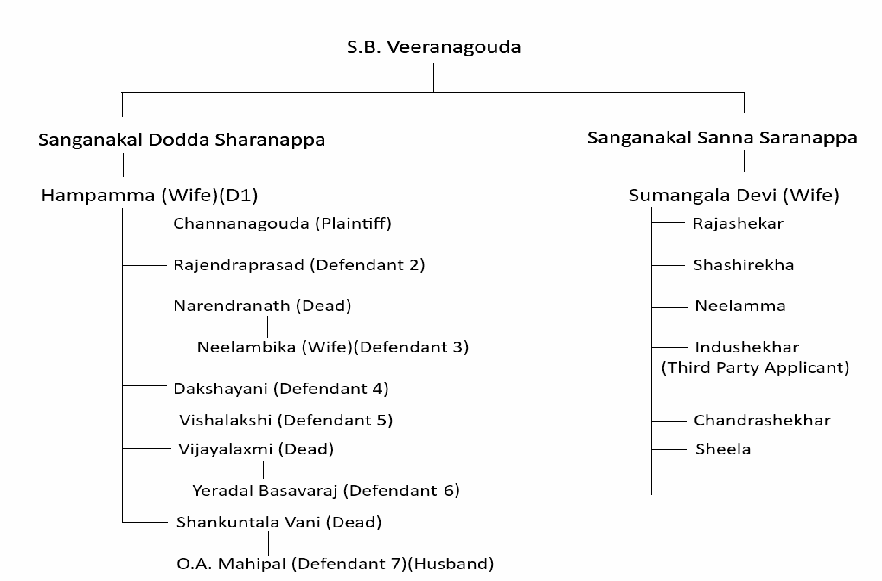
The petitioner, Sri S. Indushekhar, is the son of late Sri Sanna Sharanappa. It is the specific case of the petitioner that the common ancestor of the family, namely Sri S.B. Veeranagouda, had acquired several immovable properties situated in and around Ballari District. During his lifetime, according to the petitioner, there was an oral partition between his two sons, namely late Sri Dodda Sharanappa and late Sri Sanna Sharanappa. Under the said family arrangement, the agricultural lands situated on the left side of the Ballari–Sanganakal Road were allotted to the share of late Sri Sanna Sharanappa, whereas the lands situated on the right side of the said road were allotted to late Sri Dodda Sharanappa. It is asserted that ever since the said partition, both branches have been separately cultivating, possessing and enjoying their respective properties and the corresponding revenue entries also came to be mutated in accordance with such partition.
The petitioner further asserts that there was a subsequent partition within the branch of late Sri Sanna Sharanappa, pursuant to which the petitioner, his brothers, mother and other members of that branch have been enjoying their respective shares separately. Therefore, according to the petitioner, the branch of late Sri Sanna Sharanappa had become completely severed from the branch of late Sri Dodda Sharanappa much prior to the institution of O.S.No.39/2008.
4. The respondents herein are admittedly the children and legal representatives belonging to the branch of late Sri Dodda Sharanappa. The petitioner and respondent Nos.1 to 6 are first cousins. The petitioner, however, contends that despite such relationship, the properties belonging to the petitioner’s branch were never available for partition amongst the members of late Sri Dodda Sharanappa’s family, in view of the earlier severance in status and the independent partition between the two branches.
5. Respondent No.1 instituted O.S.No.39/2008 before the competent Civil Court seeking partition and separate possession of the properties alleged to have been left behind by late Sri Dodda Sharanappa. The suit was instituted against the plaintiff’s mother, brothers and sisters. The petitioner was admittedly not impleaded as a party to the said proceedings.
6. A careful examination of the pleadings in O.S.No.39/2008 assumes considerable significance. Defendant No.1, namely Smt. Hampamma, who is none other than the mother of the plaintiff, filed a detailed written statement disputing several assertions made in the plaint. In paragraph 4 of the written statement, she specifically denied the plaintiff’s plea that all the properties described in the plaint schedule continued to remain joint family