
 Back
Back





IN THE HIGH COURT OF BOMBAY
S.M. Modak, J.
Shabu Bhimappa Dudhale - Appellant
Versus
Vinayak Appasaheb Padavle - Respondent
Criminal Appeal No. 16 of 2015
Decided On : 18-07-2023
SEC. 256 CRPC - ACQUITTAL OF ACCUSED - The court examined the application of Section 256 of the Code of Criminal Procedure, which allows for dismissal of a complaint if the complainant is absent and the court does not find it necessary to adjourn. The court found that the trial court had hastily acquitted the accused without adequately considering the complainant's efforts to secure the accused's presence, thus setting aside the acquittal and restoring the complaint for further proceedings.
Fact of the Case:
The complaint under Section 138 of the Negotiable Instruments Act was filed in 2006, but the accused consistently avoided court summons, leading to a trial court acquittal under Section 256 of the Code of Criminal Procedure due to the complainant's absence.
Finding of the Court:
The court found that the trial court had improperly exercised its discretion under Section 256, failing to consider the complainant's persistent efforts to secure the accused's presence and the overall context of the case.
Issues: Whether the trial court correctly applied Section 256 of the Code of Criminal Procedure to acquit the accused in the absence of the complainant.
Ratio Decidendi: The court emphasized that Section 256 should not be used merely to dispose of cases without considering the complainant's efforts and the circumstances surrounding the absence. The principle of speedy trial must be balanced with the rights of the complainant.
Final Decision: The appeal was allowed, the acquittal order was set aside, and the complaint was restored for further proceedings with directions for a speedy trial.
JUDGMENT/ORDER
1. Heard learned Advocate for the Appellant-complainant. No one is present on behalf of the Respondent-accused. Issue involved in this Appeal is as under :
"Whether power under Sec. 256 of the Code of Criminal Procedure can be exercised at post evidence stage when accused remained absent ?"
2. The appeal was already admitted on 5/12/2014. The action under Sec. 390 of the Code of Criminal Procedure was also initiated. The Farad Sheet dtd. 6/6/2023, mentions that Respondent No.1-accused has furnished surety of Rs.10, 000.00 on 30/6/2015. However, no one has appeared in this Appeal. It is travesty of justice, that appeal involving trifle issue remained pending for eight years. Reasons may be different.
3. Perused the impugned order dtd. 26/12/2012, passed by 15th Judicial Magistrate, First Class, Kolhapur in Summary Criminal Case No.4161 of 2006. The accused was acquitted for the offence punishable under Sec. 138 of the N.I. Act by taking recourse to Sec. 256 of the Code of Criminal Procedure. When this order came to be passed, the matter was fixed for recording statement of the accused under Sec. 313 of the Code of Criminal Procedure.
4. The complaint was filed in the year 2006 bearing SCC No.4161/06. Roznama indicates accused was in the habit of avoiding process of this Court. The following are the important dates :-
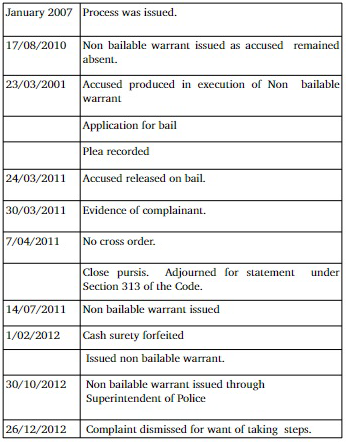
5. So from events what transpires is as follows :-
(a) The complaint is pending since 2006. (b) Accused has no respect for law. (c) He has not responded to Court summons earlier to plea and thereafter also. (d) Trial Court was required to issue non bailable warrant on various occasions.
(e) Prior to recording of plea, non bailable warrant was served and Respondent-accused was released on cash bail. (f) Non bailable warrant could not be served even through Superintendent of Police.
6. On this background, the Court of Judicial Magistrate, First Class, 15th Court, Kolhapur passed an order dtd. 26/12/2012 thereby acquitting the Respondent-accused by taking recourse to the provisions of Sec. 256 of the Code of Criminal Procedure. The learned Magistrate noted following facts in the order :-
(a) The complainant was absent persistently on 15/06/2012, 4/08/2012, 25/09/2012 and on 30/10/2012 (para 2). (b) Report of Superintendent of Police indicates that accused was outside his house (para 3). (c) Complainant has not taken steps under Sec. 82, 83 of the Code of Criminal Procedure (para 4).
7. Now the question is whether it was appropriate for the learned Magistrate to take recourse to the provisions of Sec. 256 of the Code of Criminal Procedure. If we read those provisions, we may find the following ingredients :-
(a) Case is fixed for hearing. (b) Complainant is absent. (c) His presence is required. (d) Court does not feel it necessary to adjourn the matter. Then only complaint can be dismissed.
8. The Hon'ble Supreme Court in case of Associated Cement Co. Ltd. Vs. Keshvanand, (1998) 1 SCC 687. has dealt with this issue. The purpose is to check the dilatory tactics of the complainant, principle of speedy trial is recognised.
9. However, if the entire facts and circumstances of the case are considered, there is reason to believe that the learned Magistrate has hastily passed that order. It is a matter of record that accused has no respect to the law. And on every occasion, the complainant was required to take steps. Execution of non bailable warrant is not an easy formality. At the same time, it is also true that unchallenged evidence could not have been used by the trial Court unless it was put to the accused under Sec. 313 of the Code of Criminal Procedure. At the same time, trial Court ought to have given weightage to the fact that patience of complainant was tested every time. If it is so, the trial Court waited and could have given direction to the complainant to take steps.
10. The judgment of acquittal need not be interfered rightly. But the power under Sec. 256 of the Code should not be exercised only for the pur
AI
The court established that the exercise of power under Section 256 of the Code of Criminal Procedure must be judicious, taking into account the complainant's efforts and the context of the case, rath....

Power of Magistrate under Sec.256 Cr.P.C to acquit an accused should be exercised judicially, based on a definite conclusion that complainant no longer desires to prosecute complaint.
The power of the Magistrate to acquit an accused under Sec.256 Cr.P.C should be exercised judicially, based on a definite conclusion that the complainant no longer desires to prosecute the complaint.....

The court emphasized that a complaint should not be dismissed for non-appearance of the complainant if represented by counsel, allowing for adjournment under Section 256 of the Cr.P.C.

The main legal point established in the judgment is the requirement for judicial discretion before passing an order of acquittal under Section 256 of the Code of Criminal Procedure and the necessity ....

The court held dismissal of a criminal complaint for absence of the complainant is improper if evidence exists and representation is made, emphasizing the necessity for discretion under Section 256 o....

The absence of a complainant's advocate does not justify automatic dismissal of a case if evidence is on record and the accused is avoiding service.
The court emphasized the necessity of a complainant's presence in cases governed by Section 256 of the CrPC and the inappropriate dismissal of cases where evidence has already been presented.
The main legal point established in the judgment is the importance of judicial and fair exercise of discretion under Section 256 of the Code of Criminal Procedure, emphasizing the necessity of the co....

The court established that dismissal of a complaint under Sec. 256 of the Code of Criminal Procedure requires careful consideration of the circumstances, and that a complainant's absence on a limited....



An indispensable Tool for Legal Professionals, Endorsed by Various High Court and Judicial Officers
Please visit our Training & Support
Center or Contact Us for assistance

Scan Me!
India’s Legal research and Law Firm App, Download now!


For Daily Legal Updates, Join us on :



 Back to top


