
 Back
Back





IN THE HIGH COURT OF JUDICATURE AT BOMBAY
RAVINDRA V. GHUGE, ASHWIN D. BHOBE, JJ.
Mr. Rajendra Pawar and Ors. – Petitioners
Versus
The State of Maharashtra, Through its Chief Secretary, Government of Maharashtra and Ors. – Respondents
Writ Petition No. 8668 Of 2019 With Writ Petition No. 7430 Of 2021 With Writ Petition No. 5608 Of 2015 With Writ Petition No. 2337 Of 2025
Decided On : 13-03-2025
(A) Constitution of India, 1950 - Articles 14 and 16 - Service Rules - Age of retirement - Petitioners challenged the amendment reducing retirement age from 60 to 58 years as violative of their service conditions - Fixed age of retirement cannot be altered to detriment of employees - Court held that the amended rule operates prospectively for employees appointed after the amendment. (Paras 19, 20)
(B) Employment Law - Retrospective application of rules - The court emphasized that service conditions cannot be changed to the detriment of employees with retrospective effect, reaffirming the principle that fixed age of retirement at the time of joining must be honored. (Paras 15, 16)
Facts of the case:
The Petitioners, employed under the Yashwantrao Chavan Academy of Development Administration, challenged the amendment to the service rules that reduced their retirement age from 60 to 58 years, which was fixed at the time of their appointment. (Paras 7, 9)
Findings of Court:
The court found that the amendment to the retirement age was arbitrary and violative of Articles 14 and 16, and thus, the amended rule would only apply prospectively to new employees. (Paras 19, 20)
Issues: The main issue was whether the fixed age of retirement could be altered to the detriment of employees after their appointment. (Paras 3, 6)
Ratio Decidendi: The court ruled that the fixed age of retirement, as established at the time of joining, must be maintained, and any changes cannot adversely affect existing employees. (Paras 15, 19)
Result: Writ petitions partly allowed; the amended rule declared operable prospectively.
JUDGMENT :
RAVINDRA V. GHUGE, J.
1. Rule. Rule made returnable forthwith and heard finally by the consent of the parties.
2. After the extensive submissions of the learned Advocates for the respective sides on 12th March, 2025, on account of paucity of time, we posted these matters today, for dictation of order.
3. These are peculiar cases which rest purely on peculiar facts and the interpretation of law. Whether the prescribed age of retirement of employees, as fixed at the time of their entry in service, could be abruptly altered to their prejudice?
4. For clarity, we are reproducing a ready reference chart to indicate the details of each Petitioner, in the form of a Bird’s Eye View.
The same is reproduced as under :
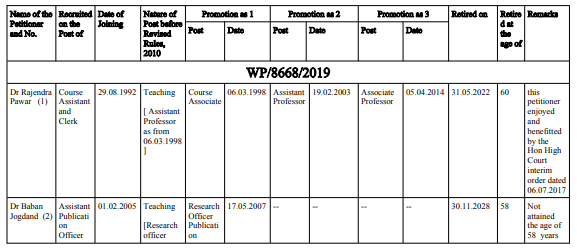
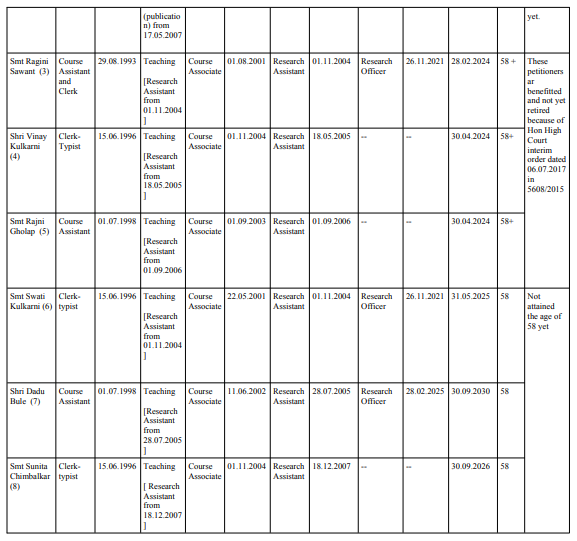
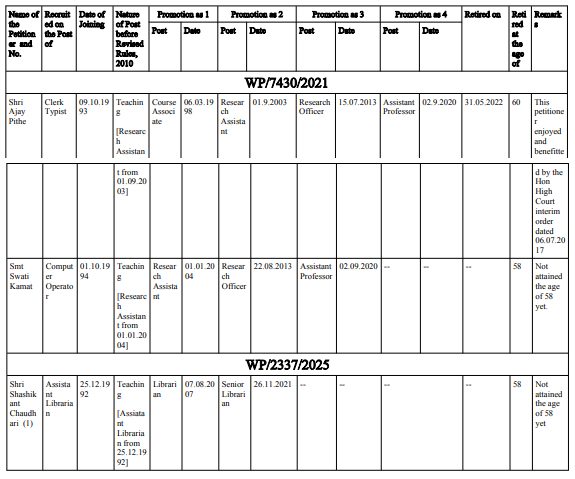
5. The only dispute as regards whether a Petitioner is in the teaching or non-teaching category, is with reference to Petitioner No. 2 in Writ Petition No. 8668 of 2019, namely, Dr. Baban Jogdand. It is claimed that he was in the teaching category. He is still in employment and is posted as Research Officer (Publication) from 17.5.2007.
The learned Advocate for the Petitioners points out that Dr. Baban Jogdand has two PHD Thesis to his credit (double Ph. D. holder), has 23 degrees in graduation/post graduation/diploma and has published7 books and 29 Articles in Journals of high repute.
The learned Advocate for the Petitioners contends that earlier he was in the teaching faculty considering his huge educational qualification. Presently, he is appointed as Research Officer(Publication)which is also a teaching post.
The learned Advocate for the employer i.e. Respondent No.3, Yeshwantrao Chavan Academy of Development Administration, Baner Road, Pune (hereinafter referred to as “the Employer”) strenuously opposes the above statement and submits that he is not in the teaching category.
If the said Petitioner Dr. Baban Jogdand is held to be in the teaching category, as the Rule stands today, the age of superannuation would be 58 years. If he is not in the teaching category, his age of superannuation would vary.
We do not intend to deal with this issue at this stage, since there is no such prayer made. We leave the said issue open to be agitated before a competent Court in an appropriate proceedings, if initiated.
6. The only issue involved in this Petition is as to whether an employee could be superannuated 2 years prior to his already fixed age of superannuation, in contravention of his service conditions indicating that he would retire 2 years later.
UNDISPUTED FACTS
7. At the outset, we desire to record the undisputed facts in these cases :
(a) Most of the Petitioners are in the teaching faculties and a small number is in the non-teaching category. The Petitioners claim that they are all in the teaching category. YASHADA claims that Dr. Baban Jogdand is the only person among the Petitioners who is presently not in any teaching activity considering his present posting.
(b) The age of retirement of all these Petitioners was specifically fixed at 60 years.
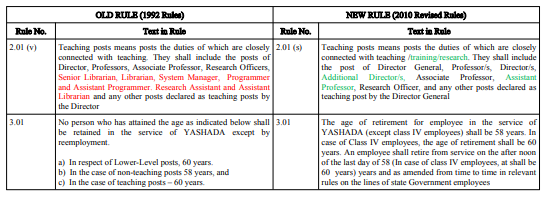
(c) The Yashwantrao Chavan Academy of Development Administration issued the Service Rules dated 1.3.1992 ( in short, the1992 Rules).
(d) All the Petitioners have been inducted in service after following the due procedure laid down in law after 1.3.1992, with a fixed age of retirement.
(e) Prior to the introduction of the 1992 Rules, the Rules prescribed by the State Government were made applicable.
(f) With the introduction of the 1992 Rules, all employees working on lower level posts, and in the case of teaching posts, would retire at the age of 60 years. In the case of non-teaching posts, 58 years was the age of retirement.
(g) All these Petitioners have been appointed after the introduction of the 1992 Rules thereby being covered by the age of retirement as is mentioned in the Rules.
(h) On 5th March, 2010 YASHADA introduced an amendment to the 1992 Rules and the said Clause 3.01 was modified as under :
3.01 Age.of retirement The age of retirement for employee in the service of YASHADA s
AI
Fixed age of retirement established at the time of appointment cannot be altered to the detriment of employees, and any amendments operate prospectively.

The fixed age of retirement established at the time of employment cannot be altered to the detriment of employees, and any amendments must operate prospectively.

Changes to retirement age rules are prospective and cannot be applied retroactively unless explicitly stated.


The central legal point established in the judgment is the applicability of G.O.Ms.No.15, dtd. 31/1/2022, which enhanced the age of superannuation of Government Employees from 60 years to 62 years, t....

Since the enhancement of the age of superannuation is a ‘public function’ channelised by the provisions of the statute and the service regulations, the doctrine of promissory estoppel cannot be used ....

Since the enhancement of the age of superannuation is a ‘public function’ channelised by the provisions of the statute and the service regulations, the doctrine of promissory estoppel cannot be used ....
Employees of autonomous bodies like the DRDA cannot claim parity with state government employees regarding retirement benefits unless explicitly provided by law or policy, and changes in retirement a....

whenever a new benefit is granted and/or new scheme is introduced, it might be possible for the State to provide a cut-off date taking into consideration its financial resources. But the same shall n....



An indispensable Tool for Legal Professionals, Endorsed by Various High Court and Judicial Officers
Please visit our Training & Support
Center or Contact Us for assistance

Scan Me!
India’s Legal research and Law Firm App, Download now!


For Daily Legal Updates, Join us on :



 Back to top


