
 Back
Back





IN THE HIGH COURT OF JUDICATURE AT BOMBAY, BENCH AT AURANGABAD
NITIN B. SURYAWANSHI, VAISHALI PATIL – JADHAV, JJ.
Kum. Bhumika, D/o. Ravindra Koli - Petitioner
Versus
The State of Maharashtra, Through its Secretary, Tribal Development Department and Ors. – Respondents
Writ Petition No. 717 of 2021
Decided On : 04-12-2025
| Table of Content |
|---|
| 1. petition challenges order of caste certificate cancellation. (Para 2) |
| 2. petitioner argues based on historical documentation for caste validation. (Para 3 , 4 , 5) |
| 3. respondent defends order citing evidence of document tampering. (Para 6 , 7 , 8 , 9) |
| 4. court analyzes validity of evidence and committee's decision-making. (Para 10 , 11 , 12 , 13 , 14 , 15 , 16 , 17 , 18 , 19 , 20) |
| 5. court finds pre-constitutional documents support petitioner's claim. (Para 21 , 22 , 23) |
| 6. court quashes committee order; validates petitioner's caste claim. (Para 24) |
| 7. court directs issuance of caste validity certificate to petitioner. (Para 25) |
JUDGMENT :
Vaishali Patil – Jadhav, J.
Rule. Rule made returnable forthwith and heard finally with the consent of the parties.
2. In this petition under Article 226 of the Constitution of India, read with the Maharashtra Act No. XXIII of 2001 and Rules of 2003, the petitioner is challenging the order dated 29.11.2020 passed by respondent no. 2 – Scheduled Tribe Certificate Scrutiny Committee (hereinafter “the Committee”), whereby it has refused to validate her ‘Tokre Koli’ Scheduled Tribe Certificate and directed it to be confiscated and cancelled, in a proceeding under that Act.
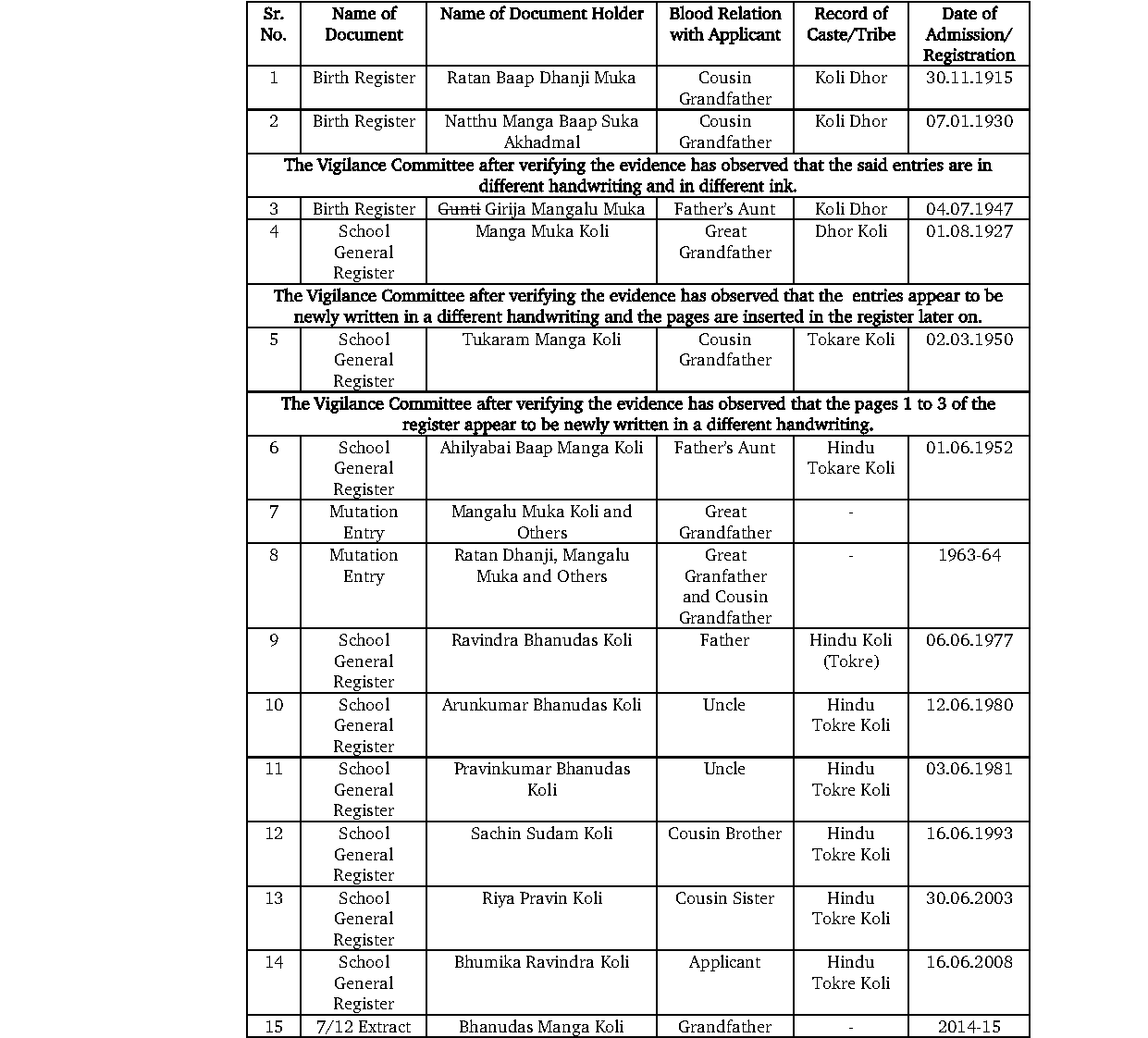
3. Learned advocate for the petitioner would submit that there are pre-constitutional entries in school admission register and birth and death’s register maintained in the ordinary course, describing the petitioner’s forefathers as ‘Dhor Koli’, ‘Koli Dhor’ and ‘Tokre Koli’. Petitioner has produced coloured photocopies of all the pre- constitutional entries from the Z.P. School and birth and death register of Tahsil Office, Shahada. Respondent-Committee has discarded these entries on the basis of recommendation in the vigilance report about there being interpolation of pages in the school register as well as in the birth and death register maintained in Tahsil Office. It is urged that interpolated pages are in different handwriting and different ink. According to the learned advocate, petitioner cannot assign any reason for such interpolation, as these documents were in custody of Government Office. According to him, none of the members of petitioner’s family or his blood rein were serving or had any direct or indirect role in maintaining the entries. As such he would urge that no malice can be attributed to him. He has relied on the judgment of Manisha D/o Madhavrao Wantekar Vs. The State of Maharashtra And Others; in Writ Petition No.13162 of 2023, decided on 15.01.2024 and Civil Appeal arising out of SLP(C)No.27410 of 2024.
Learned advocate would further submit that there are pre-constitutional entries of the year 1912, 1915, 1930, 1947 and 1950, which have more evidentiary value. In this background, the Committee ought to have validated the tribe claim of the petitioner as the pre-constitutional entries have more probative value, as has been held in various judgments.
4. He would submit that though ‘Dhor Koli’ and ‘Tokre Koli’ sound different, they are covered under one and the same entry at Sr. No. 28 of the Presidential Order. According to him, observations made in Samriddhi Yogesh Savale Vs. The State of Maharashtra and Others; in Writ Petition No. 1209 of 2022, decided on 20.07.2024 are worth referring to. This Court has expressly held therein that if the legislature in its wisdom has put ‘Koli Dhor’ and ‘Tokre Koli’ in the same entry, the claim ‘Tokre Koli’ cannot be treated as inconsistent with that of ‘Koli Dhor’.
5. Learned advocate would then submit that even the notification issued under the Maharashtra Land Revenue Code, 1966 relating to Section 36 and 36-A includes the tribal area of Nandurbar, Dhule District and the communities which are mentioned in the notification also mention Koli Dhor. In the revenue record produced by the petitioner there is mention of land being granted under Section 36 and 36-A which could have occurred only because the petitioner’s ancestors were granted the lands as tribals. This
AI
Pre-constitutional entries carry greater probative value for establishing caste claims than post-constitutional entries, and the Committee's findings of interpolation lacked sufficient evidence.

The court ruled that pre-constitutional records are more probative than post-constitutional ones, and the committee's rejection of the petitioner's claim for 'Tokre Koli' was arbitrary.
The court emphasized that documentary evidence, especially pre-independence records, is crucial in establishing caste claims, and the failure to produce valid documentation invalidates the claim.
The importance of pre-independence documents in caste validity claims and the scrutiny committee's duty to properly appreciate evidence and documents.

The court established that the probative value of pre-independence documents is paramount in tribe claims, and that the Scrutiny Committee must substantiate any adverse findings with clear evidence o....
The main legal point established in the judgment is the significance of pre-constitutional documents in establishing the genuineness of caste claims, the removal of area restrictions for Scheduled Tr....
The court emphasized that pre-Constitutional documents are of higher probative value for determining tribe claims, and invalidation by the committee on the basis of affinity test was not legally soun....
The court emphasized the importance of pre-constitutional documents in validating caste claims and condemned arbitrary administrative decisions lacking proper verification.



An indispensable Tool for Legal Professionals, Endorsed by Various High Court and Judicial Officers
Please visit our Training & Support
Center or Contact Us for assistance

Scan Me!
India’s Legal research and Law Firm App, Download now!


For Daily Legal Updates, Join us on :



 Back to top


