Back
Back





2025 Supreme(Bom) 1957
IN THE HIGH COURT OF JUDICATURE AT BOMBAY
R.M. Joshi, J.
Reliance General Insurance Co. Ltd. - Appellant
Versus
Neeta Dipak Gole - Respondents
First Appeal No.1209 of 2023, First Appeal No.1560 of 2024
Decided On : 17-12-2025
For the Petitioner: Ms.Kalpana Trivedi
For the Respondent: Mr.T.J. Mendon
Lump-sum compensation must be calculated using an appropriate multiplier, considering the claimant's permanent disability, age, and income, rather than awarded arbitrarily. Contributory negligence must also be substantiated with evidence.
Headnote:(A) Motor Vehicles Act, 1988 - Contributory Negligence - The insurer challenges the tribunal's failure to consider contributory negligence of the motorcyclist, asserting a 50% liability. The tribunal's award of lump-sum compensation of Rs.20 lakhs was contended to be erroneous due to lack of reasoned justification. (Paras 2, 3, 9)
(B) Compensation Calculation - The court found that the tribunal erred in granting a lump-sum award rather than applying an appropriate multiplier based on the claimant's age and income, following established principles. (Paras 10, 11)
(C) Evidence and Disability - The tribunal did not adequately address the evidence on the claimant's permanent disability of 60% and consequent loss of income, which warranted adjustment of compensation. (Paras 8, 9)
(D) Final Decision - Appeals from both parties: Claimant's appeal allowed for enhanced compensation and insurer's appeal dismissed.
Result: Appeals allowed for increased compensation totaling Rs.47,40,740/-. (Paras 12, 13)
| Table of Content |
|---|
| 1. case details of appeal against tribunal's award. (Para 1) |
| 2. insurer claims contributory negligence by motorcycle rider. (Para 2) |
| 3. claimants seek compensation enhancement. (Para 3) |
| 4. insurer's arguments regarding negligence and compensation validity. (Para 4) |
| 5. claimants argue for compensation due to serious injury. (Para 5) |
| 6. court analyzes contributory negligence in accident. (Para 6) |
| 7. insurer's defense on permit lacks evidence. (Para 7) |
| 8. error found in lump-sum compensation awarded. (Para 8) |
| 9. tribunal's acceptance of disability evidence questioned. (Para 9) |
| 10. compensation should use appropriate multiplier. (Para 10) |
| 11. future prospects in compensation calculation required. (Para 11) |
| 12. final decisions on appeals and compensation awarded. (Para 12 , 13) |
JUDGMENT :
R.M. Joshi, J.
. These Appeals filed by Insurer as well as Claimants take exception to the judgment and award dated 25th July 2022 passed in MACT No.132 of 2016 whereby the learned Tribunal granted lump sum compensation to the Claimants in an injury claim.
2. The Insurer take challenges to the impugned judgment and award on the ground that the Tribunal has failed to take into consideration the negligence on the part of another vehicle in occurrence of the accident. It is therefore contended that, since, this is case of the contributory negligence on the part of the rider of the motor-cycle on which the Applicant was pillion rider, the Tribunal ought to have held negligence of the rider of the motor-cycle to the extent of 50% in occurrence of the accident. It is further claimed that, the Tribunal has failed to take into consideration the evidence of RTO in order to show that the permit of the auto rickshaw i.e. the offending vehicle expired on 20th July 2014 and since the vehicle was not having valid permit, there is breach of Terms and Conditions of the policy and hence, Insurer is not liable to make payment of compensation. It is further claimed that the Tribunal has erred in awaring lump-sum compensation of Rs.20 lakhs without recording any reason therefor. On these amongst other contentions the impugned judgment is sought to be set aside.
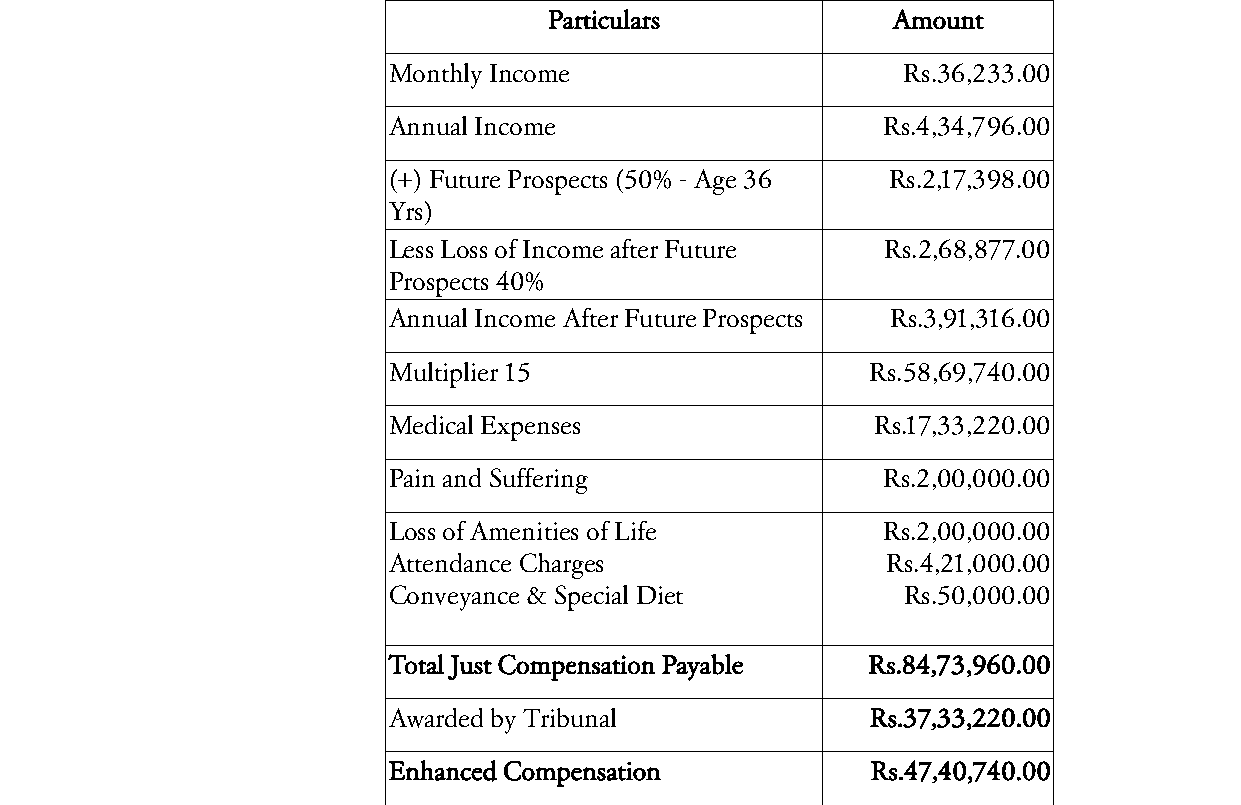
3. Whereas the Claimants by filing Appeal is seeking enhancement of the compensation on the ground that the Tribunal has committed error in not considering the income of the Injured and the appropriate multiplier has not been applied for the purpose of determination of compensation.
4. The learned counsel for the Insurer submits that the First Information Report (‘FIR’ for short) as well as the panchnama of the spot which finds part of the police papers indicates that the rider of the motor-cycle was equally responsible for the occurrence of the accident. In such circumstances, the rider must be held negligent to the extent of 50%. She further argued that the Tribunal has committed error in granting lump-sum compensation to the Claimant which is on higher side. It is submitted that the Claimant has failed to prove functional disability and hence no compensation for loss of earning can be granted to the Claimant. To support this submission, she referred to the evidence on record. On these amongst other contentions the impugned judgment and order is sought to be set aside.
5. On the other hand, the learned counsel for the Claimant submits that the Claimant has led her own evidence so also examined witness from the school where she was employed. It is his submission that on the basis of the said evidence on record employment and income of the Claimant is proved. According to him, the Claimant was terminated from service owing to the disability caused to her. It is argued that in the accident in question claimant sustained injury to her brain and due to the said injury she is incapacitated even from performing even her daily ritual. It is claimed that during the entire lifetime the Claimant would require assistance for performing day to day activities. It is submitted that since the termination of the Claimant is pr