Back





2026 Supreme(Bom) 115
IN THE HIGH COURT OF JUDICATURE AT BOMBAY
B.P. COLABAWALLA, AMIT S. JAMSANDEKAR, JJ.
Benteler Automative (China) Investment Limited – Appellant
Versus
Assistant Commissioner of Income Tax (IT), Pune – Respondent
Writ Petition No. 11074 of 2025
Decided On : 27-03-2026
Important Points
Subject
Taxation - Income Tax - DTAA and TDS
Act Referred
INCOME TAX ACT : S.195, S.197, S.9(1)(vii)(b), S.90
INCOME TAX RULES : R.28(a)(a)
FINANCE ACT : S.9(1)(vii)
Headnote
(B) Double Taxation Avoidance Agreements - Interpretation - Article 12(4) defines 'fees for technical services' as payments for services of managerial, technical or consultancy nature by resident of one State 'in' other State - Article 12(6) deems fees arising where payer resident - Both conditions cumulative - Phrase 'in the other Contracting State' requires physical provision, distinguishing from other treaties - Unilateral foreign circulars not binding without mutual agreement - Comparison with other treaties relevant to highlight deliberate language variation. (Paras 16-25, 33-42)
Facts of the case:
Non-resident provides ongoing management support, finance, HR, quality, IT, facility, technical support services to Indian subsidiary from abroad, charging cost plus 5% markup. Services via virtual modes, no personnel visit India. Indian subsidiary deducts TDS at 10%. Petitioner applies for nil TDS certificate under Section 197 claiming non-taxability under DTAA, rejected citing prior years assessments.
Findings of Court:
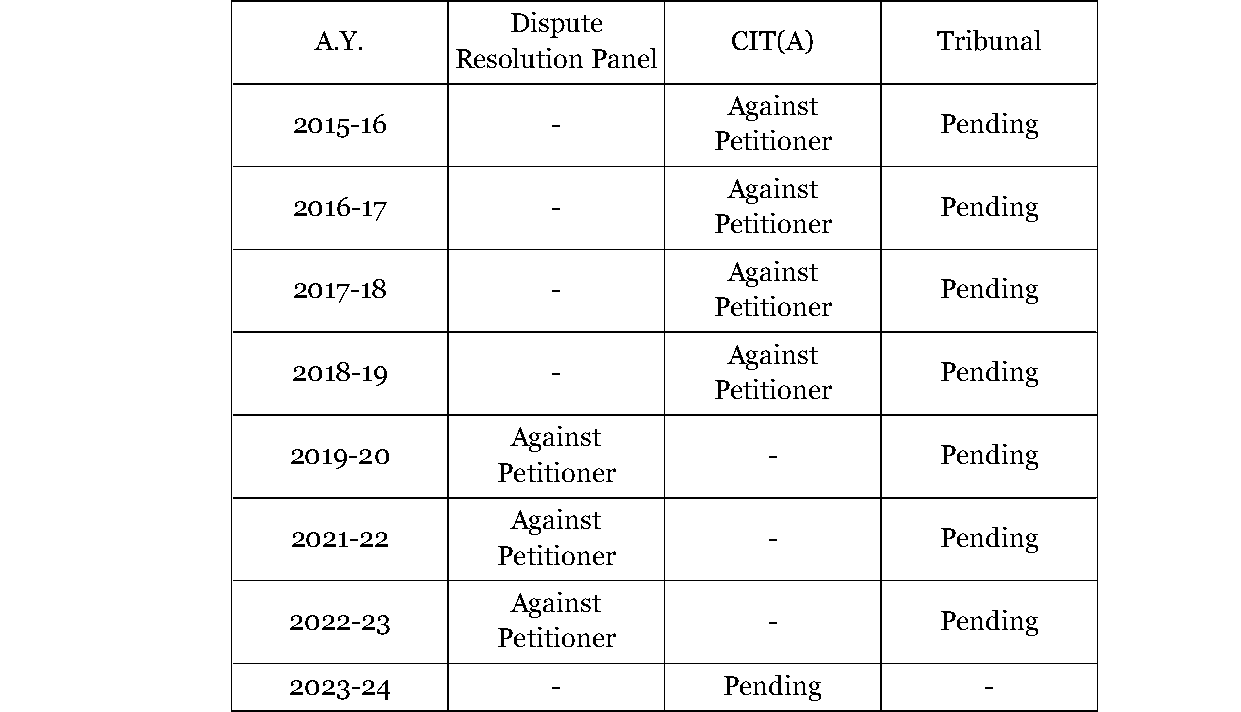
Virtual services not physically rendered in India; rejection of nil certificate valid under Rule 28AA due to pending prior assessments taxing similar income; no declaration on DTAA interpretation as pending before ITAT.
Issues: Whether virtual services constitute physical rendition 'in' India under Article 12(4); validity of rejecting nil TDS certificate under Section 197 read with Rule 28AA; appropriateness of writ declaration on taxability under DTAA.
Ratio Decidendi: Assessing Officer must consider prior years assessed tax liability under Rule 28AA(2)(ii) before issuing nil certificate; where higher authorities have upheld taxability and appeals pending, rejection justified to avoid inconsistency. Writ court refrains from DTAA interpretation sub-judice before ITAT.
Result: Writ petition dismissed, rule discharged. No costs.
For the Appellants : Sridharan, Ravi Sawana, Neha Sharma, Priyanshi Chokshi
For the Respondents: A.K. Saxena, Anil Singh, Aditya Thakkar, Savita Ganoo, D.P. Singh, Priyanka Kothari, Adarsh Vyas, Rama Gupta, Rajdatt Nagre
| Table of Content |
|---|
| 1. petition seeks declaration of non-taxability and nil tds certificate (Para 1 , 2 , 5 , 6 , 7 , 8 , 9 , 10) |
| 2. fts under article 12(4) requires services in india (Para 3 , 11 , 12 , 13 , 14 , 15 , 16 , 17 , 18 , 19 , 20 , 21 , 22 , 23 , 24 , 25) |
| 3. virtual services deemed rendered in india; prior assessments binding (Para 4 , 26 , 27 , 28 , 29 , 30 , 31 , 32 , 33 , 34 , 35 , 36 , 37 , 38 , 39 , 40 , 41 , 42 , 43) |
| 4. virtual services not equivalent to physical presence in india (Para 44 , 45 , 46 , 47 , 48 , 49 , 50 , 51) |
| 5. ao denial of nil certificate justified by prior assessments (Para 52 , 53 , 54 , 55 , 56 , 57 , 58 , 59 , 60 , 61 , 62 , 63 , 64 , 65) |
| 6. court declines dtaa declaration pending itat appeals (Para 66 , 67 , 68 , 69 , 70) |
JUDGMENT :
B.P. COLABAWALLA, J.
1. Rule. Respondents waive service. With the consent of parties, Rule made returnable forthwith and heard finally.
2. By this Petition, filed under Article 226 of the Constitution of India, the Petitioner seeks a declaration that the consideration received/receivable by the Petitioner from its Indian subsidiary, Benteler India Private Limited (for short “Benteler India”) pursuant to the Service Agreement entered into between them (Exhibit “B” to the Petition), is not taxable in India. Consequently, a relief is also sought to quash and set aside the impugned order dated 1st August 2025 passed by Respondent No.1 rejecting the Petitioner’s application for “NIL withholding tax” Certificate and for a direction to the Respondents to issue a “NIL deduction of tax at source” Certificate under Section 197 of the Income Tax Act, 1961 (for short “the IT Act”) as prayed for by the Petitioner in its application dated 1st July 2025. The Petitioner also seeks a declaration and/or a direction to the Income Tax Authorities to grant a refund to the Petitioner of the amount of tax deducted at source (TDS) by Benteler India pursuant to the above-mentioned Service Agreement.
3. To put it in a nutshell, it is the Petitioner’s case that it is a company incorporated under the laws of China and a resident of China. Under the Service Agreement (Exhibit “B” to Petition) entered into by the Petitioner with Benteler India (its subsidiary), the Petitioner supplies technical services to Benteler India. It is conceded before us that any payment made by Benteler India to the Petitioner [for the supply of technical services] would be taxed in India under the provisions of the IT Act, and more particularly Section 9(1)(vii) thereof. However, since India and China have entered into a Double Taxation Avoidance Agreement [for short the “DTAA”], taxation of the Petitioner would be governed by the provisions of the India-China DTAA as they are more beneficial to the Petitioner [Section 90 of the IT Act]. According to the Petitioner, it has no “Permanent Establishment” (for short “PE”) in India [as understood in Article 5 of the DTAA], and hence, is not liable to pay any tax in India under Article 7 thereof, for the technical services provided by it to Benteler India. The only other provision under which the Petitioner can be brought to tax in India is Article 12 of the DTAA. According to the Petitioner, even under this Article, the Petitioner cannot be taxed in India because the technical services provided by the Petitioner to Benteler India do not fall within the definition of the words “fees for technical services” (for short also referred to as “FTS”), as understood under Article 12 (4) of the India-China DTAA. According to the Petitioner, though it rendered “technical services” to its subsidiary located in India, namely Benteler India, the wordings of Article 12 (4) clearly indicate that for the services provided by the Petitioner to Benteler India to fall within the meaning of the words “fees for technical services” [as defined in Article 12 (4)], the same would have to be rendered and/or performed by the Petitioner in India and not merely from China. According to the Petitioner, if t