
 Back
Back





IN THE HIGH COURT OF JUDICATURE AT BOMBAY
Sandeep V. Marne, J.
Sunil Waman Bhide - Applicant
Versus
Chandrahas Laxman Kanhere & Ors. - Respondents
Civil Revision Application No.351 of 2023, Interim Application No.38657 of 2025
Decided On : 17-03-2026
| Table of Content |
|---|
| 1. probate revocation application based on testator's alleged title absence (Para 1 , 2 , 3 , 8 , 9 , 10 , 11) |
| 2. caveatable interest requires succession claim, not title challenge; probate optional (Para 4 , 5 , 6) |
| 3. core issue: probate revocable for testator's lack of title or capacity (Para 7 , 12) |
| 4. krishna kumar birla defines caveatable interest; g. gopal creates apparent conflict (Para 13 , 14 , 15 , 16 , 17 , 18) |
| 5. reconcile precedents: title challengers strangers to probate; follow birla (Para 19 , 20 , 21 , 22 , 23 , 24) |
| 6. probate court lacks title jurisdiction; challengers lack caveatable interest (Para 25 , 26 , 27 , 28 , 29) |
| 7. revocation application not maintainable; revision allowed and ma dismissed (Para 30 , 31 , 32 , 33) |
JUDGMENT :
SANDEEP V. MARNE, J.
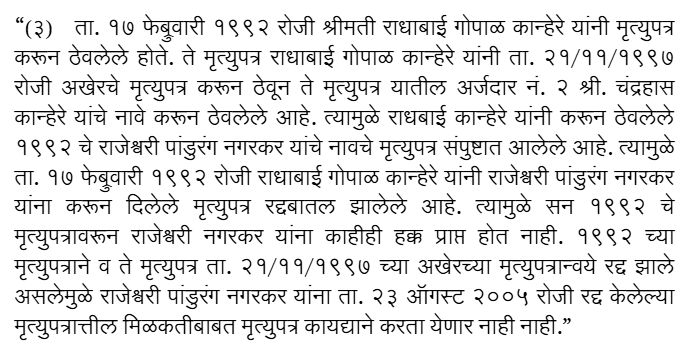
1. The Applicant has invoked revisionary jurisdiction of this Court under Section 115 of the Code of Civil Procedure, 1908 (Code) for challenging the order dated 20 December 2022 passed by the 11th Joint Civil Judge Senior Division, Pune rejecting application at Exhibit-52 filed by him seeking dismissal of Miscellaneous Application No. 616 of 2013 filed by Respondent Nos.1 to 4. The Misc. Application is filed by Respondent Nos. 1 to 4 seeking revocation of probate and according to Applicant, the same is not maintainable as the revocation of probate is sought mainly on the ground that the testator did not have title in the properties in respect of which she executed the Will.
2. Very briefly stated, facts of the case are that Nalini alias Rajeshwari Nagarkar (Rajeshwari) executed her Will dated 23 August 2005 in respect of various properties at Satara and bequeathed some of the properties enumerated in paras-6(a) and (b) of the Will in favour of her son-in-law, Shri. Sunil Waman Bhide (Applicant). The balance properties were bequeathed to her three children. Respondent No.-5 Balkrishna Digambar Thatte was named as executor in the Will. The testator passed away on 8 November 2008. The Executor filed Miscellaneous Application No. 26 of 2010 for grant of probate in respect of the Will dated 23 August 2005 before the Court of Civil Judge Senior Division, Pune. The probate was granted by the Court on 13 December 2011. On or about 2 May 2013, Lakshman Gopal Kanhere and Chandrahas Laxman Kanhere filed Misc. Application No. 616/2013 (MA) seeking revocation of the probate under Section 383 of the Indian Succession Act, 1925. The Applicant appeared in Miscellaneous Application and sought framing of preliminary issues on maintainability of the MA. By order dated 22 July 2014, Court framed preliminary issues about maintainability of the MA. However, by order dated 13 January 2016, the Trial Court proceeded to hold that MA was maintainable and rejected Applicant’s objection of maintainability.
3. Applicant challenged order dated 13 January 2016 passed by the Trial Court holding the MA to be maintainable before this Court by filing Civil Revision Application No.149 of 2016. By Order dated 20 February 2018, the Revision Application was disposed of granting liberty to the Applicant to prefer fresh application for deciding the objection of maintainability. Accordingly, Applicant preferred application at Exhibit- 52 once again praying for framing of preliminary issue and for deciding the issue of maintainability. By the impugned order dated 20 December 2022, the Trial Court has proceeded to reject Applicant’s application holding that MA for revocation of probate was maintainable. Aggrieved by the order dated 20 December 2022, the Applicant has preferred the present Revision Application. It appears that during the pendency of the application, Respondent No.3 has passed away. However, her legal heirs are already on record as pointed out in Interim Application No. 38657 of 2025.
4. Dr. Chandrachud, the learned counsel appearing for the Applicant submits that the Trial Court has erred in rejecting the objection of maintainability raised by the Applicant by relying on judgment
AI
Revocation of probate not maintainable if challenging testator's title to properties, as such claimant lacks caveatable interest and is stranger to probate proceedings limited to will's genuineness.

(1) Revocation of Probate of Will – Grant of probate is a judgment in rem – If a party has caveatable interest in estate of deceased, it is entitled to be served before final order is passed.(2) Tran....

The court ruled that failure to disclose necessary parties with caveatable interest justifies revocation of probate under Section 263 of the Indian Succession Act.

The explanations under Section 263 of the Indian Succession Act, 1925 are illustrative, allowing for revocation of probate based on just causes not explicitly listed.


The applicant must demonstrate a 'just cause' for revocation of Probate and establish a caveatable interest as per Section 263 of the Succession Act, 1925.


The main legal point established in the judgment is that the probate of a Will executed outside the local limits of the High Courts of Madras, Calcutta, and Bombay is not necessary under Sec. 213 of ....



An indispensable Tool for Legal Professionals, Endorsed by Various High Court and Judicial Officers
Please visit our Training & Support
Center or Contact Us for assistance

Scan Me!
India’s Legal research and Law Firm App, Download now!


For Daily Legal Updates, Join us on :



 Back to top


