
 Back
Back





IN THE HIGH COURT OF JUDICATURE AT PATNA
K. VINOD CHANDRAN, CJ and HARISH KUMAR, J.
LPA No.1339 of 2023 in CWJC No.4528 of 2023 with MJC No. 1091 of 2024 In LPA No.1339 of 2023
(17.5.2024)
Shubham Kumar ... Appellant
(in both)
vs.
National Institute of Technology, Patna & Ors. ... Respondents
(in both)
Constitution of India – Article 226 – Though CPC does not apply to writ proceeding general principles coming out of CPC apply squarely. (Para 12)
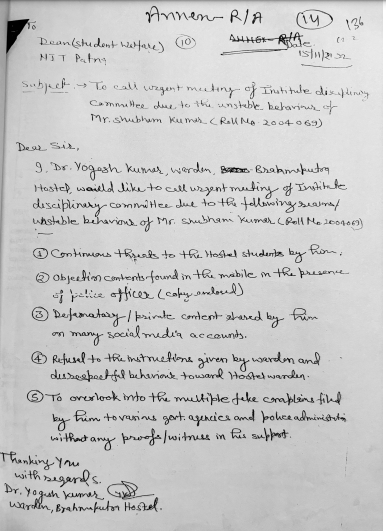
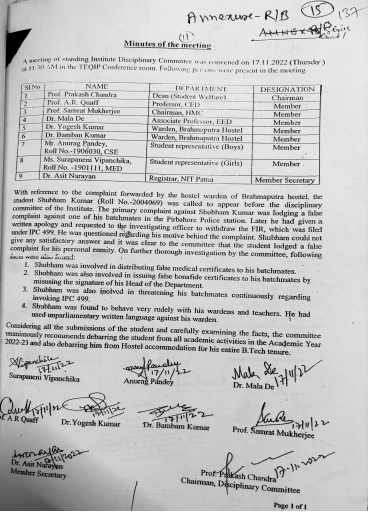
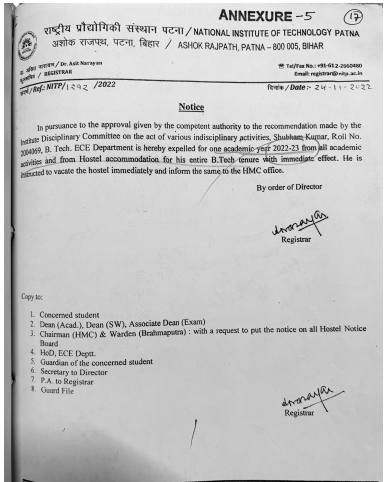
University Law – Punishment – Expulsion from Institute for one academic year – Apology does not translate to admission of guilt especially considering student's situation who was pitted against respondent-institution in which he was undergoing a course of study – Undertaking and promise, to not break any rule/order or guidelines of Institution in future; either of Institute or Warden, cannot again translate into admission of guilt – Student wanted quietus to the issue – Mere raising of complaints cannot result in a student being victimized – Institute does not offer any explanation to various complaints raised by appellant-student – Perfunctory manner in which disciplinary inquiry has been initiated and concluded clearly establish vindictive attitude of Institute – Entire action of Institute against student-appellant stands vitiated – Protest and complaints raised against authorities should not be treated lightly nor dismissed as attitudinal issues which, if so dismissed would only generate doubts about functioning of administration – Even a misguided student should be counselled and brought back to mainstream – Expulsion order set aside – Appeal allowed. (Paras 11, 14, 20, 29 and 30)
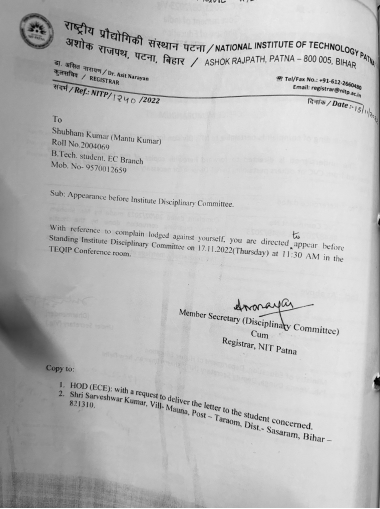
K. Vinod Chandran, CJ. – Whether the appellant, a student of the respondent Institute was victimised or whether the Institute’s image has been tarnished by the unsubstantiated allegations raised by the student before the various authorities, is the underlying issue in the appeal which arise from a writ petition challenging an order of expulsion of the student from the Institute for one academic year. The learned Single Judge noticed the submission of the respondent-Institute that they are agreeable to allow the petitioner to participate in the academic activities from the 5th semester, which would commence in July, 2023; took note of an undertaking filed by the petitioner and set aside the impugned order dated 24.11.2022 with direction to the petitioner to abide by his undertaking and participate in the academic activities from the 5th semester. Liberty was also reserved for the Institute to take appropriate action in the event of breach of undertaking.
2. The petitioner who appeared in person submitted that there was no undertaking that he would register for the 5th semester in the Academic Year 2023-2024. It was his submission that he had joined the course for the academic year 2020-2024, and when his expulsion was set aside, he should have been restored to the 5th semester and permitted to appear for the examination of the remaining semesters since his absence from the institute was only on account of the expulsion order. The appellant who appeared in person was emotionally charged and was also to an extent misdirected in his submissions. We had then appointed an Amicus Curiae, Ms. Roona, who had been assisting us ably in the hearings.
3. In this context, we were of the opinion, after hearing the matter today, that we should place on record the various stages of the hearing in the appeal for which we deem it appropriate that the different orders are extracted hereunder. We extract the orders of 30.11.2023 and 30.01.2024: –
Order dated 30.11.2023
The appellant, who was admitted in the academic year 2020-2021 was continuing his 5th Semester in B.Tech course in the respondent institute when the expulsion order was passed pursuant to a misconduct alleged against him. The learned Single Judge on the apology proffered by the appellant confirmed the order of expulsion and directed him to get himself admitted in the next year for the 5th Semester, i.e. in the academic year commencing 2023-24. Admittedly, the appellant did not proffer himself for admission to the 5th Semester in the year 2023-24.
2. The present appeal is filed against the original order after which a modification filed by him before the learned Single Judge was also rejected. The modification filed was to permit the appellant to sit for the 7th Semester which was rejected by an order by the learned Single Judge. In the present appeal, the original order passed by the learned Single Judge is challenged.
3. We see that the merits of the case with respect to justification for the expulsion was not considered by the learned Single Judge. Merely because the student proffered an apology it is not as if he gave up his contentions. In such circumstance, we would consider the matter in the appeal itself especially since a remand would entail further delay and the student will be kept out of his course. We direct the respondents to file a counter affidavit to the appeal bringing forth their defence.
4. We are also told that the 5th Semester examination is commencing on the 5th of December, 2023 by the appellant.
5. The learned Senior Counsel Sri Y. V. Giri, appearing for the respondents, however, specifically takes us to paragraph nos. 4 and 5 of the appeal in which aspersions were cast against the lawyers and also even against the Judge. It is also pointed out that such aspersions were even made a part of the modification petition.
6. Especially considering the fact that the student is appearing in person, we asked him to withdraw such aspersions cast on the persons appearing in the

The court held that educational authorities must follow principles of natural justice before issuing expulsion orders, ensuring students have the opportunity to respond.


The court emphasized that punitive actions against students must adhere to principles of natural justice, including the right to a fair hearing before any disciplinary action is taken.


Administrative actions lacking proper procedure and notice violate principles of natural justice, rendering them arbitrary and illegal.



Willful disobedience of a court order, even if based on negligence or carelessness, constitutes contempt of court and may result in imprisonment and fine.



An indispensable Tool for Legal Professionals, Endorsed by Various High Court and Judicial Officers
Please visit our Training & Support
Center or Contact Us for assistance

Scan Me!
India’s Legal research and Law Firm App, Download now!


For Daily Legal Updates, Join us on :



 Back to top


