
 Back
Back





IN THE HIGH COURT AT CALCUTTA
SABYASACHI BHATTACHARYYA, UDAY KUMAR, JJ.
State of West Bengal - Applicant
Versus
Rubber Products and Moulding Company – Respondent
RVW No. 208 of 2025 With CAN 1 of 2025 with RVW No. 209 of 2025 with CAN 1 of 2025
Decided On : 17-09-2025
| Table of Content |
|---|
| 1. facts of the case related to land acquisition. (Para 1 , 2 , 21) |
| 2. arguments concerning validity of enhanced compensation. (Para 3 , 4 , 5) |
| 3. citations illustrating court's power to review judgments. (Para 6 , 7 , 8 , 9) |
| 4. jurisdictional aspects related to inferior courts. (Para 10 , 11 , 12) |
| 5. importance of compensation assurance in property acquisition. (Para 36 , 39 , 40 , 41) |
| 6. lapse of acquisition proceedings due to failure to meet statutory time limits. (Para 44 , 46 , 47) |
| 7. conclusion of dismissal of review applications. (Para 51 , 52 , 53 , 54 , 55) |
JUDGMENT :
Sabyasachi Bhattacharyya, J.
1. The State of West Bengal has filed the present application for review of a judgment and order dated April 30, 2025, passed in F.A No.84 of 2019, whereby it was, inter alia, held that the enhanced compensation award was found to be invalid on the ground that the acquisition proceeding had lapsed in view of the delay in passing the award, more than two years after the issuance of the notice under Section 9 (3B) of the LAND ACQUISITION ACT , 1894 (hereinafter refer as the “1894 Act”).
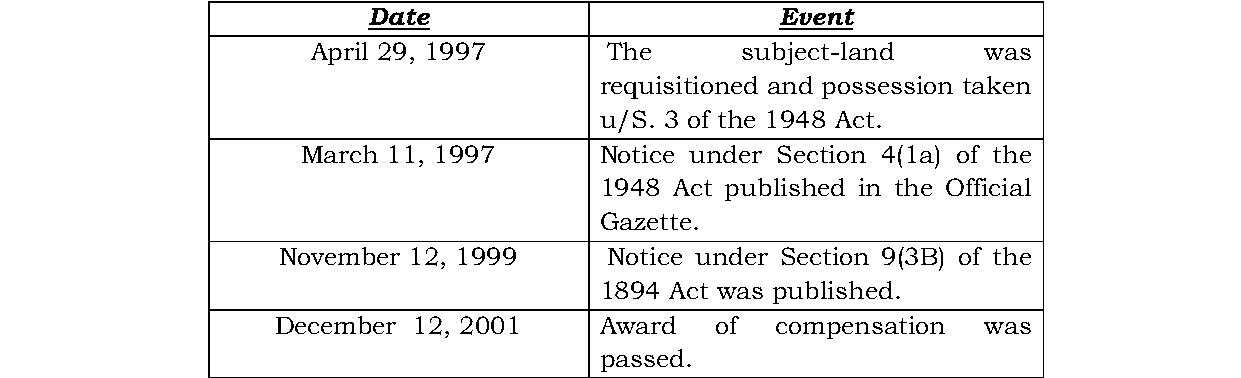
2. The relevant facts of the case, in a nutshell, are that initially the subject-land was requisitioned by the State under Section 3 of the West Bengal Land (Requisition and Acquisition) Act, 1948, (for short, “the 1948 Act”). Subsequently, a notification under Section 4 (1a) of the 1948 Act was published in the Official Gazette in the year 1985. Due to subsequent amendments to the governing legislation, the said notification lapsed and a fresh notification under Section 4 (1a) of the 1948 Act was issued by the Land Acquisition Collector on March 11, 1997.
3. Learned Additional Government Pleader (AGP) submits that by efflux of time, the 1948 Act expired after March 31, 1997. The provisions of Section 9 (3A) and Section 9 (3B) were incorporated in the 1894 Act by the West Bengal Amendment Act of 1997 with effect from April 1, 1997, when the other provisions of the 1948 Act, including Section 7A, were not in existence, save and except in respect of lands which were vested in the State Government by invoking Section 4 (1a) of the 1948 Act which were issued prior to the 1997 Act.
4. By placing reliance on sub-sections (3A) and sub-section (3B) of Section 9 of the 1894 Act, the learned AGP contends that as per the second proviso of the same, upon the Collector taking possession of the land, it is deemed to stand already vested in the Government.
5. It is submitted that a notice under Section 9 (3B) was issued on November 12, 2001 and as soon as the same came into force, the lands-in-question vested with the State Government free from all encumbrances. Thus, it is argued that the award was published on December 12, 2001, which was well within time and, as such, the finding of this Court in the order under review, to the extent that the proceeding had lapsed, was perverse and an error apparent on the face of the records.
6. Learned AGP places reliance on an unreported judgment of the Supreme Court in the matter of Kishundeo Rao and Others, vs. Govind Rao and Others, as well as an unreported Division Bench judgment of this Court in the matter of Shri Sadhan Roy (Budhuk) and others vs. Shri Arvind Kumar Singh and others, in order to elaborate on the power of the court to review its own judgment in the event there is an error apparent on the face of the record, irrespective of the parameters of Order XLVII of the Code of Civil Procedure not being strictly applicable.
7. Learned AGP next cites Reliance Airport Developers (P) Ltd vs. Airports Authority of India and Ors., reported at (2006) 10 SCC 1 , in support of the proposition that if there is an error of law, the courts have ample power to review the said judgment.
8. Learned AGP further relies on another unreported judgment of the Supreme Court in the matter of State of West Bengal and others vs. Mandodori Bhakat (dead) by LRs and Others in support of the proposition that in cases where there
AI
The lapse of acquisition proceedings under the 1948 Act can invalidate subsequent awards unless a fresh notice is issued under Section 9 of the 1894 Act, which initiates new vesting.

The court ruled that acquisition proceedings under the West Bengal Land (Requisition and Acquisition) Act lapsed due to non-compliance with statutory requirements, reviving the rights of original lan....

Notices under Section 4(1a) of the West Bengal Land (Requisition and Acquisition) Act, 1948 issued prior to March 31, 1992, and for which no award was passed within 3 years, had already lapsed and co....
The court established that lapsed acquisition notices under the 1948 Act result in the revival of original ownership, and subsequent notices cannot validate expired proceedings.
The court established that incomplete land acquisition proceedings under the 1948 Act lapse under Section 24(1)(a) of the 2013 Act, mandating compensation determination according to the latter.
Failure to comply with statutory timelines for land acquisition leads to the lapse of the acquisition, reviving the original owner's title to the land.
Where Section 24(1)(a) of the Right to Fair Compensation and Transparency in Land Acquisition, Rehabilitation and Resettlement Act, 2013 (2013 Act) applies, i.e. where there is no Award on the date o....
The main legal point established in the judgment is that the acquisition proceedings lapsed as no award was made within 2 years of the declaration under Section 6 of the 1894 Act, and the State was d....

Failure to pass an award within 12 months post-enactment of the new land acquisition legislation results in lapse of the acquisition proceedings initiated under the old legislation.



An indispensable Tool for Legal Professionals, Endorsed by Various High Court and Judicial Officers
Please visit our Training & Support
Center or Contact Us for assistance

Scan Me!
India’s Legal research and Law Firm App, Download now!


For Daily Legal Updates, Join us on :



 Back to top


