
 Back
Back





IN THE CIRCUIT BENCH CALCUTTA HIGH COURT AT JALPAIGURI
Subhendu Samanta, J.
Munmun Pal & Ors. – Appellant
Versus
Papi Byadh Roy and Anr. – Respondent
Fma 5 of 2024 With Fmat (Mv) 10 of 2024
Decided On : 05-10-2024
Judgment :
Subhendu Samanta, J.
1. Both the appeals are preferred against the Judgment and award dated 20nd December, 2023 passed by the Learned Judge, Motor Accident Claim Tribunal ADJ, 3rd Court Jalpaiguri, in MAC Case No. 97 of 2020.
2. The brief fact of the case is that one Pratik Kr. Pal died in a road traffic accident on 10.09.2019. The present petitioners being the widow and two daughters of the deceased filed an application u/s 166 of MV Act before the Learned Tribunal for getting compensation. The claim case was contested by the insurance Company by filing written statement. The Learned Tribunal after hearing the parties and after receiving evidence has allowed the compensation amounting to Rs. 1,04,66,344/- in favour of the claimants and directed the Insurance Company to pay the compensation.
3. Being aggrieved by and dissatisfied with the said award the claimants as well as the Insurance Company has preferred separate appeals. The ground for preferring appeal by the claimant is ---
i) income of the deceased as assessed by the Learned Tribunal is erroneous.
The Insurance Company has preferred the appeal on the grounds first there are contributory negligence on behalf of the deceased in such accident.
ii) There is no loss of income in this particular case so claimants are not entitled to get any compensation.
iii) The income as assessed by the Learned Tribunal is erroneous.
Regarding the Income of the Deceased
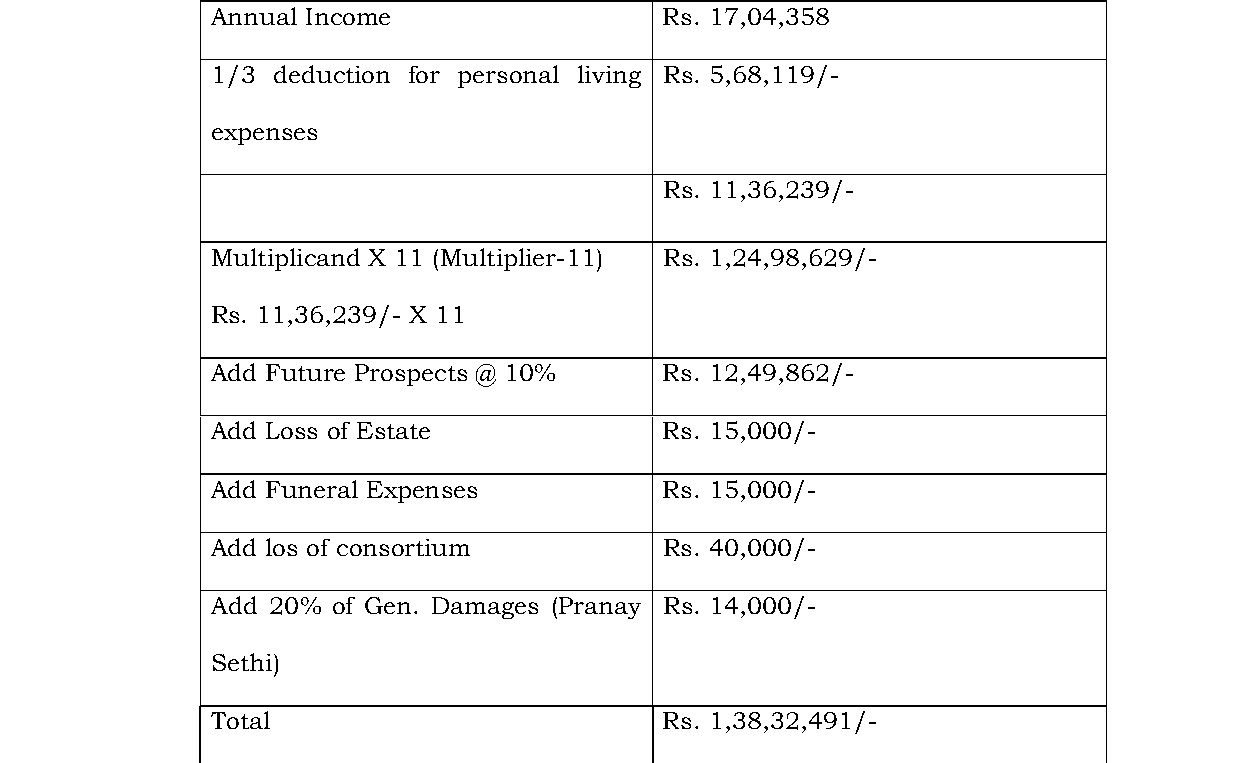
Both the claimant and Insurance Company has raised this point. Learned Counsel for the claimants submits that the learned Tribunal has erroneously considered the income of the deceased to be Rs. 12,88,803/- which is the average income of three years income appearing in the income tax return (ITR) filed by the deceased prior to his death. He submits the Learned Tribunal was erroneous in fixing the yearly income of the deceased by averaging three years income. He submits that the last year’s income appearing in the ITR should be considered to be the income of the deceased. In support of his contention he cited a decision of Hon’ble apex Court in Smt. Anjali and Ors. Vs. Lokendra Rathod and Ors. wherein the Hon’ble Apex court has held that
The Tribunal and the High Court both committed grave error while estimating deceased’s income by disregarding the Income Tax Return of the Deceased. The appellants had filed the Income Tax Return (2009-2010) of the deceased, which reflects the deceased’s annual income to be Rs.1,18,261/-, approx. Rs.9,855/- per month. This Court in Malarvizhi & Ors. (Supra) has reaffirmed that the Income Tax Return is a statutory document on which reliance be placed, where available, for computation of annual income. In Malarvizhi (Supra), this Court has laid as under:
'10. ...We are in agreement with the High Court that the determination must proceed on the basis of the income tax return, where available. The income tax return is a statutory document on which reliance may be placed to determine the annual income of the deceased.'
Hence, this Court is of the opinion that the deceased's annual income be fixed at Rs.1,18,261/-, approx. Rs.9,855/- per month keeping in mind the deceased's Income Tax Return for the year 2009-2010.
4. Learned Counsel appearing on behalf of the Insurance Company raised strong objection. He submits that there is not loss of income of the claimant’s due to the death of the deceased. He argued that evidence of PW 1 clearly disclosed the claimant No. 1 being the widow of the deceased become one of the director of the said company, wherein the deceased was a director. Thus, the claimant is not entitled to get any compensation in this case. However, the income assessed by the Learned Tribunal is erroneous. He submits that the dependency is the prime factor to award compensation under the Motor Vehicles Act. In this case the claimant No. 1 has already employed so they are not dependent upon the deceased and not entitled to get any compensation.
5. In support of his contention he cited a deci

The assessment of contributory negligence, medical expenses, and income, as well as the interpretation of evidence and legal principles established by higher courts, are crucial in determining compen....

Contributory negligence must be substantiated by evidence; lack thereof necessitates full liability of the insurer, not apportionment of compensation.

The insurance company is liable for compensation in a motor accident claim when the driver of the offending vehicle is found negligent, and the absence of a valid driving license does not absolve the....


The main legal point established in the judgment is the proper attribution of contributory negligence and the computation of just and reasonable compensation.

The main legal point established in the judgment is the application of principles of negligence and contributory negligence in motor accident cases, along with the determination of compensation for f....

The court ruled that the absence of the truck driver required an inference of sole negligence, overturning the Tribunal's finding of contributory negligence against the deceased.
The main legal point established in the judgment is the application of negligence, contributory negligence, and composite negligence principles in motor accident cases, and the need for new strategie....

The court reiterated that contributory negligence cannot be established merely from the accident's circumstances without direct evidence, resulting in a revised compensation amount reflecting the dec....



An indispensable Tool for Legal Professionals, Endorsed by Various High Court and Judicial Officers
Please visit our Training & Support
Center or Contact Us for assistance

Scan Me!
India’s Legal research and Law Firm App, Download now!


For Daily Legal Updates, Join us on :



 Back to top


