
 Back
Back





IN THE HIGH COURT AT CALCUTTA
SHAMPA DUTT (PAUL), J.
Surapati Nandi – Appellant
Versus
Pashupati Nandi and Others – Respondents
C.O. No. 3977 of 2024
Decided On : 20-05-2026
| Table of Content |
|---|
| 1. appellate court review of civil revision against trial court dismissal. (Para 1 , 2) |
| 2. dispute over pre-emption rights vs. commercial property characterization. (Para 3 , 4 , 5 , 6 , 7) |
| 3. evidentiary value of record of rights in property disputes. (Para 8 , 9 , 10 , 11 , 12 , 13 , 14) |
| 4. rights of co-sharers in unpartitioned ancestral property. (Para 15 , 16 , 17 , 18 , 19 , 20 , 21 , 22 , 23 , 24 , 25 , 26 , 27) |
| 5. section 22 of the hindu succession act applies to commercial immovable properties. (Para 28) |
| 6. restoration of preferential rights for class-i legal heirs. (Para 29 , 30 , 31 , 32) |
JUDGMENT :
SHAMPA DUTT (PAUL), J.
1. The civil revision has been preferred challenging a judgment/order dated 13th September, 2024 passed by the learned Civil Judge (Junior Division) 2nd Additional Court at Contai, District - Purba Medinipur, in Judicial Misc. Case No. 14 of 2015 [CIS Registration No. Misc. Case (Preemption) 06 of 2015].
2. Vide the impugned order, the learned Trial Court was pleased to dismiss the Misc. Case under Section 22 of the Hindu Succession Act. The learned Trial Court declined to grant a decree of pre-emption by evaluating the market value of 3/4th share of the suit property.
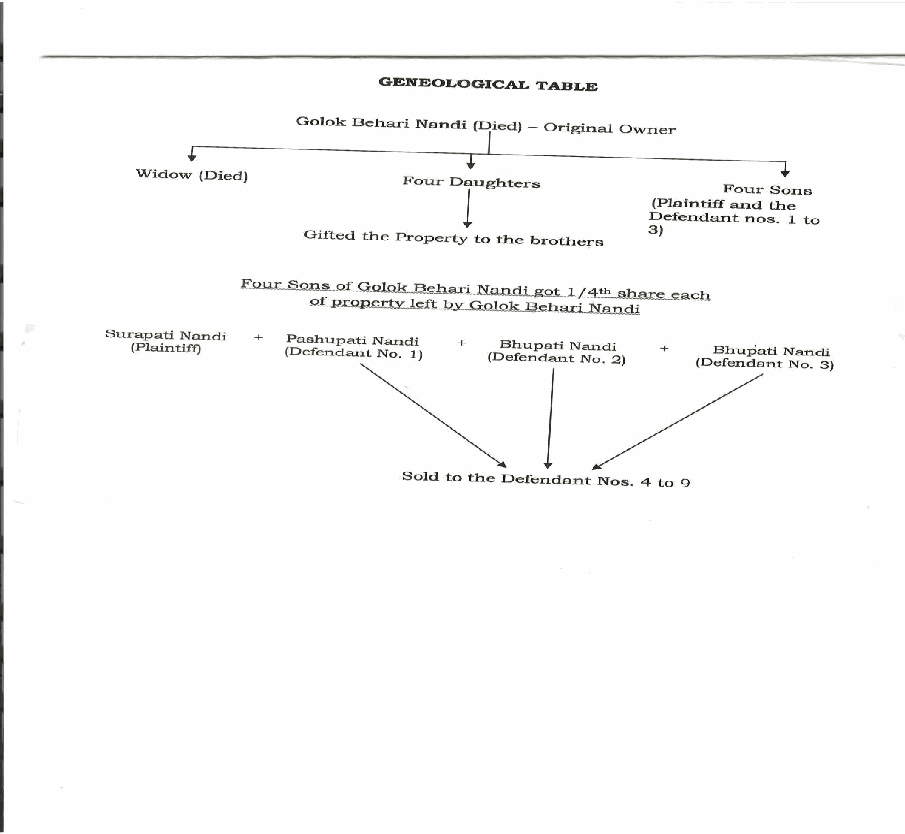
3. The petitioner's case before the learned Trial Court is that the "Ka" schedule property originally belonged to Golok Behari Nandy, the father of the petitioner as well as opposite parties no. 1, 2 and 3. The suit plot is a non-agricultural plot and a two storied building has been constructed upon the same after having acquired the property from their father after his death, by way of inheritance.
On 09.04.2008, the opposite parties no. 1, 2 & 3 declared that they intended to transfer their share in the suit plots to stranger purchasers before making an offer of sale to the petitioner, who had preferential right to purchase the suit plot by dint of being a class one legal heir. The opposite parties no. 1, 2 and 3 have violated the injunction order of the suit and transferred the suit plot in favour of the opposite parties no. 4 to 9 by virtue of sale deeds and hence the petitioner has submitted that these sale deeds are void, collusive and is liable to be rejected. It has been further submitted by the petitioner that he is ready and willing to purchase the suit plot at the market value of the suit plot.
Hence, the instant Misc. case.
4. The opposite parties case before the Trial Court is that the suit plots are situated in the center of "Deuli Hat". It has been submitted that Golok Behari Nandy was a permanent resident of Mouza Purusottampur and his paternal house is situated in Mouza Purusottampur. By way of partition deed dt. 31.07.1969, Golok Behari Nandy had acquired some portion out of his paternal property in plot no. 2490 and had constructed his residential house upon the same. For the purpose of conducting his business, he had purchased the suit plots 217/478 & 218/479 and had developed the one storied house upon the same and had started conducting business himself in that building. The rest of the building and one godown was given away as tenancy to the opposite party. It has been pleaded over and over again that the suit plots of this case do not refer to residential house of Golok Behari Nandy.
5. The petitioner along with his brother had acquired a plan of approval from the gram panchayet to reconstruct the house situated in the residential suit plot for the purpose of conducting the business effectively. Golok Behari Nandy had four sons and four daughters. The four daughters had transferred their share to their brothers by separate deeds. It is the O.Ps. case that the building had always been used as commercial building and they have been using the same as tenants. After the property was partitioned among the four brothers, these opposite parties no. 4 to 9 purchased the share of the opposite party no. 1 to 3 in the suit plots, by way of registered sale deed no. 1791 dt. 26.08.2008 and accordingly they have been in po
AI
A plaint must disclose a clear cause of action; clever drafting that creates an illusion of a cause of action is insufficient for maintaining a suit.


The court clarified that a will's condition restraining alienation does not apply to the legal representatives of the testator and that a right of preemption under the Hindu Succession Act is only ap....

The main legal point established in the judgment is the applicability of Section 22 of the Hindu Succession Act, 1956 to agricultural land and the preferential right of heirs to acquire property to p....


Preferential right to acquire property – Right under Section 22 of Hindu Succession Act, 1956 cannot be exercised after partition between co-heirs.
The main legal point established in the judgment is that the receipt of property by way of gift does not constitute inheritance as heirs specified in Class I of the Schedule to the Hindu Succession A....

The central legal point established in the judgment is the interpretation and application of Section 22 of the Hindu Succession Act, 1956, in the context of a property dispute between brothers.



An indispensable Tool for Legal Professionals, Endorsed by Various High Court and Judicial Officers
Please visit our Training & Support
Center or Contact Us for assistance

Scan Me!
India’s Legal research and Law Firm App, Download now!


For Daily Legal Updates, Join us on :



 Back to top


