
 Back
Back





IN THE HIGH COURT OF CHHATTISGARH AT BILASPUR
Goutam Bhaduri, Rajani Dubey, JJ.
Tularam Patel S/o Late Dhajaram Patel - Appellant
Versus
Budheshwar Nayak S/o Meharchand Nayak – Respondent
FA No. 660 of 2018, FA No. 6 of 2019
Decided On : 05-07-2024
(A) Hindu Succession Act, 1956 - Section 6 - Registration Act, 1908 - Section 32 - Evidence Act, 1872 - Section 73 - Civil suits for declaration and cancellation of sale deed and permanent injunction - The trial court annulled a sale deed executed under alleged fraud, ruling that the seller lacked exclusive rights to the property. The appeals against the decree were dismissed. (Paras 4, 24)
(B) Fraud - The court found that the sale deed was executed under fraudulent circumstances, as the seller was misled by his counsel, who was also the purchaser. The evidence presented supported the claim of fraud. (Paras 22, 23)
Facts of the case:
The case involved two civil suits regarding the validity of a sale deed executed by a septuagenarian seller in favor of a purchaser who was also his counsel. The plaintiffs claimed the deed was fraudulent, while the defendant argued it was valid. (Paras 4, 6)
Findings of Court:
The court upheld the trial court's finding that the sale deed was executed under fraud, leading to its annulment. (Paras 24)
Issues: The main issues included the validity of the sale deed and whether it was executed under fraudulent circumstances. (Paras 4, 24)
Ratio Decidendi: The court ruled that the sale deed was void due to fraud, emphasizing the importance of evidence in proving ownership and the validity of transactions. (Paras 22, 23)
Result: Appeals dismissed.
JUDGMENT :
Goutam Bhaduri, J
Heard.
1. Since both the appeals are arising out of common judgment and decree dated 30-11-2018 passed by the 7th Additional District Judge, Bilaspur, C.G as also common facts and issue involved in these appeals, they are being heard together and decided by this common judgment.
2. By order dated 5-10-2018 civil suit Nos.325-A/2012 and 74-A/2018 were consolidated and decided by the trial Court vide common impugned judgment and decree as stated supra.
3. Civil Suit No.325A/2012 filed by the plaintiffs (Budheshwar Nayak & Ors.)/respondents herein was allowed and against which FA No.660 of 2018 has been filed by the appellant/defendant No.1 whereas civil suit No.74A/2018 filed by the plaintiff (Tularam Patel)/appellant herein was dismissed and against the same FA No.6 of 2019 was filed by the appellant/plaintiff.
4. The brief facts of the case are that:-
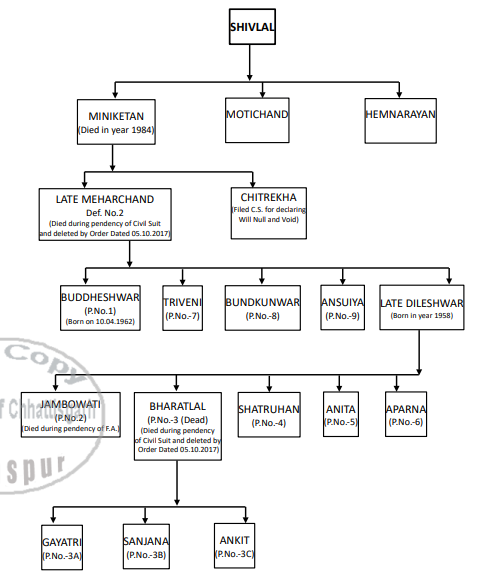
(A). Tularam Patel had filed a suit (civil suit No.74-A/2018) for permanent injunction and Budheshwar Nayak & others filed a suit (civil suit No.325-A/2012) for declaration and cancellation of sale deed and possession. Since the property inter se was one and the same, therefore, by a common judgment and decree both the suits were decided.
(B) Budheshwar Nayak & others filed a suit, which was bearing Civil Suit No.325A/2012 before the Additional District Judge, Bilaspur with the averments that a sale deed which is executed by Meharchand Nayak (father of Budheshwar) in favour of Tularam Patel, is null and void and is out come of fraud and Meharchand Nayak did not have exclusive right to execute the sale deed. Whereas Tularam Patel, who was the purchaser of the suit land filed the suit No.74-A/2018 for injunction that by a registered sale deed he purchased the suit land, therefore, the seller or their heirs be injuncted to interfere with the peaceful possession. To prove their respective case both the parties apart from their pleadings in counter adduced evidence and examined all the witnesses.
(C). Budheshwar Nayak & Ors. stated that Tularam Patel, who was the counsel of Meharchand Nayak, who was septuagenarian at the relevant time, on a promise that certain bail bond to be furnished took him to the Registrar Office and committed fraud in lieu of furnishing the bail bond got the sale deed executed without any payment of amount. On the contrary, Tularam Patel, the counsel denied the same.
(D) After both the civil suits were consolidated by order dated 5-10-2018, the learned Additional District Judge decreed the suit in favour of Budheshwar Nayak, who was claiming through Meharchand and others. No cross-objection has been filed. Simultaneously, the suit filed by Tularam Patel was dismissed claiming injunction. Hence, Tularam Patel, the purchaser of the suit property, has filed both these appeals.
5. For the sake of convenience, Tularam Patel & Budheshwar Nayak & Others would be hereinafter referred to as “the appellant & the respondents”, respectively.
6. (a) Learned counsel for the appellant would submit that in order to prove a registered sale deed to be an out come of fraud, the respondents failed to adduce evidence and it is only on the basis of certain copy of the sale deed, the expert opinion was obtained, which was produced before the Court. He would further submit that Meharchand Nayak, the seller of the suit property, was not examined and original sale deed though which was filed by the appellant was never sent for examination. He would further submit that the property, in fact, was got divided in between Meharchand Nayak and his legal heirs, which is evident from the Ex. D/22, wherein the part of the suit property was subject of sale by the respondents and that too was during the life time of Meharchand Nayak.
(b) Learned counsel would further submit that the complaint was made in name of Meharchand Nayak and Budheshwar Nayak and in his cross-examination at para 17 he admitted that he made those complaints that raises a doubt about his conduct. He would fur
AI
The court annulled a sale deed executed under fraudulent circumstances, affirming that a seller lacking exclusive rights cannot validly transfer property.

The main legal point established is the interpretation of Section 58(c) of the Transfer of Property Act, 1882, to determine the nature of a sale deed as a mortgage or an absolute sale.

The presumption of validity of a registered sale deed cannot be dismissed without compelling evidence to substantiate claims of fraud and incapacity.

(1) Secondary evidence – A notarized true copy is generally not admissible as primary evidence in Courts – It may, however, be admitted as secondary evidence.(2) Partition – Undivided share of a copa....

The plaintiff failed to prove ancestral property claims, leading to the dismissal of the partition suit and the recognition of the defendant's legal ownership.

The court emphasized that evidence cannot be adduced contrary to the arguments in a written document and held that the relief of partition cannot be granted in the face of a document registered lawfu....

Sale deeds executed by a senior family member are valid if conducted for legal necessity and with mental competency, reinforcing the rights of the karta under coparcenary property law.



An indispensable Tool for Legal Professionals, Endorsed by Various High Court and Judicial Officers
Please visit our Training & Support
Center or Contact Us for assistance

Scan Me!
India’s Legal research and Law Firm App, Download now!


For Daily Legal Updates, Join us on :



 Back to top


