
 Back
Back





IN THE HIGH COURT OF CHHATTISGARH AT BILASPUR
Ravindra Kumar Agrawal, J.
Kamlesh Jaiswal S/o Late Shyam Sunder Jaiswal - Appellants
Versus
State Of Chhattisgarh, Through SHO Patna District Korea - Respondent
CRA No. 1713 of 2022, CRA No. 1770 of 2022
Decided On : 19-07-2024
Narcotic Drugs and Psychotropic Substances Act, 1985 - Section 20(b)(ii)
(C) - Criminal Procedure Code, 1973 - Section 374(2) - Conviction and sentence under NDPS Act for possession of ganja - Prosecution failed to prove beyond reasonable doubt due to non-compliance with mandatory provisions of the NDPS Act, particularly regarding sampling and witness testimonies - Independent witnesses turned hostile, raising doubts on the search and seizure process - Conviction set aside, appellants acquitted. (Paras 36, 35, 34, 33, 32)
Facts of the case:
The appellants were convicted for possessing 292.800 kg of ganja, seized from their vehicle during a police search. The prosecution's case relied on witness testimonies and procedural compliance under the NDPS Act.
Findings of Court:
The court found that the prosecution did not establish the chain of custody and proper sampling procedures, leading to a failure in proving the case against the appellants.
Issues: The main issues included the validity of the search and seizure, the credibility of witness testimonies, and compliance with the NDPS Act's sampling requirements.
Ratio Decidendi: The court emphasized that the prosecution must prove its case beyond reasonable doubt, especially when independent witnesses do not support the prosecution's claims, and that proper sampling procedures must be followed to ensure the integrity of evidence.
Result: Appeals allowed, conviction set aside, and appellants acquitted.
Key Points: - The prosecution must prove its case beyond reasonable doubt, especially in drug-related offenses, with emphasis on compliance with mandatory procedures (!) (!) . - The sampling procedure and compliance with NDPS Act provisions (including Section 52-A verification, sampling from packets, and identification), and the status of independent witnesses are central to the conviction’s validity (!) (!) (!) (!) . - Independent witnesses were hostile or turned, casting doubt on search and seizure, weakening the prosecution’s case and leading to acquittal on appeal (!) (!) . - The weighing, sampling, and labeling issues (S-1/S-2 markings, Lot sampling, and Standing Order 1/89 compliance) were critical to the court’s reasoning for overturning the conviction (!) (!) (!) (!) . - The appeals resulted in setting aside the trial court’s conviction, acquitting the appellants, and directing their release and fresh compliance actions under Cr.P.C. provisions (!) (!) . - The evidence about the chain of custody, panchnamas, and Malkhana entries were scrutinized and found lacking in persuasiveness for upholding a conviction (!) (!) (!) .
ORDER :
Ravindra Kumar Agrawal, J.
1. Both these appeals are arising out of the same crime number and the same sessions trial, therefore both are being heard and decided together.
2. Both these criminal appeals are filed under Section 374(2) of the Code of Criminal Procedure, 1973 against the judgment of conviction and the sentence dated 21.10.2022, passed by learned Special Judge (Narcotic Drugs and Psychotropic Substances Act, 1985), Baikunthpur, District Koriya, Chhattisgarh, in Special Criminal Case No. 7 of 2020, whereby the appellants have been convicted for the offence under Section 20(b)(ii)(C) of the Narcotic Drugs and Psychotropic Substances Act, 1985 (hereinafter called as ‘NDPS Act’) and sentenced for R.I. for 10 years with fine of Rs. 1 lakh to each of the appellants, in default of payment of fine, further simple imprisonment for 6 months.
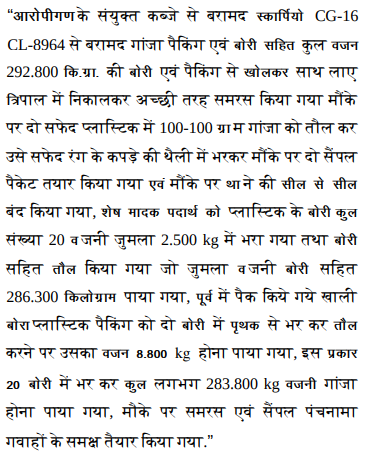
3. The case of the prosecution, in brief, is that on 01.03.2020, a secret information was received by the police of Police Station Patna, District Korea, that a white colour Scorpio vehicle bearing No. CG-16/CL-8964 coming from Surajpur to Baikunthpur having loaded with Ganja. The witnesses were being called and secret information Panchnama was prepared. The information regarding secret information was sent to the senior police officer, and thereafter, the police reached on the spot, and near Dakaipara Bypass, the vehicle of the appellants were intercepted. On being searched, the accused persons were found sitting in the vehicle, they disclosed their names, then the police party informed the appellants about the secret information. The notice under Section 50 of the NDPS Act was given to them and informed about their right to search, either by police persons, gazetted officer, or any Magistrate. The appellants have given their consent to be searched by the police party, and their consent were reduced in writing in Exhibit P-6, P-7 and P-8. The Panchnama regarding search without warrant was also prepared, which is Exhibit P-3. The Panchnama regarding secret information and seizure of the vehicle was also prepared, which is Exhibit P-4. Police party also gave their search to the accused persons, and Panchnama was of the same has also been prepared as Exhibit P-9 and P-10. The accused persons were separately searched by the police party and on being searched, from accused Kamlesh Jaiswal, cash of Rs. 1450/- has been seized from him. From accused Bahadur Ram Kurre, his Aadhar card, driving license, PAN card, ATM card of Axis Bank, cash of Rs. 640/- and two mobile phones have been seized. From accused Ramesh Kumar Dewangan, his driving license, cash of Rs. 280/- and one mobile phone have been seized. The key of the vehicle number CG-16/CL-8964 was also seized from Ramesh Kumar Dewangan and the Talasi Panchnama was prepared as Exhibit P-11, seizure memo was prepared as Exhibit P-12. On being searched of the vehicle, the alleged contraband ganja was found, which was in plastic packets and filled in 11 bags, and kept at middle and rear seat of the vehicle. The said contraband was seized vide seizure memo Exhibit P-13. When the accused persons were asked about the contraband ganja, which was kept in 280 packets in 11 bags, they disclosed that it was being transported from Sonpur, Odisha, for its sale, and the vehicle belongs to themselves and then the Panchnama with that effect was prepared vide Exhibit P-14. Seized contraband was identified by its smell, taste, and by burning and the identification Panchnama Exhibit P-15 was prepared. The witness for the weighment of the seized contraband ganja was called vide Exhibit P-16. The weighment apparatus was physically verified, and Panchnama was prepared to that effect vide Exhibit P-17. On being weighed, it was found total 292.800 kg which were kept in various packets and bags, and the weighment Panchnama was prepared vide Exhibit P-18. The details of the packets and bags, in which the contraband ganja was kept is given hereinbelow:-
| Packe | |
AI
The prosecution must prove its case beyond reasonable doubt, especially in drug-related offenses, where compliance with mandatory procedures is crucial.


Confession of accused recorded by a Police Officer is not admissible in evidence as the same is hit by Section 25 of Evidence Act.

Non-examination of independent witnesses is not fatal to the prosecution in NDPS cases; minor sampling irregularities do not undermine the case’s integrity, and mandatory sentences under the NDPS Act....

Recovery of Ganja – Samples drawn in presence of Magistrate and list thereof on being certified alone would constitute primary evidence for the purposes of trial.
Prosecution must adhere to strict evidential procedures in NDPS Act cases; failure undermines the conviction. In this case, inconsistencies in evidence and chain of custody led to acquittal.

The court emphasized the necessity for strict adherence to procedural safeguards in drug-related cases, ruling that non-compliance rendered the prosecution's case unsustainable.

Strict adherence to procedural requirements in the NDPS Act is essential for securing convictions; failure to follow these mandates can lead to acquittal.

The prosecution must comply with mandatory procedures for seizure and sampling under the NDPS Act, and failure to do so undermines the conviction.



An indispensable Tool for Legal Professionals, Endorsed by Various High Court and Judicial Officers
Please visit our Training & Support
Center or Contact Us for assistance

Scan Me!
India’s Legal research and Law Firm App, Download now!


For Daily Legal Updates, Join us on :



 Back to top


