
 Back
Back





HIGH COURT OF CHHATTISGARH AT BILASPUR
RAJANI DUBEY, SACHIN SINGH RAJPUT, JJ
Ghondul Sahu, died and deleted as per Honble Court Order Dated 16-01-2024 – Appellant
Versus
Bisan Sahu S/o Shri Ghondul Sahu - Respondent
FA No. 555 of 2018
Decided on : 06-03-2025
(A) Code of Civil Procedure, 1908 - Section 96 - Appeal against judgment and decree - Legality and validity of trial court's decree allowing plaintiff's suit for declaration of ancestral property and injunction against defendants - The trial court found that the suit property was ancestral and that the plaintiff had a 1/4 share, based on evidence of joint family ownership. (Paras 2, 3, 12, 14)
(B) Ancestral Property - Definition and rights - The court reaffirmed that property inherited from ancestors is considered ancestral, and all coparceners have equal rights unless proven otherwise. (Paras 12, 14)
Facts of the case:
The plaintiff claimed a share in ancestral property, alleging that the defendants sold portions of it without his consent. The defendants contended that the property was self-acquired. The trial court ruled in favor of the plaintiff, declaring the sales void.
Findings of Court:
The trial court's findings were based on proper appreciation of evidence, confirming the ancestral nature of the property and the plaintiff's entitlement to a share.
Issues: The main issues included whether the property was ancestral and whether the sales executed by the defendants were valid.
Ratio Decidendi: The court held that the property was ancestral, and the sales executed by the defendants were invalid as they exceeded their power to transfer the property.
Result: Appeal dismissed.
| Table of Content |
|---|
| 1. defendants' claims of self-acquisition (Para 4) |
| 2. trial court's findings (Para 5 , 6 , 7 , 8 , 9 , 10 , 11 , 12 , 13) |
| 3. ancestral property rights (Para 14) |
| 4. appeal outcome (Para 15) |
Judgment :
(Rajani Dubey, J.)
Challenge in this appeal under Section 96 of Code of Civil Procedure is to the legality and validity of the judgment and decree dated 10.8.2018 passed by the Additional District Judge, Gariyaband in Civil Suit No.26A/2015 whereby the suit of the plaintiff has been allowed. (Parties shall hereinafter be referred to as per their description before the trial court.)
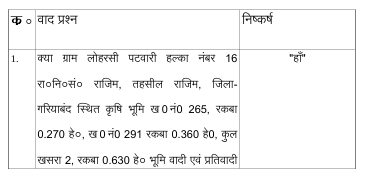
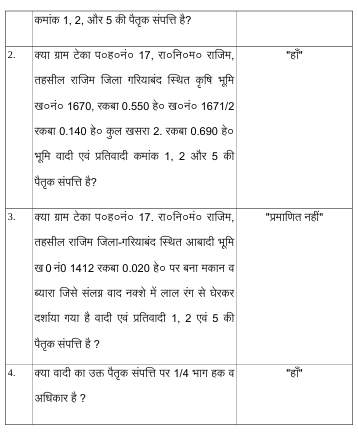
02. The admitted facts in this case are that Defendant No.1 Ghondul Sahu is son of Mukundi Sahu. Plaintiff Bisan Sahu, defendant No.2 Doman Sahu and defendant No.5 Bhanupratap Sahu are sons of defendant No.1 whereas minor defendant No.3 Chhatrapal is son of defendant No.2 Doman Lal Sahu and defendant No.4 Smt. Geeta bai is wife of defendant No.2. Defendant No.1 Ghondul has only 0.55 hectare of agricultural ancestral land of Khasra No.1670 situate at Village-Teka. On 13.5.2015 defendant No.1 Ghondul sold 0.360 hectare of land bearing Khasra No.291 situate at Village-Loharsi in favour of defendant No.2 Doman Sahu through registered sale deed for a consideration of Rs.9,51,300/-. On the same day, defendant No.1 also executed a registered sale deed in favour of defendant No.5 Bhanupratap Sahu in respect of land bearing Khasra No.265, area 0.270 hectare situate at Village-Loharshi for a sale consideration of Rs.7,13,500/-. Further, on 28.9.2015 defendant No.1 sold land bearing P.H.No.17/33, khasra No.1671/2, area 0.14 hectare and Khasra No.1670, area 0.550 hectare situate at Village-Teka for a sale consideration of Rs.12,22,500/- to defendant no.3 Chhatrapal through registered sale deed.
03. Case of the plaintiff, in brief, is that the plaintiff and defendants No. 1 to 5 are members of the same family. Name of defendant No.1 has been recorded as owner of the ancestral property which is in fact the ancestral property of the plaintiff and defendants No. 1, 2 & 5 and as such, they all have equal 1/4 share in the said property. However, on the influence of defendants No. 2 & 5, father of the plaintiff i.e. defendant No.1 would not take care of him and even after marriage, he was separated from the family members and hence he started living separately and was maintaining his family somehow. In the year 2014- 15 when the plaintiff claimed his share in the ancestral property, it was refused by defendant No.1. A social meeting was also held in this regard where looking to the act of the defendants No.1, 2 & 5 they were ostracized by the society. Being aggrieved, they prepared registered sale deeds on 13.5.2015 worth Rs.9,51,300/- in favour of defendant No.2 and another sale deed in favour of defendant No.5 worth Rs.7,13,500/- and on 28.9.2015 also prepared a registered sale deed whereby certain lands were sold in favour of defendant No.3. These sale deeds were executed with a view to grab share of the plaintiff. Based on these sale deeds, names of defendant No.2 Domal Sahu and defendant No.5 Bhanupratap Sahu were recorded in the revenue records in respect of land situate at Village-Loharsi but the name of minor defendant No.3 Chhatrapal has not been recorded in respect of land situate at Village-Teka sold to him. The plaintiff had raised objections at the time of mutation on the basis of these sale deeds. Hence he filed a suit for declaration that all these three sale deeds are illegal and void, not binding on him, he is entitled for 1/4 share in the suit property, defendants No. 1 to 5 be permanently injuncted from selling, transferring, alienating or mortgaging the suit property in any manner till conclusion of the partition proceedings and he be also granted mesne profit @ Rs.1 lac per annum from the date of filing of suit till the date of partition from defendants No. 1 to 5.
04. Defendants No.1 to 5 in their written statement denying all the adverse aver
The court affirmed that ancestral property rights are inherent to all coparceners, and sales executed without consent are invalid.


The court reaffirmed that a sale deed executed for family and legal necessity by a joint family member is binding, barring challenge by family members after significant delay without sufficient cause....

The court ruled that property is non-ancestral when not inherited from a common male ancestor, upholding legal validity of voluntary sales for consideration made by owner.

The burden of proof lies on the party alleging ancestral or joint property, and without evidence to support the claim, the Courts may reject the suit.

The karta of a Hindu Joint Family can validly alienate joint family property for legal necessity or benefit of the estate, binding all family members.

Property inherited post-partition is categorized as separate property under Hindu law, thus allowing the vendor exclusive rights to sell without objections from the objectors.

A natural guardian cannot sell a minor's property without prior court approval, and any such sale is voidable at the minor's instance, reinforcing the protection of minors' rights in property matters....



An indispensable Tool for Legal Professionals, Endorsed by Various High Court and Judicial Officers
Please visit our Training & Support
Center or Contact Us for assistance

Scan Me!
India’s Legal research and Law Firm App, Download now!


For Daily Legal Updates, Join us on :



 Back to top


