
 Back
Back





HIGH COURT OF CHHATTISGARH AT BILASPUR
Ravindra Kumar Agrawal, J.
Rajkumar Satnami, S/o Resham Lal Satnami - Appellant
Versus
Panna Lal Satnami, S/o Resham Lal Satnami - Respondent
SA No. 499 of 2016
Decided On : 12-12-2025
| Table of Content |
|---|
| 1. jurisdiction and admission of substantial questions of law. (Para 1 , 2 , 11) |
| 2. nature of the property and ownership rights. (Para 6 , 9) |
| 3. arguments concerning the validity of the will. (Para 12 , 13 , 14) |
| 4. standards for proving the execution of a will. (Para 17 , 19 , 20 , 21 , 22) |
| 5. principles established regarding the attestation required for a will. (Para 24 , 26 , 27) |
| 6. testimonies of attesting witnesses and their importance. (Para 28 , 33 , 35 , 38) |
| 7. effect of registration on the validity of a will. (Para 41 , 42) |
| 8. final determination on the will's validity based on evidence. (Para 45 , 46 , 48) |
JUDGMENT :
Ravindra Kumar Agrawal, J.
1. The present second appeal has been filed by the defendant under Section 100 of the Code of Civil Procedure, 1908 against the impugned judgment and decree dated 07.09.2016 passed by learned First Additional District Judge, Balod Bazar, District Baloda Bazar-Bhatapara in Civil Appeal No. 19-A/2016, whereby the first appeal is dismissed and the judgment and decree dated 30.04.2013 passed by learned Civil Judge Class-I, Kasdol, District Baloda Bazar Bhatapara in Civil Suit No. 4-A/2013 has been affirmed.
2. The present second appeal has been admitted on 17.07.2017 on the following substantial questions of law:
1. “Whether the Courts below have erred in holding that the registered deed of Will dated 9.9.2010 (Ex.P-11) executed by Gurbari Bai in favour of Defendant No.1-Raj Kumar is a forged and fabricated one?”
2. “Whether the Courts below were justified in holding that due execution, attestation and validity of the registered Will deed dated 9.9.2010 (Ex.P-11) was not duly established by Defendant No.1-Raj Kumar Satnami in accordance with law?”
3. For the sake of convenience the status of the parties shown in the suit are being taken in the present appeal.
4. The plaintiff had filed a civil suit for declaration of his title over the suit land total admeasuring 1.445 hectare situated at village Barapali, Patwari Halka No. 24, RI Circle Gidhauri, Tahsil Kasdol, District Baloda Bazar-Bhatapara and admeasuring 0.385 hectare situated at village Semra, Tahsil Kasdol, District Baloda Bazar-Bhatapara, partition and separate possession of the suit property and permanent injunction.
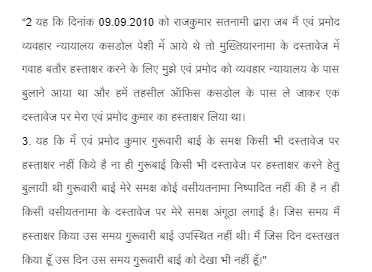
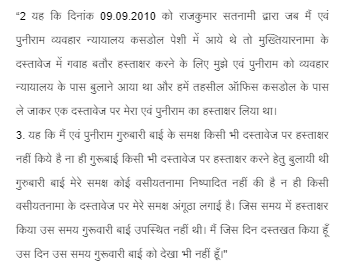
5. The plaintiff had pleaded in his plaint that the suit property was owned by one Gurbari Bai who is the mother of the plaintiff as well as defendant no.1. Gurbari Bai has died on 08.02.2012. The plaintiff and defendant No.1 are having equal share over the suit property as per their succession and Gurbari Bai has orally partitioned the property in the year 2005, and given the shares of the parties and she was residing with the plaintiff and defendant No.1 from time to time. The parties are in possession of the respective shares of the property and cultivating as per their share. The property obtained by the plaintiff in his share has been shown in schedule-B annexed with the plaint. In the year 2010, when Gurbari Bai suffered from ailment, the defendant No.1 took her with him for her treatment and got will deed prepared on09.09.2010. Gurbari Bai was an illiterate lady and she has never executed any will in favour of the defendant No.1 and the alleged will deed dated 09.09.2010 is a forged document. For the last 3 years of her death, she continually suffered by ailment and physically and mentally not sound. Taking advantage of her physical and mental status, the defendant No.1 has got executed will deed on 09.09.2010. After death of Gurbari Bai, the defendant No.1 has filed an application before the Tahsildar Kasdol for mutation of his name in the revenue records on the basis of said will and when the plaintiff came to know about the said will, he raised objection before the Tahsildar and pleaded that the said will is forged and fabricated. The attesting witnesses to that will have also filed their affidavit before the Tahsildar that they did not know about execution of any will deed in favour of the defendant
AI
The propounder of a will must prove due execution and attestation, particularly when suspicious circumstances exist; mere registration does not guarantee authenticity.

The execution of a will must strictly adhere to statutory requirements, including valid attestation by witnesses, and mere registration does not suffice to validate a will in the presence of suspicio....


The validity of a Will under Section 63 of the Indian Succession Act requires a full trial if disputed facts exist, rather than being decided as a preliminary issue.


The courts ruled that the failure to prove the valid execution and attestation of a Will invalidates claims of property based on it, emphasizing statutory requirements for witness testimony.

The execution of a will must comply with statutory requirements, including proper attestation by witnesses; failure to do so invalidates the will.

The main legal point established in the judgment is the importance of proper execution and attestation of wills, mortgages, and gifts as per the statutory provisions of the Indian Succession Act and ....



An indispensable Tool for Legal Professionals, Endorsed by Various High Court and Judicial Officers
Please visit our Training & Support
Center or Contact Us for assistance

Scan Me!
India’s Legal research and Law Firm App, Download now!


For Daily Legal Updates, Join us on :



 Back to top


