
 Back
Back





HIGH COURT OF CHHATTISGARH AT BILASPUR
SANJAY KUMAR JAISWAL, J.
Kumaril Hirwani, S/o. Late Parasram - Appellant
Versus
Vishnu Soren, S/o. Sawna Soren – Respondent
ACQA No. 1007 of 2024
Decided On : 14-11-2025
JUDGMENT :
SANJAY KUMAR JAISWAL, J.
1 This appeal is preferred under Section 378(4) of the Code of Criminal Procedure, 1973, against the judgment dated 23.09.2021 passed in Criminal Appeal No. 108/2019 by learned Sessions Judge, Rajnandgaon, District - Rajnandgaon (C.G.), whereby the respondent has been acquitted for the offence punishable under Section 138 of N.I. Act. Criminal Appeal No. 108/2019 arose out of judgment dated 30.10.2019, in Criminal Case No. 3271/2017 by the Judicial Magistrate First Class, Rajnandgaon, District – Rajnandgaon (C.G.), wherein the respondent was convicted and sentenced for the offence punishable under Section 138 of N.I. Act.
2 The facts of the case, in brief, were that complainant/appellant Kumaril Hirwani, describing accused Vishnu Soren as a neighbour and acquaintance of his brother-in-law, filed a complaint alleging that the accused had borrowed Rs.1,50,000 (one lakh fifty thousand rupees) from him to meet household needs. To repay the amount, the accused provided the complainant with an account payee cheque No. 022512, dated 05/05/2017, for the amount of Rs.1,50,000 (Ex.P-1), from his account with UCO Bank, Naya Raipur branch. The complainant deposited the check in his account with the State Bank of India, Dongargaon branch, for payment. However, according to the memorandum received from the bank, Exhibit P-2, dated 21/06/2017, the check was returned unencashed due to insufficient funds in the account. Subsequently, the complainant sent a legal notice (Exhibit P-3) to the accused demanding the amount, the registered postal receipt of which is Exhibit P-4. The accused refused to accept the notice and was returned as Exhibit P-5 with a note. When the accused failed to pay the check amount within 15 days of receiving the notice, the complainant filed a complaint under Section 138 of the Negotiable Instruments Act on 07/09/2017. During trial, only the complainant examined himself. In his statement under Section 313 of the Code of Criminal Procedure, the accused denied the complainant's evidence, declared himself innocent, and presented no evidence in his defence.
3 Vide judgment dated 30/10/2019 passed by the trial Court, Judicial Magistrate First Class, Rajnandgaon, District-Rajnandgaon, (C.G.) in Criminal Case No. 3271/2017 “Kumaril Hirwani vs Vishnu Soren”, the accused was convicted and sentenced as under:-
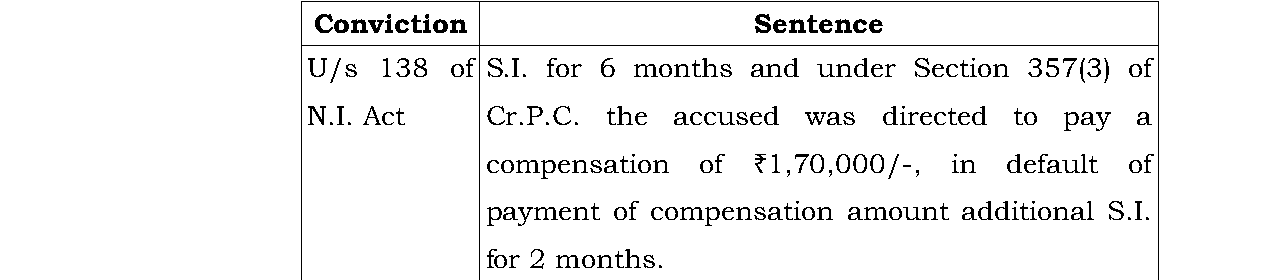
4 The Sessions Court allowed the appeal against the above conviction and sentence of the trial Court and acquitted the accused. Hence, this appeal.
5 Learned counsel for the appellant submits that the learned appellate Court committed gross error by holding that the complainant had not examined any witnesses in support of his complaint and also held that the complainant had neither mentioned the date on which the said cheque was dishonored and returned to his bankers State Bank of India Branch Dongargaon nor the complainant had mentioned the date on which the accused had refused to accept notice which was served on him by complainant. He further submits that the Sessions Court overlooked the fact that the accused neither denied his signature on the cheque nor denied the fact of issuing the cheque. In such circumstances, Section 138 of the Negotiable Instruments Act presumes in favour of the complainant. The Sessions Court's conclusion in this regard is not justified, and the acquittal is not sustainable. Therefore, the appeal is liable to be allowed.
6 Learned counsel for the respondent/accused supported the impugned judgment, submitting that the learned trial Court has passed an appropriate order after going through the entire oral as well as documentary evidence, which does not call for any interference.
7 Heard learned counsel for the parties and went through the entire record with utmost circumspection.
8 The first ground on which the accused was acquitted by the Sessions Court was that the complainant had failed to prove that the cheque in question was given to him by the accused in full or i
AI
The presumption of liability under Section 139 of the Negotiable Instruments Act favors the cheque holder unless rebutted by the accused, who must present evidence to challenge the presumption.

The burden of proof, legal presumptions, and the accused's admission of debt in the issuance of the cheque are crucial in determining liability under the Negotiable Instrument Act.

The main legal point established in the judgment is the presumption in favor of the holder under Section 139 of the NI Act, the rebuttable presumption of consideration under Section 118(a), and the r....
The presumption under Sections 139 and 118 of the Negotiable Instruments Act mandates that once a cheque's signature is established, it is presumed to be issued for a debt, shifting the burden to the....
The presumptions under sections 138 and 139 of the NI Act favor the holder, shifting the burden to the accused to rebut the claims of liability.
The main legal point established in the judgment is the rebuttable nature of the presumption in favor of the holder of a cheque under Sections 118 and 139 of the N.I. Act, emphasizing the burden of p....

Admission of cheque execution triggers Sections 118/139 NI Act presumptions of debt; burden on accused to rebut by evidence; trial acquittal ignoring presumption and shifting onus to complainant is p....

Presumption under Section 139 NI Act that cheque is for debt discharge holds unless rebutted by preponderance of probabilities; trial acquittal reversed for perversely ignoring defence witness confir....

The burden of proof under Section 138 of the Negotiable Instruments Act lies on the accused to show that the cheque was not issued in discharge of any debt or liability.



An indispensable Tool for Legal Professionals, Endorsed by Various High Court and Judicial Officers
Please visit our Training & Support
Center or Contact Us for assistance

Scan Me!
India’s Legal research and Law Firm App, Download now!


For Daily Legal Updates, Join us on :



 Back to top


