
 Back
Back





IN THE HIGH COURT OF DELHI AT NEW DELHI
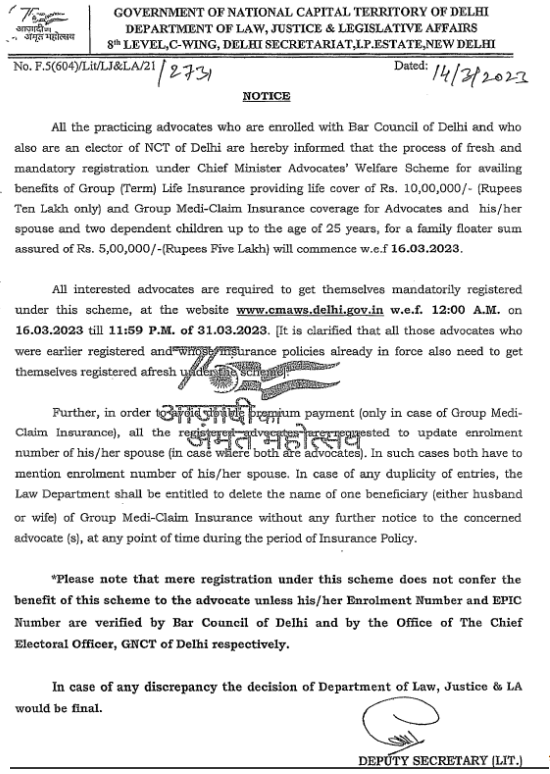
SANJEEV NARULA, J.
Darshana Rani – Petitioner
Versus
The Government NCT Of Delhi And Anr. – Respondents
W.P.(C) 7519 Of 2024
Decided On : 13-11-2024
(A) Chief Minister Advocate Welfare Scheme - Life Insurance Claim - The scheme was introduced for the benefit of advocates in Delhi, providing life insurance coverage of INR 10 Lakhs. The petitioner sought claim for her deceased son, whose eligibility was not verified before his death. (Paras 1-20)
(B) Eligibility Criteria - Mere registration under the scheme does not confer benefits until verification of credentials by the Bar Council and electoral authorities is completed. (Paras 11-18)
(C) Distinction between Policies - The Group (Term) Insurance and Group Medical Insurance policies are distinct, with separate eligibility criteria and timelines. (Paras 16-17)
Findings of Court:
The court found that the petitioner's son was not eligible for the life insurance claim as he passed away before the policy commenced.
Issues: The main issue was whether the petitioner's son was eligible for the life insurance claim under the CMAWS.
Ratio Decidendi: The court ruled that the insurance coverage is contingent upon the activation of the policy, which occurred after the death of the petitioner's son.
Result: Writ petition dismissed.
JUDGMENT :
(Sanjeev Narula, J.)
1. Mrs. Darshana Rani, the Petitioner, a widow and senior citizen, seeks directions for payment of life insurance claim of INR 10 Lakhs under the Chief Minister Advocate Welfare Scheme,[“CMAWS”] on account of the death of her son, Late Sh. Kamal Khurana, Advocate.
2. The CMAWS was introduced by Government of NCT of Delhi,[“GNCTD”] vide Cabinet Decision No. 2794 dated 18th December, 2019, for the benefit of Advocates enrolled with the Bar Council of Delhi,[“BCD”], who are the residents of Delhi. The stated object of the scheme is to recognise the role and contributions of Advocates in society and the growth of the legal fraternity, in terms of building a strong democracy, encouraging active citizen engagement as well as participation in nation building. The scheme was approved by the Cabinet in 2019 and an annual outlay of INR 50 Crores was created for implementation of the scheme.
3. To enhance the welfare of advocates, benefits under the scheme included: Group (Term) Insurance policy of Life Insurance Corporation of India,[“LIC”], providing a life cover of Rs. 10 Lakhs per advocate; Group Medi-claim coverage through New India Assurance Company Ltd,[“NIACL”] for the Advocate, their spouse and two dependent children upto the age of 25 years, under a family floater sum insurance of upto INR 5 Lakhs; and other benefits such as E-libraries and Creche facilities in 6 District Courts of Delhi.
4. In order to streamline the process of inviting applications under CMAWS, in March 2023 a Standard Operating Procedure,[“SOP”] was framed by Respondent No. 1 - Department of Law, Justice & Legislative Affairs, GNCTD,[“Law Department”] with the approval of Minister (Law) of GNCTD. As per the said SOP, online applications for fresh enrolment under the CMAWS are invited twice a year, during the months of January and July respectively. In order to be eligible under the CMAWS, an applicant is required to submit their enrolment details with the BCD as well as documents establishing that they are on the electoral role of GNCTD. It has been clarified that an advocate can only be conferred the benefit of the CMAWS if his/her Enrolment Number and Electors Photo Identification Card,[“EPIC”]/Voter ID card numbers are duly verified by the BCD and the Office of the Chief Electoral Officer, GNCTD, respectively.
5. Pertinently, when the CMAWS was first introduced, the Group (Term) Insurance Policy taken by GNCTD from LIC was valid for one year. It therefore needed to be renewed at the expiry of the term period. In this regard, all beneficiaries/advocates were required to re-register themselves and get verifications with the CMAWS afresh, whenever a notice to this effect is issued by Respondent No. 1 - Law Department, GNCTD.
6. Respondent No. 1 submits that initially in the first phase of the CMAWS around 37,145 advocates submitted their applications for registration. After the final verification process for the scheme, the Department entered into a contract with LIC to provide the Group (Term) Insurance to 21,964 advocates, who were found to be eligible. Thereafter, the first policy came into effect from 20th November, 2020 to 19th November, 2021 for period of one year.
7. In 2021, prior to the expiry of the Group Term Insurance Policy, the Law Department requested LIC to continue the same policy with effect from 20th November, 2021, however, LIC refused to do so under the existing terms and conditions, as well as premium rates. Under these circumstances, the BCD approached this Court through W.P.(C) 13010/2021 titled Bar Council of Delhi v. Govt. of NCT of Delhi seeking necessary directions to ensure continuation of the Group Term Insurance Policy. In this regard, the Court on 18th November 2021, directed extension of the policy in favour of the existing members on a pro-rata basis for one month, while the Law Department and LIC engaged in negotiations over the premium rates and other terms and conditions of the Group (Term) Life I
AI
Eligibility for life insurance benefits under the Chief Minister Advocate Welfare Scheme requires verification of credentials, which was not completed before the claimant's death.

scheme of the Advocates Act, 1961 as also the various Bar Council Rules and Regulations give primacy to the place of practice and not residence. Governmental policies are amenable to judicial review ....

The employer is obligated to ensure employee insurance coverage, and non-deduction of premiums does not negate compensation claims under the Group Personal Accident Insurance Scheme.

Compassionate appointment rights are not vested; applicants are entitled to consideration under the prevailing scheme at the time their applications are assessed.


Agreed pension scheme and trust deed bind insurer upon fund receipt and performance; subsequent master policy's conflicting terms void for lacking good faith disclosure, severed by blue pencil rule.
Eligibility for admission as 'Ward of Insured Person' does not require receipt of benefits under the ESI Act, but rather being eligible as defined.

The court affirmed the appointments under the death in harness category, recognizing applicants in a frozen panel while mandating financial assessment procedures.

The term 'bread earner' in insurance policies includes all contributing family members, not just the head of the family, ensuring broader eligibility for compensation.

An insurance policy lapses if the premium is not paid within the grace period; revivals after the insured's death are impermissible under contract terms.



An indispensable Tool for Legal Professionals, Endorsed by Various High Court and Judicial Officers
Please visit our Training & Support
Center or Contact Us for assistance

Scan Me!
India’s Legal research and Law Firm App, Download now!


For Daily Legal Updates, Join us on :



 Back to top


