Back


2026 Supreme(Del) 622
IN THE HIGH COURT OF DELHI AT NEW DELHI
C. HARI SHANKAR, OM PRAKASH SHUKLA, JJ.
K K Bansal - Appellant
Versus
Koninklijke Philips Electronics Nv - Respondent
RFA(OS)(COMM) 17 of 2018, CM APPL. 31483 of 2018, CM APPL. 26137 of 2023, CM APPL. 38867 of 2023, CM APPL.38868 of 2023 & CM APPL. 66350 of 2024, RFA(OS)(COMM) 18 of 2018, CM APPL. 31488 of 2018, CM APPL. 25194 of 2023, CM APPL. 38819 of 2023, CM APPL. 38820 of 2023 & CM APPL. 66349 of 2024
Decided On : 18-05-2026
Important Points
Subject
Intellectual Property Law - Patent Law
Act Referred
EVIDENCE ACT : S.114, S.45
Headnote
(B) Evidence - Best Evidence Rule - Adverse inference - Failure of a party to produce documentation such as essentiality analysis logs and licensing agreements, which are in their possession and form the basis of their claim, permits the court to draw an adverse inference under the law of evidence. (Paras 118, 119).
(C) Appeal - Scope and ambit - An appellate court must ensure that the impugned decision is not based on unproven assertions or procedurally infirm evidence and will set aside a decree where the plaintiff fails to discharge the burden of proving infringement and the essentiality of the invention. (Paras 170, 171).
Facts of the case:
An action for patent infringement was initiated against entities manufacturing hardware components that read digital encoded data. The patent in suit expired during the litigation, confining the dispute to the calculation of damages and the essentiality of the patent as a standard essential patent. The defendants argued that their components were purchased from authorized dealers in the open market, invoking the doctrine of international exhaustion, and that the patentee had failed to prove the essentiality of the patent or any actual infringement.
Findings of Court:
The court held that the patentee failed to establish that the patent was an essential standard, as the expert reports submitted were not properly proven and lacked mapping to the claims. Furthermore, the court determined that the patent holder's rights over the product were exhausted upon its sale in the open market, and no evidence was provided to demonstrate that the claimed royalty rates were fair, reasonable, and non-discriminatory.
Issues: The main issues were whether the patent in suit was an essential standard, whether the defendants' products infringed the patent claims, whether patent rights were exhausted by market sales, and whether the claim for damages met the requirement of FRAND licensing standards.
Ratio Decidendi: The court ruled that an infringement claim necessitates direct product-to-claim mapping, which was absent. Furthermore, legal principle dictates that once a patentee sells an item in the open market, patent rights are exhausted; therefore, no infringement could be claimed against users of those legitimate parts. The patentee holds the burden of proof to demonstrate the essentiality of the patent and the fairness of license fees, which the patentee failed to satisfy by withholding primary evidence.
Result: Appeals allowed.
For the Appellant : Ms. Swathi Sukumar, Sr. Adv. with Mr. S. Santanam Swaminadhan, Mr. Naveen Nagarjuna, Mr. Ritik Raghuwanshi, Mr. Kartik Malhotra, Mr. Anindit Mandal, Ms. Shreya Mansi James, Advs.
For the Respondent: Mr. Pravin Anand, Ms. Vaishali R Mittal, Mr. Siddhant Chamola, Mr. Gursimran Singh Narula, Advs.
| Table of Content |
|---|
| 1. framework for establishing standard essential patents (seps) (Para 1 , 2 , 3 , 4 , 5 , 6 , 7 , 8 , 9) |
| 2. methods for proving patent infringement in seps (Para 10 , 11 , 12 , 13 , 14) |
| 3. frand licensing obligations and disclosure requirements for sep holders (Para 15 , 16 , 17 , 18 , 19 , 20 , 21 , 22 , 23 , 24 , 25) |
| 4. background of the specific patent dispute and appellate issues (Para 26 , 27 , 28 , 29 , 30 , 31 , 32 , 33 , 34 , 35 , 36 , 37) |
| 5. rival contentions and nature of decoded technology in dvd players (Para 38 , 39 , 40 , 41 , 42 , 43 , 44 , 45 , 46 , 47) |
| 6. determining essentiality of suit patent to industry standards (Para 48 , 49 , 50 , 51 , 52 , 53 , 54 , 55 , 56) |
| 7. proving infringement through evidence and product-to-claim mapping (Para 57 , 58 , 59 , 60 , 61) |
| 8. adjudication of damages based on frand royalty rates (Para 62 , 63 , 64) |
| 9. appellate arguments regarding patent exhaustion and evidence sufficiency (Para 65 , 66 , 67 , 68) |
| 10. determining scope and identification of the patented product (Para 69 , 70 , 71 , 72 , 73 , 74 , 75 , 76 , 77 , 78 , 79 , 80 , 81 , 82) |
| 11. criteria for proving sep essentiality via expert evidentiary standards (Para 83 , 84 , 85 , 86 , 87 , 88 , 89 , 90 , 91 , 92 , 93 , 94 , 95 , 96 , 97 , 98) |
| 12. necessity of direct mapping and best evidence for infringement (Para 99 , 100 , 101 , 102 , 103 , 104 , 105 , 106 , 107 , 108 , 109 , 110 , 111 , 112 , 113 , 114 , 115 , 116 , 117 , 118 , 119 , 120 , 121) |
| 13. application of the international doctrine of patent exhaustion (Para 122 , 123 , 124 , 125 , 126 , 127 , 128 , 129 , 130 , 131 , 132 , 133 , 134 , 135 , 136 , 137 , 138 , 139 , 140 , 141 , 142 , 143 , 144 , 145) |
| 14. adjudication of royalty rates and damage calculation methodology (Para 146 , 147 , 148 , 149 , 150 , 151 , 152 , 153 , 154 , 155 , 156 , 157 , 158 , 159 , 160 , 161 , 162 , 163 , 164 , 165 , 166 , 167) |
| 15. final appellate decision set aside earlier decree for lack of proof (Para 168 , 169 , 170 , 171) |
JUDGMENT :
C. HARI SHANKAR, J.
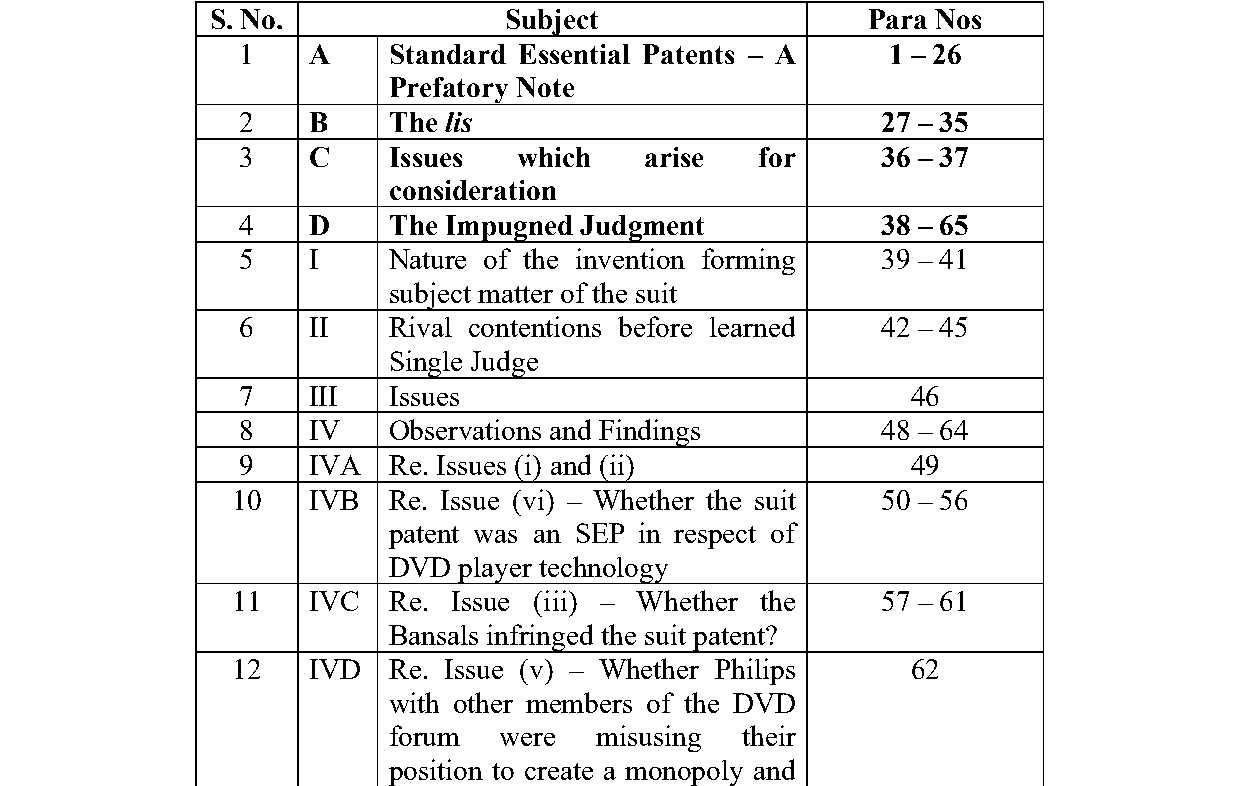
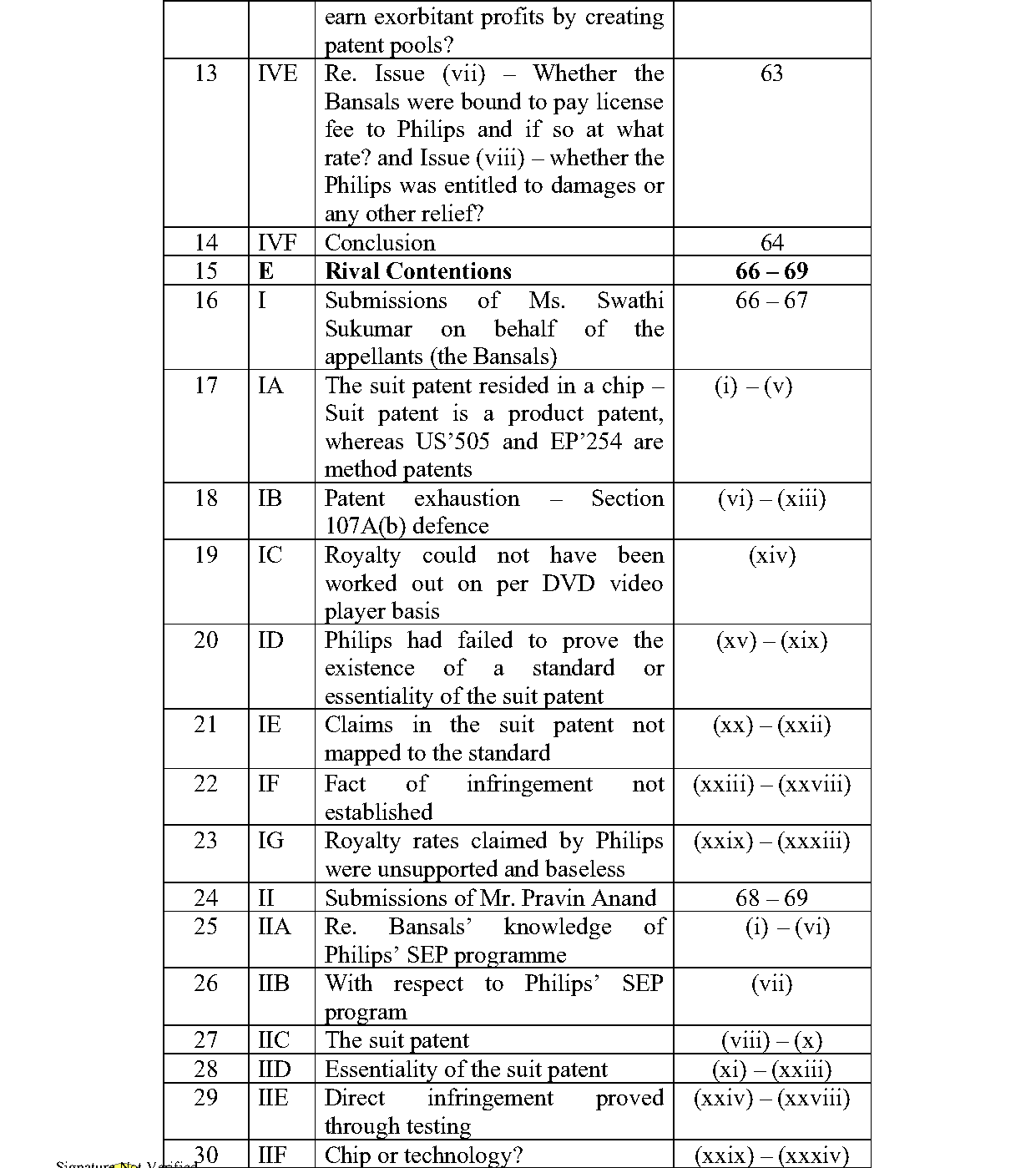
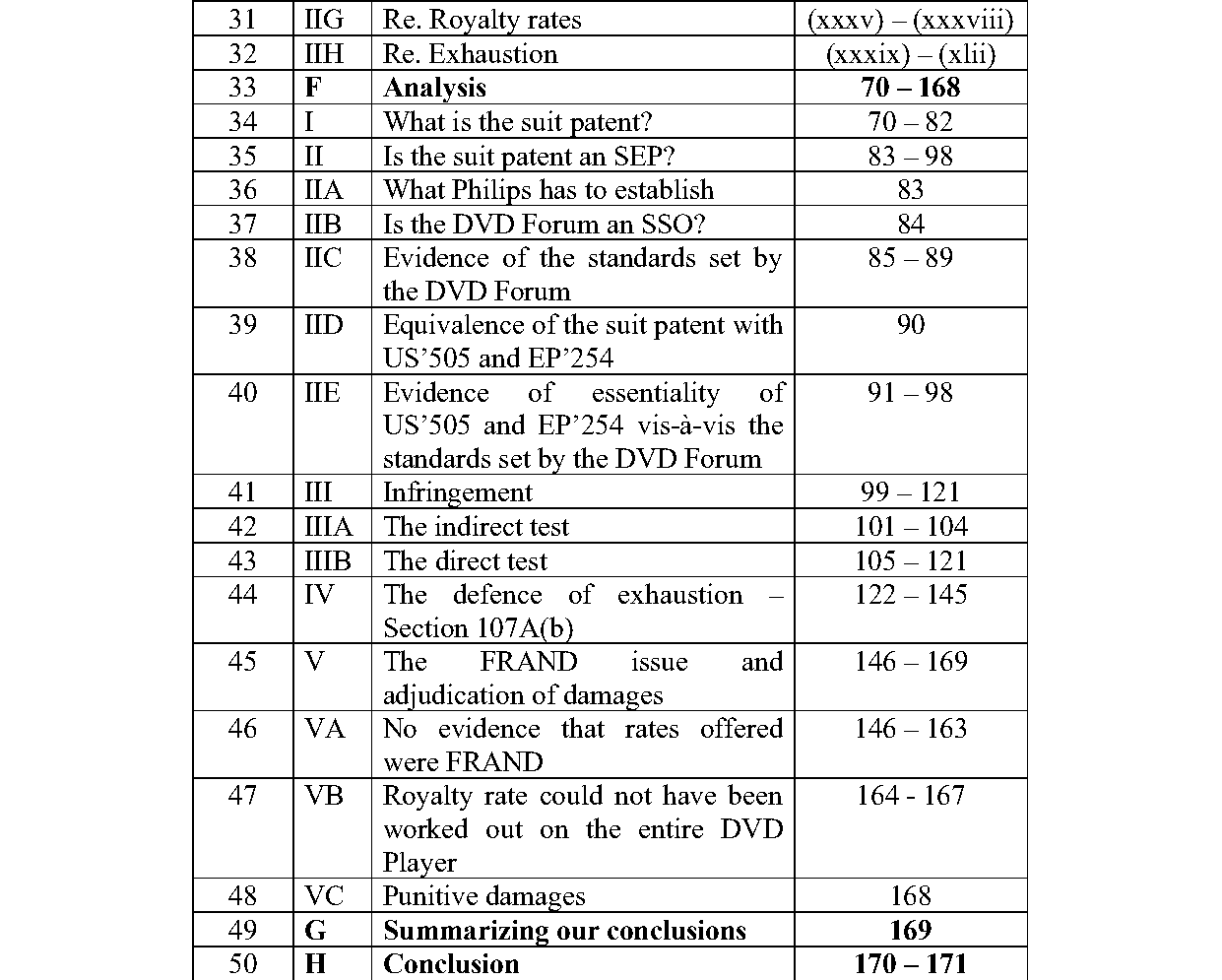
Facilitative Index to the Judgment A. Standard Essential Patents – A Prefatory Note
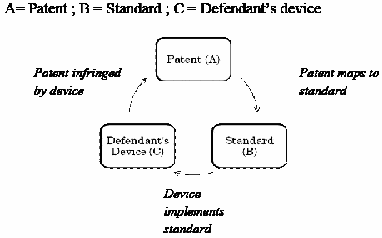
1. Standard Essential Patents [“SEPs” hereinafter] are strange and complex creatures. Infringement litigation, involved SEPs, is delicate and involved. For a plaintiff, who claims to be the holder of an SEP, to establish infringement and claim damages from a defendant, he has to first establish that his patent is an SEP; thereafter, that the defendant’s product infringes his patent; that he is willing to offer use of the patent to the defendant on licence at terms which are fair, reasonable and non-discriminatory, “FRAND” and that the defendant is not willing to take a licence on those terms, i.e. that the defendant is an “unwilling licencee”. It is only thereafter that a Court can compel a defendant to take a licence at the terms offered by the plaintiff, or at other FRAND terms as may be fixed by the Court, and injunct the defendant from using the plaintiff’s SEP in default.
2. Each of these steps is more complex than the other.
3. To demonstrate that his patent is an SEP, a plaintiff has to establish the existence of a standard, set by a Standard Setting Organization, “SSO” hereinafter. The SSO must certify the standard to be essential for operating a particular technology.
4. The categories of standards, and their importance, and the concept of “essentiality” were thus explained by a Division Bench of this Court in Intex Technologies (India) Ltd v. Telefonaktiebolaget L.M. Ericsson, 2023 SCC OnLine Del 1845 (DB)
“39. Since Standard Essential Patent is a relatively new species of patent, it is necessary to define it as well as propound the test of infringement in such cases and explain the importance of standards.
40. A standard in simple terms is a prescribed list of features or technical specifications in relation to a particular technology. The purpose of the standard is to ensure that every product manufactured as per the standard has certain common d