Back


2026 Supreme(Guj) 247
IN THE HIGH COURT OF GUJARAT AT AHMEDABAD
HEMANT M. PRACHCHHAK, J.
State Of Gujarat - Appellant
Versus
Rajubhai Mansukhbhai Maachhi & Ors. – Respondents
R/Criminal Appeal No. 1447 of 2009
Decided On : 17-06-2026
For the Appellant : Ms Jirga Jhaveri, Addl. Public Prosecutor
For the Respondents: Mrs. Rekha H. Kapadia.
In an appeal against acquittal, the appellate court must not interfere unless the trial court’s findings are perverse or ignore material evidence. The accused benefits from a double presumption of innocence, and the prosecution bears the burden of proving all statutory ingredients of the charged offenses beyond reasonable doubt.
Headnote:(A) Criminal Law - Appellate Court - Powers in appeal against acquittal - Scope of intervention - Court is to see that decision arrived at is not afflicted by perversity, illegality or any other such vice which may compromise it beyond redemption - An order is not to be interfered with simply because another view is possible - It is well settled that in case of acquittal there is double presumption in favour of the accused - Firstly, the presumption of innocence is available under the fundamental principle of criminal jurisprudence - Secondly, the accused having secured acquittal, the presumption of their innocence is further reinforced, reaffirmed and strengthened. (Paras 15, 16, 17, 18)
(B) Offenses against Public Peace and Liberty - Special legislation - Requirement for ingredients to be proven - For the offense of intentionally insulting or intimidating a member of a community, said act must be committed in a public place within public view - Absence of cogent evidence to establish the incident occurred in a public view and failure of prosecution to connect evidence to commission of crime renders the charges unsustainable - Evidence of witnesses not supported by medical findings - Complainant found to be in the habit of filing complaints for compensation indicating misuse of provisions. (Paras 13, 14, 19)
Facts of the case:
The appellant-State challenged an order of acquittal passed by the trial Court concerning charges of voluntarily causing hurt, intentional insult, and criminal intimidation. The complainant alleged that the respondents abused and assaulted the complainant and family members due to personal animosity and pending litigation. The trial Court found that the prosecution failed to prove the charges beyond reasonable doubt. The State appealed the acquittal, contending that the evidence was sufficient to convict.
Findings of Court:
The Court held that the prosecution failed to establish a credible case. The medical evidence provided by the medical officer did not support the oral testimony given by the prosecution witnesses. Furthermore, the essential statutory requirement that the offensive comments were made in a 'public place within public view' was not fulfilled. The Court observed the lack of consistency in witness statements and noted that the complainant had a history of filing similar litigation to obtain financial compensation.
Issues: The main issues were whether the trial Court's findings of acquittal were perverse or erroneous, whether the evidence provided was sufficient to prove the charges, and whether the essential ingredients of the special legislative act were met.
Ratio Decidendi: The appellate court must exercise extreme restraint when reviewing an acquittal, as the accused enjoys the protection of a double presumption of innocence. Where the prosecution fails to provide cogent and consistent evidence, or fails to prove the specific requirements of the charged offenses—specifically the presence of a 'public place within public view'—the order of acquittal is deemed legally sustainable and should not be disturbed unless it is shown to be perverse.
Result: Appeal dismissed; judgment of acquittal confirmed.
| Table of Content |
|---|
| 1. summary of prosecution case and procedural history. (Para 1 , 2 , 3 , 4 , 5 , 6 , 7 , 8) |
| 2. summary of opposing parties' arguments and contentions. (Para 9 , 10) |
| 3. court's analysis of evidence sufficiency and statutory requirements. (Para 11 , 12 , 13 , 14) |
| 4. appellate standards for reviewing acquittal judgments. (Para 15 , 16 , 17 , 18) |
| 5. confirmation of acquittal and dismissal of appeal. (Para 19 , 20 , 21) |
JUDGMENT :
HEMANT M. PRACHCHHAK, J.
1. The appellant - State of Gujarat has preferred this appeal under Section 378(1)(3) of the Code of Criminal Procedure, 1973 against the judgment and order dated 18.04.2009 passed by the learned Special Judge, Bharuch (hereinafter be referred to as “the trial Court”) in Special (Atrocity) Case No.22 of 2008, whereby the trial Court has acquitted the original accused Nos.1 to 4 (respondents herein) from the offences punishable under Sections 323, 504, 506(2) and 114 etc of the Indian Penal Code (hereinafter be referred to as “the IPC”) read with Section 3(1)(10) of the Scheduled Castes and Scheduled Tribes (Prevention of Atrocities) Act, 1989 (hereinafter be referred to as “the Atrocity Act”).
2. Short facts of the prosecution case are that the complainant Natvarbhai Motibhai Solanki, Hindu (Bhangi), was belonging to Scheduled Caste, residing at Jambusar with his family, and he was serving in the Limaj Primary School as a Teacher, since last nine years. That, the complainant was residing in the Vrundavan Society, where no one of his Bhangi community, and people of Maachhi, Vaghari, Parmar and Makwana castes were living in that society. That, the accused No.1 Rajubhai and accused No.3 Kalidasbhai Bhikhabhai were residing besides complainant. That, three years ago, the accused Nos.1 & 3 quarreled with the complainant by asking why he came to live in their society, and also beaten him and therefore, the complainant lodged complaint against the accused persons wherein, they were acquitted due to lack of evidence. That, other case was pending in the Bharuch Court and date of hearing was 08.02.2008, i.e. next day of the incident. Therefore, on the day of incident, while the complainant was returning to his home from school, at that time, the accused Nos.1 & 3 came in front of the complainant's home holding sticks, and told him not to remain present in the court next day and also gave filthy abuses to complainant and therefore, the complainant requested them not to abuses. At that time, accused No.2 Manjulaben, wife of accused No.1 and accused No.4 Maniben, wife of accused No.3 also came there. All the accused got angry and accused Nos.1 & 3 inflicted stick blows on chest, stomach, and back side of complainant. At that time, Pragnesh, son of complainant tried to save complainant, but the accused No.3 also inflicted stick blows on him and caused injuries to them, and the accused Nos.2 & 4 caught hair of complainant's wife and gave kick and fist blows, and intentionally caused hurt to them. Thereafter, all the accused persons went away from there by giving abuses. Therefore, complaint was filed and an offence was registered as II.C.R.No.7/2008 at Jambusar Police Station, against the accused persons for offences punishable under Sections 323, 504, 506 (2) and 114 of the Indian Penal Code read with Sections 3(1) (10) of the Atrocity Act.
2.2 After completion of the investigation, charge-sheet was filed against respondents accused before JMFC, Bharuch. As the offences committed by respondents were absolutely triable by the Court of Sessions, same was committed to the Sessions Court under Section 209 of Cr.P.C. Thereafter, charge was framed against the respondents accused for the offences punishable under Sections 323, 504, 506(2) and 114 of the Indian Penal Code read with Sections 3(1) (10) of the Atrocity Act, 1989. The accused persons pleaded not guilty to the charges and claimed to be tried.
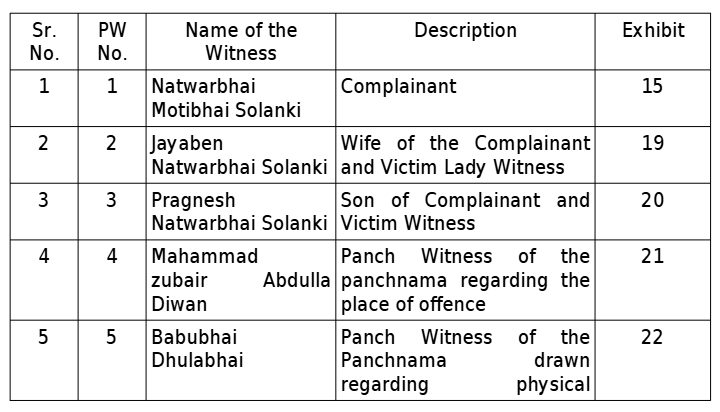
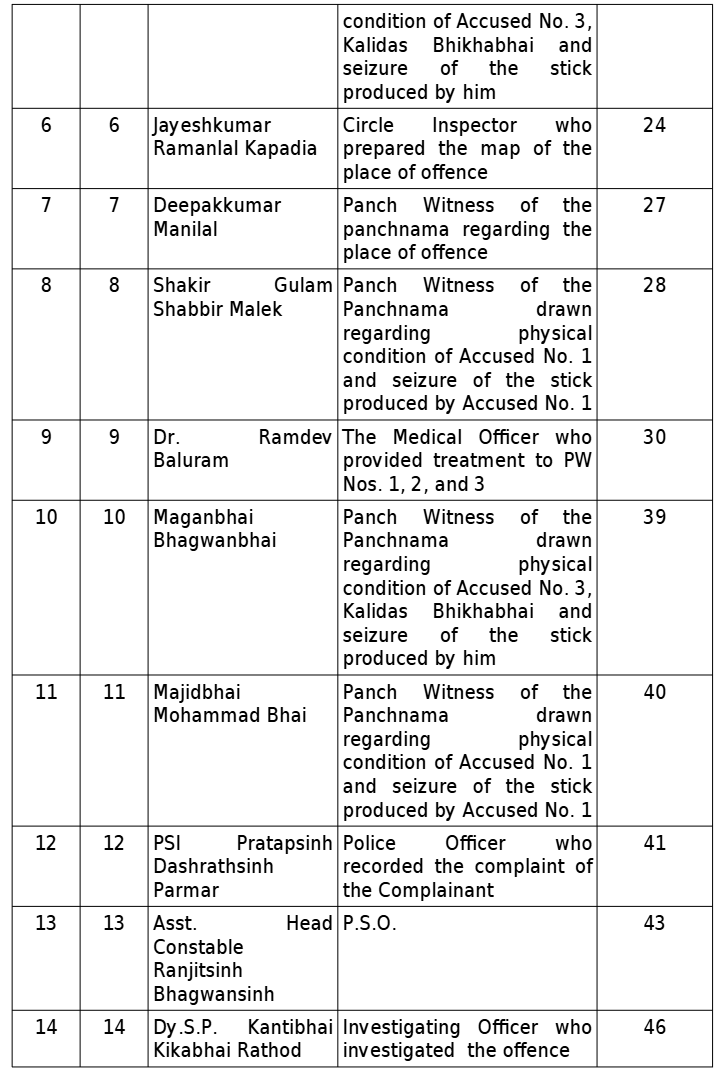
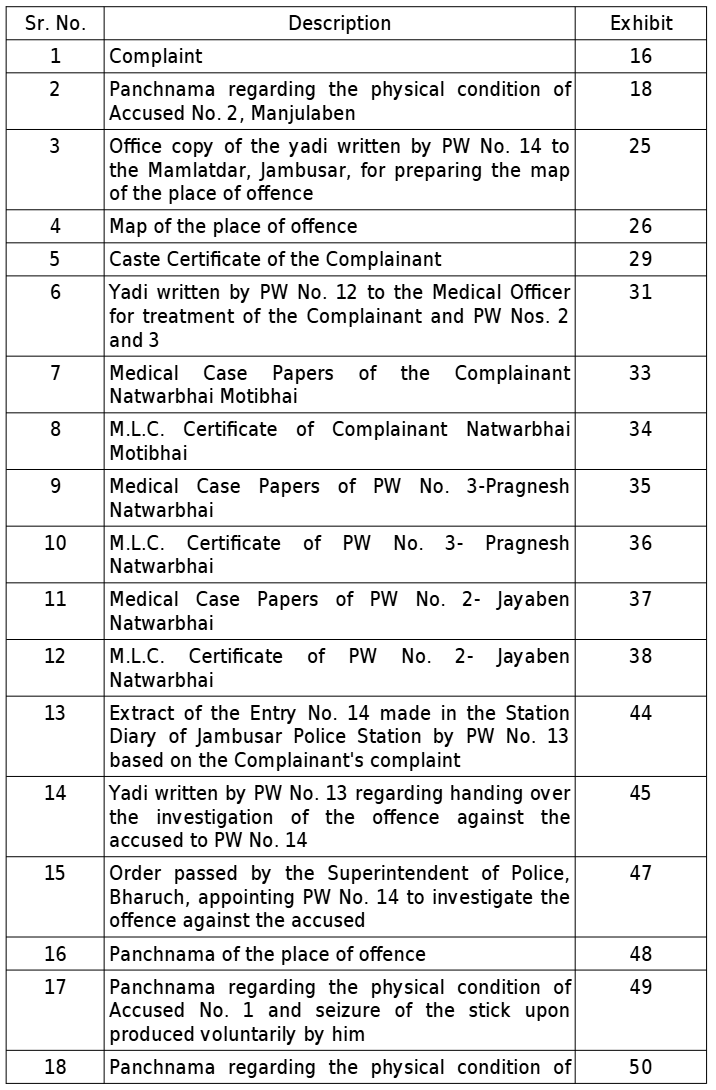
3. It appears from the records that to prove the case, the prosecution has examined the follo